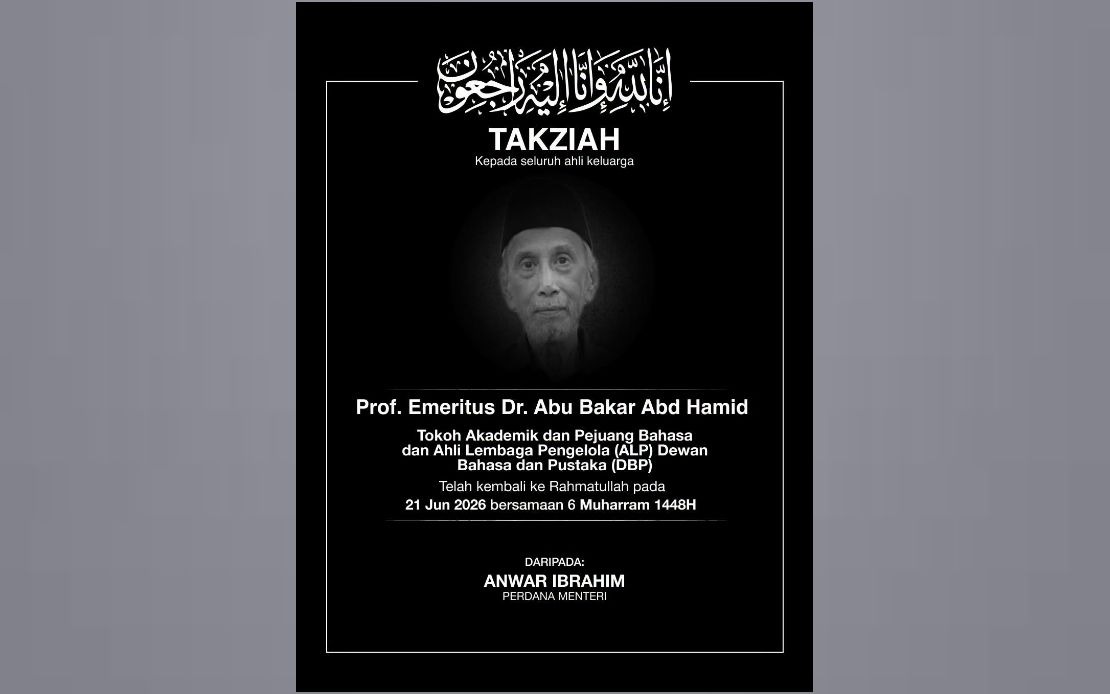
Prime Minister Datuk Seri Anwar Ibrahim has mourned the loss of Professor Emeritus Datuk Abu Bakar Abd Hamid, one of Malaysia's most influential voices in literary scholarship and academic institution-building. The respected scholar passed away unexpectedly on Sunday, June 21, at his residence in Petaling Jaya, collapsing from sudden respiratory distress around 10:30 p.m. Anwar's tribute, shared across social media, underscored the profound impact Abu Bakar had on generations of Malaysian intellectuals and the nation's cultural landscape.
Abu Bakar's death marks the end of an era for Malaysian academia and letters. Born in Johor, he carved out a distinguished career as a custodian of Malay literary traditions during a transformative period for the nation's intellectual institutions. His work spanned multiple dimensions of scholarship and public service, making him one of the few figures whose influence extended across universities, government agencies, and cultural circles. The loss is felt particularly acutely because Abu Bakar represented a vanishing generation of scholar-statesmen who combined rigorous academic work with direct participation in nation-building projects.
Anwar's connection to Abu Bakar was personal and formative. As a former student, the Prime Minister acknowledged the debt owed to teachers who shaped not just academic understanding but personal character. In his Facebook post, Anwar described Abu Bakar as someone whose passion for knowledge was contagious, someone who inspired rather than merely instructed. This relationship between mentor and student underscores how intellectuals of Abu Bakar's stature functioned as moral exemplars within Malaysian society, not simply repository of facts or theories but embodiments of scholarly commitment and intellectual integrity.
Among Abu Bakar's most enduring legacies is his instrumental role in establishing Universiti Kebangsaan Malaysia. In 1968, he served as joint secretary of the committee tasked with founding what would become the nation's premier Malay-language university. This institution emerged during a pivotal moment in Malaysian higher education, reflecting post-independence aspirations to build locally-rooted universities capable of advancing knowledge in Malaysian languages and addressing the nation's development needs. Abu Bakar's contribution to UKM's genesis represented more than administrative work; it embodied a vision of what a national university could achieve in post-colonial Asia.
At Universiti Malaya itself, Abu Bakar held significant institutional responsibility as deputy vice-chancellor from 1987 onwards, a position that placed him at the centre of policy decisions shaping Malaysia's oldest university. His leadership during this period coincided with major transformations in Malaysian higher education, including the expansion of the university system and debates over the balance between traditional liberal education and vocational training. Those who worked alongside him during this era recall someone committed to maintaining academic standards whilst facilitating the institution's growth and relevance to national priorities.
Beyond academia, Abu Bakar's public service extended to the media landscape. From 1996 to 2000, he chaired the Board of Governors of Bernama, the Malaysian National News Agency. This role positioned him at the intersection of literature, governance, and national communication strategy, further illustrating his reputation as a trusted custodian of important institutions. His oversight of a major news organisation reflected the confidence placed in him by successive governments and society's recognition of his judgment and integrity.
The literary world particularly mourned Abu Bakar's passing. Throughout his career, he accumulated numerous prestigious awards and accolades recognising his extraordinary contributions to Malay literature and literary criticism. These honours reflected not merely his scholarly output but his role as a guardian of literary standards and a mentor to emerging writers and critics. At a time when Malay literature was establishing itself as a serious field of academic study, Abu Bakar helped legitimise and institutionalise its study, demonstrating that literary scholarship could achieve the same rigour and prestige as other academic disciplines.
The timing of Abu Bakar's death, occurring suddenly without prolonged illness, shocked those who knew him. His presence at academic functions and cultural events had remained regular, suggesting to many that his active engagement with intellectual life would continue for years to come. The sudden departure of someone in his eighties who remained mentally engaged and professionally active serves as a reminder of mortality's unpredictability, even for those blessed with long, productive lives.
Abu Bakar's funeral, held at Bukit Kiara Muslim Cemetery on Monday following traditional Islamic rites, drew academics, government officials, and cultural figures seeking to pay final respects. The gathering itself constituted a statement about his place in Malaysian society—one where administrators, scholars, politicians, and writers could find common cause in honouring his memory. His passing leaves an intellectual void difficult to fill, particularly in an era when fewer scholars bridge the gap between academic work, public service, and cultural stewardship as seamlessly as he did.
For Malaysia's literary and academic communities, Abu Bakar Abd Hamid exemplified the possibility of a life devoted to knowledge, institution-building, and cultural advancement. His influence on university development, literary criticism, and intellectual discourse remains embedded in the institutions he helped establish and the scholars he mentored. Anwar's tribute acknowledges not merely a distinguished life but a model of what Malaysian intellectual leadership could achieve when combined with integrity, humility, and genuine commitment to advancing knowledge and national development.

