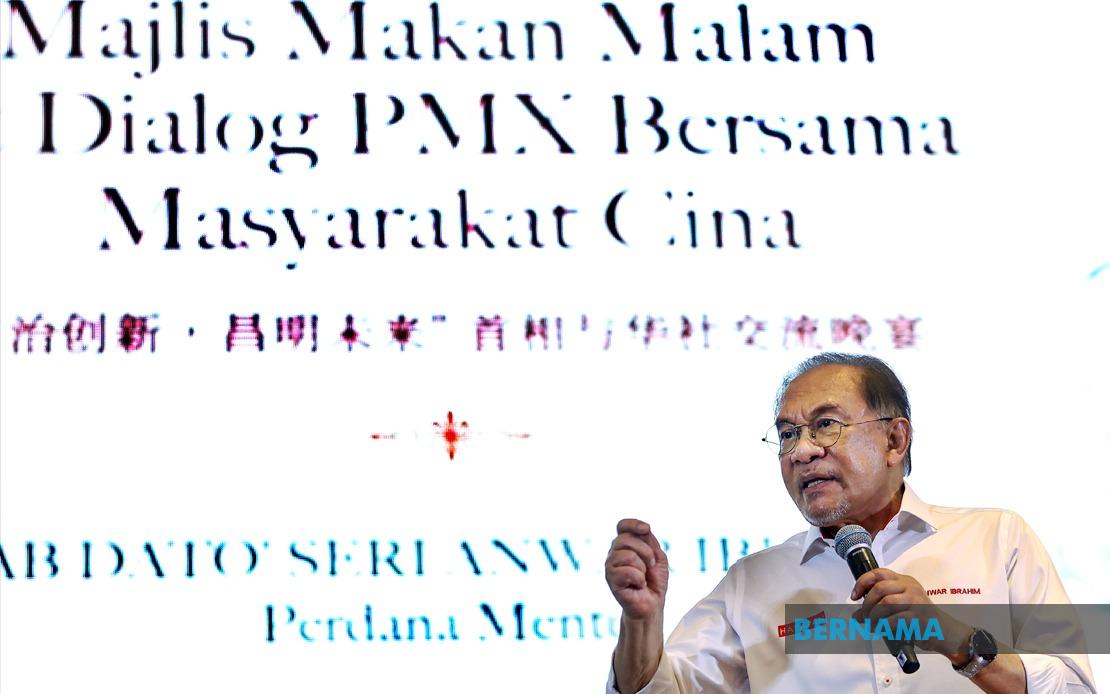
Prime Minister Datuk Seri Anwar Ibrahim has reinforced his commitment to transforming Malaysia into a prosperous and cohesive nation, emphasizing that his leadership philosophy centres on inclusivity and genuine service to all Malaysians. Speaking during a community gathering in Johor Bahru, Anwar articulated a vision rooted in cross-communal engagement and transparent governance, signalling that his administration's direction remains grounded in principles of unity and equal treatment across the country's diverse population.
At the dinner reception hosted by the Chinese business and civic community, Anwar outlined his personal ambition to be remembered not merely as a political figure, but as a leader genuinely invested in the welfare of every Malaysian. His remarks reflected a conscious effort to position his administration as one built on substance rather than mere political performance, with a particular emphasis on the ethical dimensions of governance. The Prime Minister's language suggested a deliberate pivot toward what he views as authentic stewardship rather than transactional politics, a distinction that carries weight given Malaysia's recent history of governance challenges and public scepticism about political intentions.
The core of Anwar's message centred on the indivisibility of national wellbeing from inclusive leadership. He articulated that every citizen, irrespective of ethnicity or religious background, occupies an equal place in his governance priorities. This rhetorical positioning is significant for a multi-ethnic nation like Malaysia, where communal concerns often dominate political discourse. By framing his leadership through the lens of universal service rather than community-specific appeals, Anwar appeared to be addressing broader anxieties about fair representation and equitable resource distribution—concerns that have periodically destabilised Malaysian politics and society.
Anwar's personal reflections on legacy carry particular resonance given his age and the relatively compressed timeframe of his premiership. His candid acknowledgement that retirement approaches lent weight to his pronouncements about what he wishes to leave behind. Rather than focusing on infrastructure projects or economic metrics—traditional measures of political achievement—Anwar emphasised the intangible yet foundational qualities of integrity, inclusiveness, and genuine public affection. This pivot suggests an understanding that sustainable national progress requires trust between government and citizenry, a commodity that has been in short supply throughout recent Malaysian political cycles.
The emphasis on "fair and clean leadership" carries specific connotations within Malaysia's contemporary context. The country has witnessed multiple administrations confronted by corruption allegations and governance lapses, creating public wariness about political sincerity. Anwar's repeated invocation of these values appears calculated to address such scepticism directly, positioning his government as a departure from problematic precedents. For Malaysian voters across different communities and socioeconomic strata, assurances of transparent and equitable governance represent fundamental baseline expectations rather than aspirational ideals.
The Johor Bahru setting and specifically the engagement with the Chinese business community underscore deliberate outreach strategies within Anwar's administration. Johor, Malaysia's second-largest state and a significant economic hub, has particular importance in broader calculations about national stability and development. The Chinese community's historical role in Malaysia's commerce and civil society makes their engagement symbolically meaningful in demonstrating cross-communal dialogue. Such gatherings serve both practical purposes—obtaining feedback from important stakeholder groups—and symbolic functions in reinforcing the administration's commitment to inclusive consultation.
Anwar's language about people reciprocating his leadership through affection and loyalty reveals something about the emotional dimensions underlying his political philosophy. Rather than framing governance as a technical enterprise or a contest for power, he positioned it as a moral and relational undertaking. This appeal to sentiment, coupled with his emphasis on personal authenticity, suggests an understanding that Malaysian political legitimacy derives partly from whether citizens perceive their leaders as genuinely invested in collective welfare rather than factional interests. Whether such sentiments translate into durable policy outcomes and institutional change remains a question that extends beyond rhetoric into the domain of demonstrable governmental performance.
The attendance of Datuk Seri Amirudin Shari, both a senior PKR figure and the Selangor Menteri Besar, signalled party unity and reinforced the hierarchical support structure behind Anwar's vision. Selangor's governance record and Amirudin's profile carry implications for how Anwar's national agenda translates into subnational implementation. The presence of such senior colleagues at community engagement events typically serves to reinforce messaging coherence across different levels of the administration and to demonstrate that the Prime Minister's articulated values enjoy backing from the broader political structure supporting his government.
For Malaysian stakeholders observing political trajectories and governance directions, Anwar's pronouncements merit assessment against actual policy implementation and resource allocation decisions. The gap between aspirational rhetoric about inclusive leadership and concrete governmental action often determines whether such commitments achieve substantive realisation. His framing of service to all citizens as his primary obligation provides a useful metric against which future policy announcements and budgetary priorities can be evaluated by the Malaysian public and international observers alike.
The broader significance of Anwar's remarks extends to questions about Malaysia's political maturation and institutional resilience. A Prime Minister publicly prioritising legacy considerations tied to ethical governance and cross-communal trust signals something about evolving standards for political discourse in the country. Whether Malaysia's political institutions, party structures, and electoral mechanisms can adequately support and sustain such commitments to inclusive governance remains an ongoing test. Anwar's explicit embrace of these values at the community level represents a positive signal for those invested in Malaysia's development as a functional, transparent, and equitable polity, even as concrete outcomes continue to develop through the administrative lifecycle of his government.

