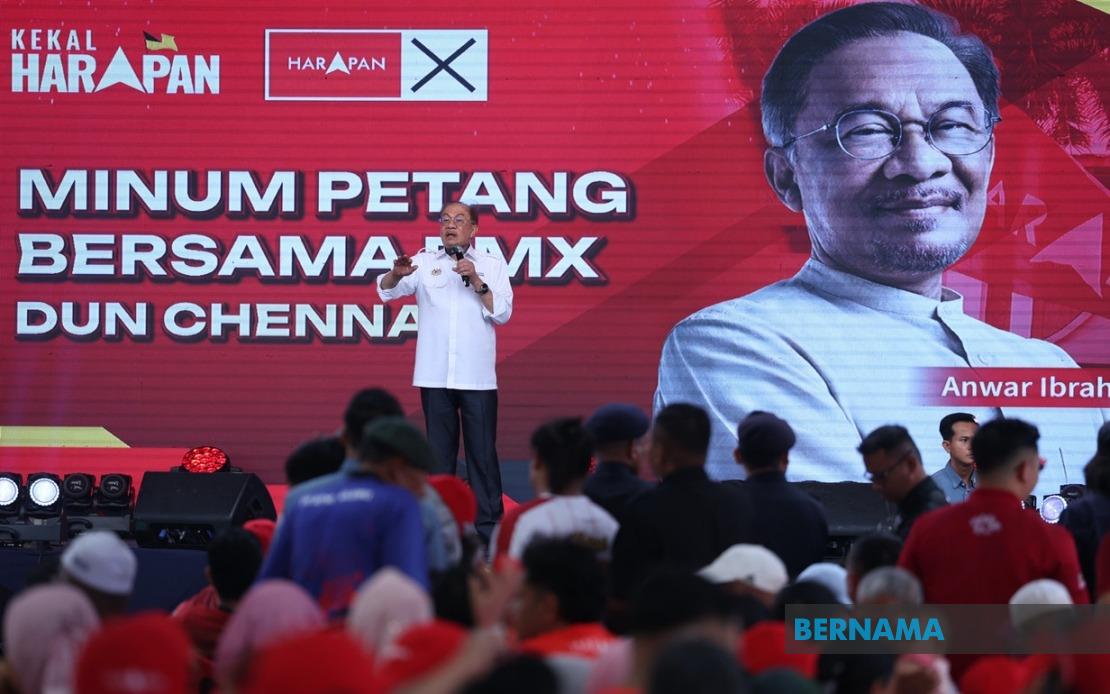
Prime Minister Datuk Seri Anwar Ibrahim has moved to counter what he describes as misleading campaign rhetoric by assuring the Orang Asli community that government funding earmarked for them remains secure and will not be withdrawn following the forthcoming Negeri Sembilan state election, regardless of which coalition gains control of the state administration. Speaking during an afternoon engagement in the Chennah constituency at Simpang Durian on July 29, Anwar directly addressed circulating claims that various political factions have been suggesting to indigenous voters that allocations would evaporate if particular candidates or parties failed to secure electoral victories.
The Prime Minister, who simultaneously holds the Finance portfolio, emphasised that the approval and disbursement of government funds operate according to established legal frameworks and constitutional provisions rather than fluctuating with electoral outcomes or political calculations. He pointed out that as Finance Minister, he personally exercises authority over such allocations and stressed his commitment to maintaining support for the Orang Asli provided that proper procedures are followed. This statement carries particular weight coming from the head of government and the minister controlling the nation's purse strings, effectively removing any ambiguity about the financial security of Orang Asli programmes regardless of political shifts in Negeri Sembilan's state government.
The timing and context of Anwar's reassurance reveal deeper concerns about campaign practices in the Negeri Sembilan election. Transport Minister Anthony Loke, who is also the Pakatan Harapan candidate for Chennah, disclosed that there has been systematic dissemination of claims designed to create anxiety among Orang Asli voters regarding the security of existing government support. Loke's comments indicate that opposition parties or other political actors have been leveraging fears about fund withdrawal as a campaign tactic, attempting to manipulate indigenous voters through what he characterised as intimidation and misinformation.
The inclusion of such allegations in campaign messaging reflects a broader pattern in Malaysian politics where vulnerable or marginalised communities become targets for fear-based electoral strategies. The Orang Asli, who comprise a significant portion of the electorate in certain constituencies, including Chennah, represent a particularly sensitive constituency given their historical marginalisation and dependency on government support programmes. Any suggestion that funding could be weaponised for political purposes strikes at fundamental concerns about equity and fairness in how public resources are distributed.
Loke's remarks underscore the importance of ensuring that electoral contests remain grounded in substantive policy discussions rather than degenerating into campaigns built on threats and false claims. By framing the election as a choice between fact-based discourse and fear-mongering tactics, the Transport Minister has attempted to elevate the terms of debate. He has consistently communicated to Orang Asli audiences throughout the two-week campaign period that no voter should face intimidation or threats from any political party, positioning Pakatan Harapan as the entity committed to ethical campaign conduct.
The constitutional and legal emphasis that Anwar placed on his reassurance carries significant implications for how government funding mechanisms should function. In a properly functioning democracy, allocations determined by law and constitutional authority should operate independently of electoral results at state level, particularly when those allocations stem from federal revenue and federal decision-making. By anchoring his commitment to legal and constitutional processes rather than political discretion, Anwar has effectively restated a principle that should underpin public resource management: the separation of funding decisions from electoral politics.
The Orang Asli community's historical experience with promises and policy reversals may explain the particular vulnerability of indigenous voters to such campaign tactics. Repeated instances where government programmes have been inadequately funded, inconsistently implemented, or subjected to sudden changes have created justified wariness about the durability of commitments made by political actors. Against this backdrop, Anwar's specific assurance that allocations will continue as long as proper procedures are observed represents an attempt to provide concrete reassurance rooted in ministerial responsibility and legal obligation rather than mere political rhetoric.
The involvement of both the Prime Minister and Transport Minister in this campaign engagement also suggests that Pakatan Harapan views the Negeri Sembilan election with considerable strategic importance. The party's willingness to deploy high-level political figures to address campaign allegations about Orang Asli funding indicates that this issue resonates significantly with voters and that the coalition seeks to differentiate itself from competitors by emphasising ethical campaign practices and respect for indigenous communities' interests.
From a broader Southeast Asian perspective, the Malaysian experience with indigenous populations and their relationship to government support mirrors challenges faced across the region. Competition for indigenous votes through claims and counterclaims about resource allocation reflects the political salience of indigenous issues and the recognition that marginalised communities represent important electoral constituencies. How Malaysia addresses these concerns—through genuine commitments to constitutional governance and transparent, law-based resource allocation—may set instructive examples for regional peers grappling with similar dynamics.
The distinction Anwar drew between allocations determined by law and those subject to political discretion is particularly relevant in the Malaysian federal context. Given that indigenous affairs and many development programmes affecting Orang Asli communities receive federal funding, state-level electoral changes should not logically affect the continuity of federally-approved support. By clarifying this relationship, the Prime Minister has provided a framework for understanding how government machinery should maintain consistency in supporting vulnerable populations irrespective of shifts in state political leadership.
Moving forward, the substance of Anwar's commitment will be measured against actual implementation following the Negeri Sembilan election. Orang Asli voters, having been exposed to competing claims and campaign pressure, will assess whether government allocations indeed continue uninterrupted and whether the pace, quality, and responsiveness of services remains consistent. The credibility of all political actors on indigenous issues will ultimately depend on whether their words translate into sustained, effective action that genuinely improves the circumstances of Orang Asli communities across Malaysia.

