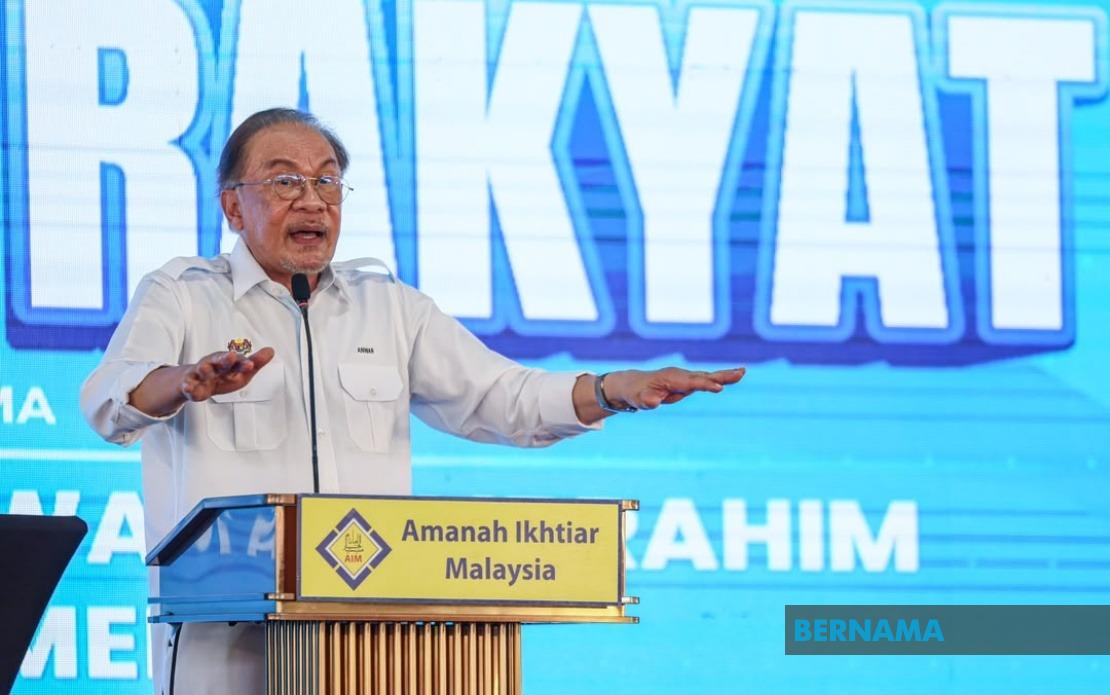
Prime Minister Datuk Seri Anwar Ibrahim has attributed the intensifying political pressure he faces to his government's relentless pursuit of those who misappropriate public funds or exploit their positions for personal benefit. Speaking at a campaign event in Batu Pahat for the Senggarang state constituency during Johor's election campaign, Anwar suggested that opposition groups have coalesced against him precisely because the MADANI Government has made clear its intolerance for corruption and abuse of authority. This characterisation of his opposition as a reaction to his anti-corruption agenda frames the current political climate as a conflict between reform-minded leadership and entrenched interests resistant to accountability.
As chairman of Pakatan Harapan, Anwar articulated a vision of governance centred on preventing officials from leveraging their positions to acquire land, secure lucrative contracts, obtain equity stakes, or accumulate personal wealth through their tenure. The framing is significant for Malaysian voters considering the trajectory of governance reform, particularly in Johor, where the election offers an opportunity to reshape state-level administration. Anwar's emphasis on this principle underscores a core campaign message: that his coalition is committed to a qualitatively different approach to public office than what preceded it. By repeatedly stressing this distinction, he seeks to reinforce PH's identity as the party of institutional reform and ethical governance, a positioning that carries considerable weight among voters fatigued by scandals in preceding administrations.
Anwar used his personal conduct as evidence of his commitment to this doctrine. He highlighted that despite numerous official visits to Johor as Prime Minister, he has not accumulated land, secured projects, or obtained shares in the state—a concrete example meant to demonstrate that the principles he espouses apply equally to himself. This approach serves dual purposes: it inoculates him against accusations of hypocrisy while simultaneously challenging other leaders to adopt similar restraint. In the context of Malaysian politics, where perception of leader integrity directly influences voter behaviour, such personal testimony carries particular rhetorical weight. The assertion that he has maintained this discipline despite three-and-a-half years in office, during which opportunities for self-enrichment would have been abundant, frames his leadership as exceptional among Southeast Asian democracies where executive power is frequently leveraged for personal accumulation.
The Prime Minister called on Johor voters to entrust state governance to Pakatan Harapan, arguing that alignment between state and federal governments would enable more efficient implementation of development initiatives and welfare programmes. This argument addresses a practical governance concern: administrative coordination across different political jurisdictions can create friction and inefficiency. By proposing unified PH control, Anwar positions electoral victory in Johor as necessary for unlocking the state's full developmental potential. This message resonates particularly in Johor, Malaysia's wealthiest state by gross domestic product, where voters have legitimate expectations of rapid progress and rising living standards.
Yet Anwar also acknowledged that despite billions of ringgit invested in major projects across Johor, fundamental challenges persist. Housing affordability remains critically problematic, he noted, with ordinary citizens unable to access moderately priced homes despite the state's economic prosperity. Infrastructure deficiencies affect transportation networks, while religious facilities and social assistance programmes require expansion. This acknowledgment serves an important rhetorical function: it prevents PH from appearing complacent about past development while maintaining that the state government has failed to translate economic growth into broad-based prosperity. The observation that Johor's wealth has concentrated among a small cohort while the majority struggle reflects growing inequality concerns across Malaysia and Southeast Asia more broadly, making it a resonant campaign theme.
Anwar dedicated particular attention to defending Pakatan Harapan's partnership with the Democratic Action Party, a point of controversy in Johor's Muslim-majority constituencies. He asserted that over his three-and-a-half years as Prime Minister, DAP members serving in the Cabinet have never opposed initiatives benefiting Malays or Islam. This defence addresses a persistent electoral vulnerability for PH in Malay-Muslim dominated areas, where suspicion of DAP's secular orientation has occasionally benefited opponents. By claiming documented evidence supporting PH's track record of prioritising Malay-Muslim interests even while including DAP, Anwar attempts to neutralise this line of attack. The specificity of his three-and-a-half-year timeframe invites scrutiny but also suggests confidence in his record.
The campaign event in Senggarang itself became part of the narrative Anwar constructed. He described the turnout as extraordinary, noting that supporters waited under intense heat to participate, and contrasted this enthusiasm against his broader experience campaigning across Malaysia. The observation that large crowds gathered despite difficult weather conditions serves as implicit evidence of grassroots support and momentum, important psychological factors in electoral contests. Anwar explicitly encouraged voters in Senggarang, Rengit, and Penggaram to channel this enthusiasm into concrete electoral support for PH candidates, attempting to convert demonstrated interest into actual votes.
The Johor state election encompasses 172 candidates competing for 56 seats, a significant portion of Malaysia's state-level electoral landscape. Scheduled polling on July 11 with early voting on July 7 means the campaign period is compressed, requiring intensive effort from all parties competing. Johor's electoral outcome carries implications beyond the state itself, as it will signal whether PH can consolidate power in Malaysia's wealthiest state or whether opposition coalitions can successfully contest PH's positioning as the reformist force in Malaysian politics. The election thus represents a critical moment for evaluating whether Anwar's anti-corruption messaging translates into electoral success or whether other factors weigh more heavily in voters' calculations.
Anwar's framing of opposition to his government as a reaction to anti-corruption stringency rather than to other substantive policy disagreements deserves scrutiny. This narrative conveniently positions critics as defenders of corruption, a rhetorical advantage in any political system. Whether rival parties actually oppose PH primarily because of anti-corruption efforts or because of other policy disagreements, competing visions of federalism, or simple partisan competition remains an open question. The Prime Minister's characterisation likely reflects genuine friction between his government's reform agenda and entrenched interests, but it may also oversimplify the complex motivations driving Malaysian opposition politics. Nevertheless, for voters concerned about governance quality, Anwar's willingness to emphasise anti-corruption as a defining feature of his administration represents a substantive campaign positioning that distinguishes PH from some predecessors.
The campaign speech ultimately connects multiple threads important to Malaysian voters: anti-corruption governance, development outcomes, social welfare accessibility, and inter-ethnic political cooperation. By weaving these elements together and presenting them as interconnected components of a coherent governing philosophy, Anwar constructs an ambitious case for PH's continued leadership. Whether this messaging proves sufficient to expand PH's footprint in Johor or whether opposition parties successfully mobilise counter-narratives will become clear following the July 11 polling. The outcome will significantly influence Malaysian politics' trajectory over the next electoral cycle.

