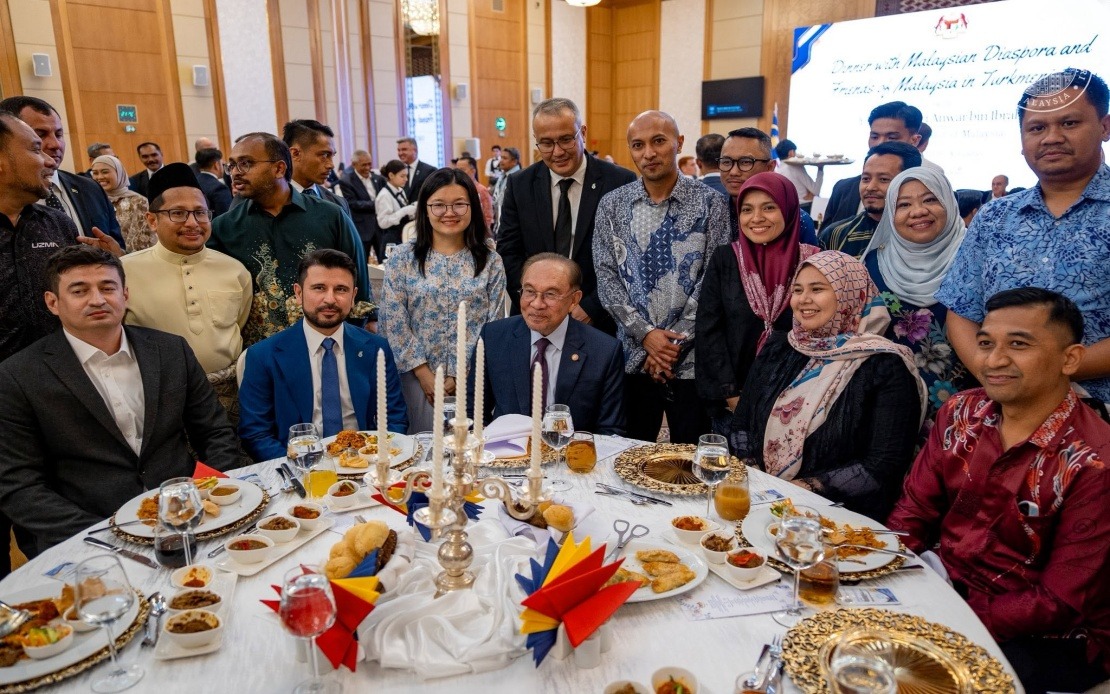
Prime Minister Datuk Seri Anwar Ibrahim used his official visit to Turkmenistan to meet with members of the Malaysian diaspora community based in Ashgabat, reinforcing the government's commitment to maintaining close ties with citizens living abroad. The engagement formed part of a broader strategy to strengthen bilateral relations and underscore Malaysia's ongoing interest in its overseas population, a demographic that plays an increasingly significant role in the country's diplomatic and economic outreach efforts.
The diaspora encounter highlighted the government's perspective on Malaysians abroad as more than simply expatriates working in foreign lands. In Anwar's characterization, these individuals function as unofficial ambassadors, actively contributing to Malaysia's international reputation and expanding the nation's networks across diverse regions. This framing reflects a deliberate policy shift toward viewing the overseas community as strategic assets in furthering national interests and cultural influence beyond traditional diplomatic channels.
During the engagement in Ashgabat, Anwar conveyed the importance of maintaining connection to home despite physical distance. He encouraged the diaspora to stay informed about Malaysia's development trajectory and ongoing progress, suggesting that informed overseas Malaysians can better serve as advocates for the country within their respective adopted communities. This emphasis on continued awareness and involvement signals the government's desire to prevent cultural drift among long-term expatriates while leveraging their insider knowledge of foreign markets and societies.
The Prime Minister's visit to Turkmenistan represents a continuation of diplomatic momentum that gained pace following Turkmenistan President Serdar Berdimuhamedov's official visit to Malaysia in December 2024. By reciprocating with a two-day official visit to the Central Asian nation, Anwar demonstrated Malaysia's commitment to deepening bilateral engagement with countries outside its traditional spheres of interaction. For Malaysian readers, this expansion into Central Asia represents an attempt to diversify the country's diplomatic footprint and explore new economic corridors beyond Southeast Asia and the Middle East.
The visit encompassed objectives that extended well beyond conventional trade and investment discussions. Anwar articulated an intention to expand people-to-people friendship, deepen mutual understanding between the two nations, and identify fresh avenues of cooperation that could prove mutually beneficial. This broader framework suggests Malaysia views its relationship with Turkmenistan as potentially multi-dimensional, touching on cultural, educational, and technological domains rather than remaining confined to purely commercial interests.
Turkmenistan, a nation of roughly six million people situated along the Caspian Sea, represents a potentially significant partner for Malaysia in Central Asian affairs. The country possesses substantial natural gas reserves and serves as a transit hub for regional commerce, factors that make it strategically interesting for Malaysian businesses seeking to expand into Central Asian markets. However, the current Malaysian diaspora presence in Ashgabat likely remains modest compared to communities in more established expatriate destinations, suggesting the government views this visit partly as groundwork for future community development in the region.
Anwar's social media reflection on the encounter emphasized the warmth and connection felt despite geographical separation, describing the gathering as though the diaspora and homeland government representatives were meeting in Kuala Lumpur itself. This rhetorical emphasis on emotional continuity serves multiple purposes: it reassures overseas Malaysians that the government values their presence and contribution, while simultaneously framing diaspora engagement as a natural extension of national governance rather than a peripheral concern.
The timing of this visit carries implications for Malaysia's broader positioning in Central Asia. As the region attracts increasing attention from regional powers and emerging economies, Malaysia's proactive diplomatic engagement signals an intention not to be left behind in exploring partnerships and collaborations. For Malaysian investors and entrepreneurs, such government-level visits typically pave the way for easier market entry, reduced bureaucratic friction, and enhanced business-to-business connections with local counterparts.
From a policy perspective, the emphasis on diaspora engagement reflects contemporary understanding of globalization's impact on national communities. Malaysian policymakers recognize that citizens abroad can serve as economic multipliers through remittances, investment, knowledge transfer, and international advocacy. By maintaining active dialogue with these populations and positioning them as partners in national development, the government attempts to harness their collective influence for Malaysia's advancement on the world stage.
Looking forward, such diplomatic engagements may catalyze increased Malaysian presence in Central Asian capitals, whether through expanded trade offices, cultural institutions, or educational initiatives. For the Malaysian diaspora in Ashgabat, direct engagement from the Prime Minister signals that their circumstances and contributions are recognized at the highest governmental levels, potentially strengthening their sense of connection to home even as they build lives in adopted countries. This balanced approach to diaspora relations—acknowledging their autonomy and international contributions while maintaining cultural and institutional links to Malaysia—represents an increasingly sophisticated government strategy in the age of globalized populations.