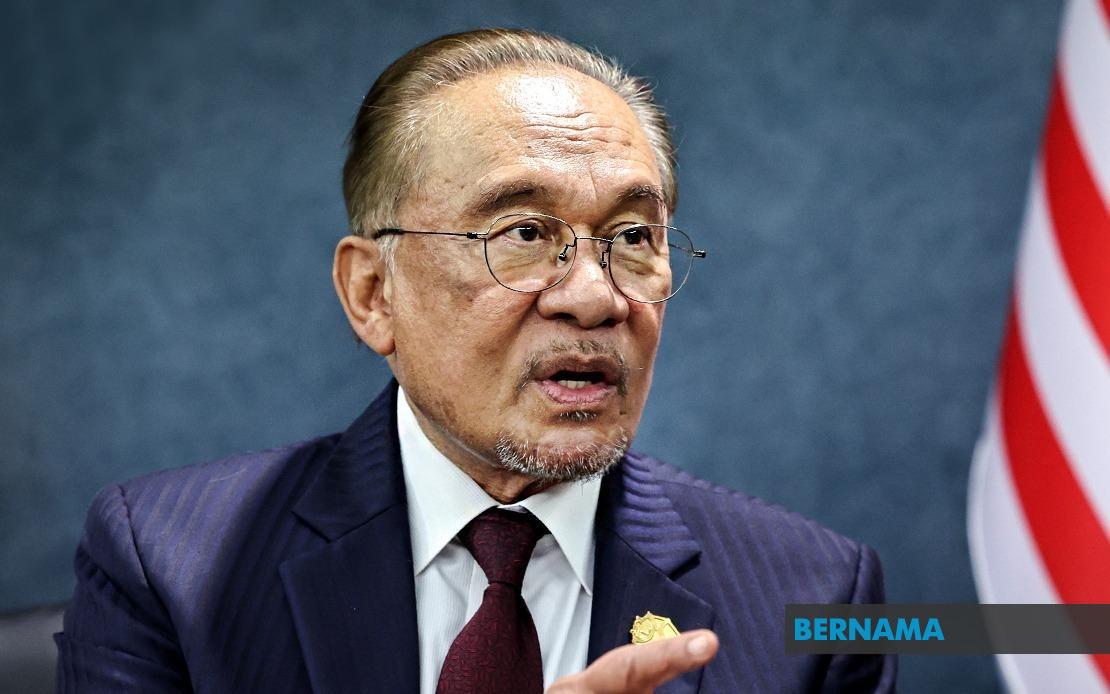
Prime Minister Datuk Seri Anwar Ibrahim was scheduled to address the ASEAN-Russia Business Forum in Kazan on June 17, delivering remarks to business representatives and officials from across the ASEAN region and Russia. The engagement formed part of a broader programme accompanying the ASEAN-Russia Commemorative Summit, reflecting the deepening institutional ties between Southeast Asia's premier regional grouping and Moscow. The forum proceedings were held at Kazan IT Park, where the Prime Minister received a formal welcome from Ilya Nachvin, Minister of Digitalisation of Public Administration, Information Technologies and Communications of the Republic of Tatarstan.
Anwar, who simultaneously holds the position of Finance Minister, used the occasion to outline Malaysia's perspective on economic cooperation between ASEAN and Russia to an assembled audience of senior business figures and government delegates. His participation underscored Malaysia's commitment to maintaining engagement with Russia despite geopolitical complexities, positioning the country as a constructive voice within ASEAN's diplomatic architecture. The event reflected Malaysia's broader strategic approach of maintaining balanced relationships with major powers whilst advancing the region's collective interests.
Following his address to business leaders, the Prime Minister proceeded to the Tatar State Academic Theater for the ASEAN-Russia Commemorative Summit Gala Dinner. This ceremonial gathering brought together senior representatives from all ASEAN member states alongside Russian officials for an evening of diplomatic exchange and cultural celebration. The dinner setting also provided the platform for Anwar to participate in a courtesy call with Russian President Vladimir Putin, offering an opportunity for bilateral dialogue on matters of mutual concern.
The 2024 edition of the summit carried particular symbolic weight, marking the 35th anniversary of ASEAN-Russia dialogue relations. This milestone reflected the evolution of engagement that commenced in 1991 with the opening of formal diplomatic channels. The relationship subsequently deepened when Russia attained full ASEAN Dialogue Partner status in 1996, a designation that positioned Moscow within the broader architecture of ASEAN's external engagement strategy. Most significantly, the two sides elevated their partnership to a Strategic Partnership framework in 2018, explicitly recognising mutual commitment to expanding cooperation across political-security, economic, and socio-cultural domains.
Kazan, the host city for this year's commemorative summit, carries considerable historical and contemporary significance. Situated approximately 800 kilometres east of Moscow at the confluence of the Volga and Kazanka rivers, the city has developed into Russia's principal centre east of the capital, earning the designation of the country's third major metropolis after Moscow and St Petersburg. Home to roughly 1.3 million residents, Kazan boasts more than a millennium of recorded history and functions as a vital bridge between Russian and Islamic civilisations, making it a symbolically appropriate venue for ASEAN-Russia engagement given the substantial Muslim populations within Southeast Asia.
The selection of Kazan also reflects the city's status as one of Russia's paramount repositories of Islamic culture and heritage. This cultural dimension carries relevance for ASEAN engagement, as several member states, particularly Malaysia, Brunei, and Indonesia, maintain Islamic identities as core components of their national character. The venue thus facilitated discussions that could incorporate the civilisational and cultural dimensions of the ASEAN-Russia relationship beyond purely transactional economic or security matters.
Economic dimensions form a crucial foundation of contemporary ASEAN-Russia relations. In 2024, bilateral trade between the two regional blocs reached USD18.1 billion, demonstrating the substantial commercial integration that has developed despite periodic geopolitical tensions. Russian foreign direct investment into ASEAN economies stood at USD92.97 million during the same period, equivalent to RM367.90 million in Malaysian currency terms. These figures, whilst notable, suggest considerable untapped potential for deepening economic partnership, particularly in light of ASEAN's market size and Russia's resource wealth.
Malaysia's individual trade relationship with Russia occupied a position of moderate significance within the broader landscape of European commerce. Russia ranked as Malaysia's ninth-largest trading partner among European nations in 2025, with bilateral trade valued at RM8.72 billion, or approximately USD2.04 billion. This standing reflected Malaysia's diversified approach to international commerce, maintaining substantive engagement with Moscow despite the country's broader commercial orientation toward Western markets and intra-Asian trade flows.
The composition of bilateral trade between Malaysia and Russia revealed complementary economic structures. Malaysian exporters principally supplied Russia with electrical and electronic products, machinery, equipment components, and processed food items—sectors reflecting Malaysia's manufacturing and agricultural strengths. Conversely, Malaysian imports from Russia concentrated on petroleum products, mineral commodities, and chemicals alongside chemical-based products, categories underscoring Russia's resource endowments and energy wealth. This trade pattern suggested limited overlap in competitive sectors, creating a relatively stable foundation for sustained commercial exchange.
The ASEAN-Russia engagement framework serves as the institutional expression of the strategic partnership, functioning as the pre-eminent platform for high-level interaction between the two actors. This status distinguishes ASEAN-Russia relations from numerous other partnerships, reflecting the elevated priority both sides assign to the relationship. Regular summits, ministerial meetings, and sectoral dialogues provide structured mechanisms for addressing shared interests and managing potential friction points, a significance heightened by the contemporary geopolitical environment characterised by great power competition and shifting alignments.
For Malaysia specifically, the commemorative summit represented an opportunity to reinforce its position as a constructive participant in regional and international affairs. By maintaining substantive engagement with Russia through multilateral ASEAN mechanisms, Malaysia demonstrated commitment to inclusive regional architecture rather than alignment with exclusive geopolitical blocs. This approach aligned with Malaysia's historical diplomatic tradition of non-alignment and equidistance from major powers, a principle articulated most recently through the country's reaffirmation of its foreign policy doctrine emphasising strategic autonomy.
The timing of Anwar's participation coincided with a broader assessment of ASEAN's strategic posture toward major powers during a period of international recalibration. The summit provided occasion for reflection on the ASEAN-Russia relationship's evolution and its contributions to regional peace and prosperity. The presence of Malaysia's Prime Minister at such high-level proceedings demonstrated the country's continued investment in maintaining multiple dimensions of international engagement, essential for a small state navigating great power competition and seeking to preserve the space for independent policy formulation within a rapidly transforming regional and global order.

