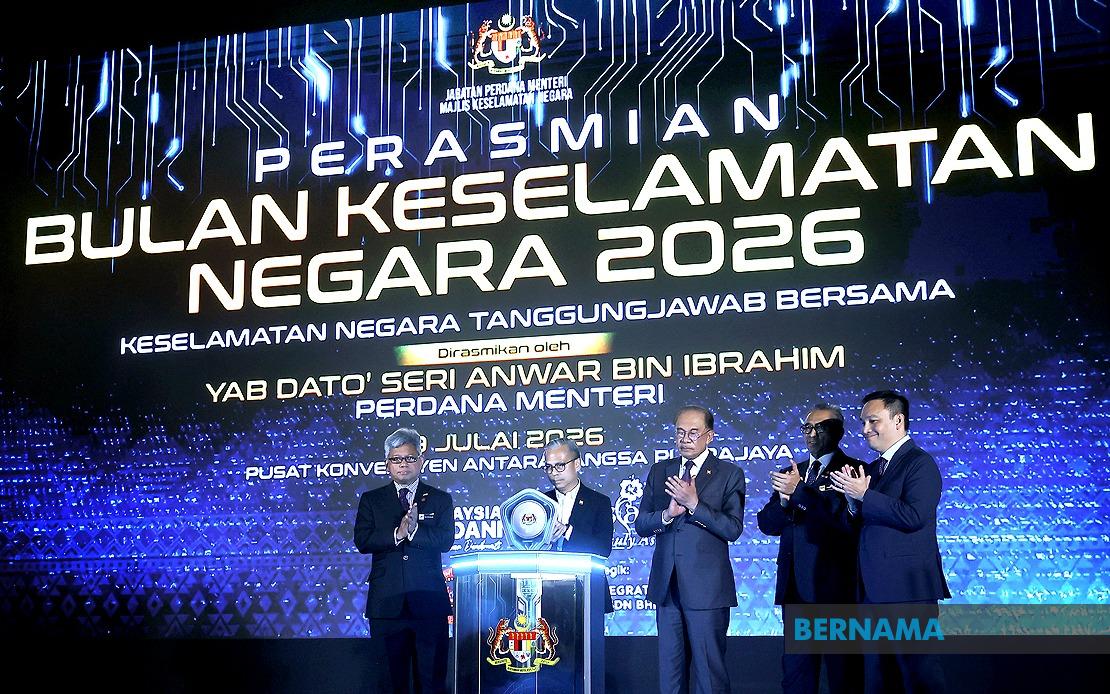
Prime Minister Datuk Seri Anwar Ibrahim has sounded a stark warning against the persistent use of divisive identity politics in Malaysia, arguing that such tactics distract the nation from addressing far more pressing security challenges that threaten its stability and prosperity. Speaking at the launch of National Security Month 2026 in Putrajaya on July 9, Anwar underscored his growing frustration with what he described as the rehashing of outdated political grievances rooted in race, religion, and regional sentiment, even as the country grapples with increasingly sophisticated security threats spanning the digital, technological and cyber domains.
The Prime Minister's intervention reflects a deepening concern within government circles about the weaponisation of identity-based narratives in Malaysian politics. These divisions, he cautioned, have the potential to fracture national cohesion at precisely the moment when unified and coordinated action is most needed. Anwar drew an implicit contrast between the intensity of parliamentary debates focused on longstanding communal divisions and the relative neglect of emerging security challenges that, left unaddressed, could pose existential risks to the nation's economic and social fabric.
In his remarks, Anwar revealed the substance of conversations he has been conducting with colleagues across cabinet and parliament, indicating that he has repeatedly urged fellow leaders to recalibrate their priorities. The Prime Minister's frustration appears rooted in the observation that elected representatives and government officials continue to expend considerable political capital on issues that, while historically significant, pale in comparison to the urgency and complexity of contemporary security threats. This disconnect between the focus of political discourse and the actual threat landscape facing Malaysia suggests a troubling misalignment in how national leadership is channelling its attention and resources.
The event was attended by Communications Minister Datuk Fahmi Fadzil, Chief Secretary to the Government Tan Sri Shamsul Azri Abu Bakar, and National Security director-general Datuk Raja Nurshirwan Zainal Abidin, signalling the whole-of-government nature of the security challenge Anwar seeks to address. The presence of these senior officials underscores that this is not merely a rhetorical exercise but part of a broader strategic reorientation aimed at refocusing bureaucratic capacity and ministerial attention on threats that transcend traditional security categories.
Anwar's dual role as Prime Minister and Finance Minister gives him a unique vantage point on the intersection between economic resilience and national security. This positioning allows him to articulate how internal divisions can weaken Malaysia's capacity to project strength and attract investment, while also leaving the country vulnerable to external manipulation and exploitation by hostile actors. The emphasis on security becomes, in this formulation, not merely a defensive posture but a prerequisite for economic competitiveness and regional standing.
Central to Anwar's message is an exhortation to government leadership to adopt a fundamentally different operational mindset. Rather than following established bureaucratic routines and waiting for security challenges to materialise before responding, he has called for a proactive, anticipatory approach grounded in deep understanding of emerging technologies and novel threat vectors. This represents a significant departure from traditional governmental response patterns, which often privilege reaction over prevention and crisis management over strategic foresight.
The invocation of technological and digital threats as principal security concerns reflects the evolution of the threat landscape in the 21st century. Unlike conventional military threats or even terrorism, which remain within the conceptual frameworks that have dominated security discourse for decades, cyber attacks, artificial intelligence-driven information warfare, and digital infrastructure vulnerabilities operate according to different logic and timescales. Malaysia's vulnerability to such threats is compounded by its status as an increasingly digitised economy with significant reliance on technology infrastructure across both public and private sectors.
Anwar's intervention also carries implications for Malaysia's regional positioning. Southeast Asia faces mounting geopolitical pressures, with major powers increasingly using cyber capabilities and information operations as instruments of statecraft. Nations that remain internally fractured and distracted by domestic identity conflicts are substantially more vulnerable to such external pressures. By calling for unity and focus, Anwar is implicitly arguing for Malaysia's capacity to maintain strategic autonomy in an increasingly contested regional environment.
The National Security Month 2026 programme provides an institutional framework for translating Anwar's concerns into concrete policy action. Such initiatives, when coupled with leadership messaging, can help reshape bureaucratic priorities and resource allocation patterns. However, the success of this effort will ultimately depend on whether the exhortation to abandon divisive identity-based politics gains traction among political elites across competing parties and factions, many of whom have invested heavily in such narratives for electoral advantage.
The tension Anwar identifies reflects a broader challenge facing contemporary democracies: the pull of identity-based politics in electoral systems often conflicts with the imperatives of national security and economic performance. For Malaysia specifically, this tension is sharpened by the complex history of communal relations and the constitutional architecture that enshrines recognition of ethnic and religious identities in statecraft. Anwar's call is not for erasing such recognition but for rebalancing political discourse to prioritise collective security and prosperity over sectional advantage.
Looking forward, the sustainability of this strategic reorientation will depend on whether the government can demonstrate concrete progress on security challenges while maintaining the inclusive governance model that Anwar has championed. This balancing act requires both stronger institutional mechanisms for coordinating security responses across government and more sophisticated communication strategies that explain to the public why such coordination matters for their daily lives and economic wellbeing. The warning itself, however, signals that Malaysia's leadership recognises the stakes involved and is willing to challenge established political habits in pursuit of national security objectives.

