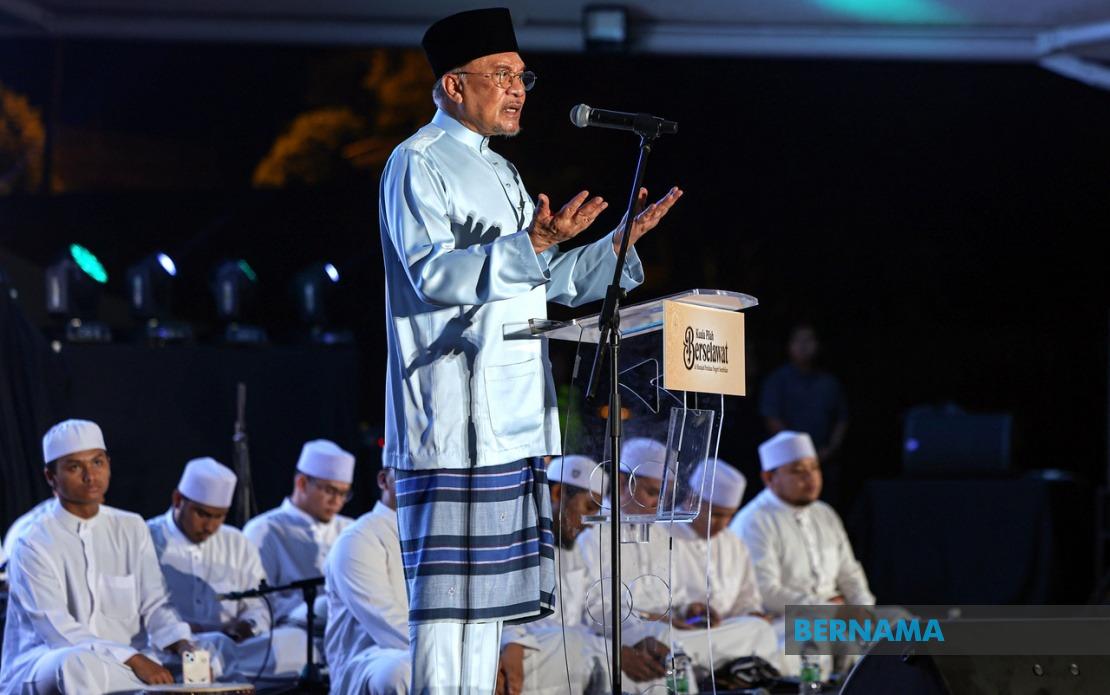
Prime Minister Datuk Seri Anwar Ibrahim has demanded that all investigations stemming from the Royal Commission of Inquiry into Lembaga Tabung Haji proceed with complete transparency and accountability, with explicit assurances that individuals found culpable for wrongdoing will face consequences without exception or favour. Speaking at a public gathering in Kuala Pilah on July 30, he framed the RCI's conclusions as a definitive record of responsibility that must now serve as the foundation for rigorous prosecutorial action, rejecting any notion of institutional cover-ups or selective enforcement.
The Prime Minister's emphatic stance reflects mounting public pressure for visible action following the RCI's completion of its inquiry into the pilgrimage fund's governance lapses. Tabung Haji, Malaysia's statutory authority managing savings and pilgrimages for Muslim citizens, has faced sustained scrutiny over financial management, investment decisions, and administrative failures that have eroded public confidence in the institution. The RCI's identification of culpable parties represents a critical juncture where political rhetoric must crystallise into concrete prosecutorial outcomes, a threshold that previous administrations struggled to cross decisively.
Anwar's pronouncement carries particular weight in Malaysia's institutional landscape, where concerns about selective justice and preferential treatment of politically connected individuals have historically undermined public trust in investigations. By explicitly stating that "there must be no more cover-ups" and emphasising the extended delay in addressing misconduct, he positioned the investigation as a test of the government's commitment to meritocratic accountability rather than partisan manipulation. The phrase "we have waited long enough" acknowledges public frustration whilst simultaneously placing responsibility squarely on his administration to deliver tangible outcomes within a reasonable timeframe.
The gathering where these remarks were delivered included several ministerial figures with portfolios relevant to governance and institutional oversight. Minister in the Prime Minister's Department (Religious Affairs) Datuk Dr Zulkifli Hasan and his deputy Marhamah Rosli attended, underscoring the religious dimensions of Tabung Haji's mandate and the government's recognition that public trust in Islamic institutions affects broader social cohesion. Education Minister Fadhlina Sidek and Selangor Menteri Besar Datuk Seri Amirudin Shari were also present, reflecting the event's positioning as a broader statement on governance standards across multiple administrative levels.
The transparency mandate carries significant implications for Malaysia's investigative agencies, particularly those tasked with examining potential financial crimes and breach of fiduciary duty. Investigators must now operate with heightened awareness that outcomes will be subject to intense public scrutiny and comparative assessment against the RCI's documented findings. Any perceived divergence between the commission's conclusions and subsequent enforcement actions would invite immediate criticism and accusations of political interference, placing considerable pressure on investigators to demonstrate methodological rigour and evidentiary sufficiency.
Tabung Haji's governance challenges have accumulated over multiple administrations, making the current investigation symbolically important for establishing a precedent regarding institutional accountability. The fund manages tens of billions of ringgit in pilgrim savings and manages the logistical infrastructure for Muslim pilgrims undertaking the Hajj, making it a cornerstone institution within Malaysia's Islamic social architecture. Failures in its stewardship therefore extend beyond financial metrics to encompass public confidence in the government's capacity to safeguard religiously significant institutions from mismanagement and malfeasance.
The Prime Minister's framing of the RCI report as determinative of culpability, rather than merely suggestive, represents a strategic choice to elevate the commission's conclusions within the hierarchy of investigative evidence. This positioning potentially constrains investigative discretion, obligating agencies to pursue identified individuals aggressively rather than treating RCI findings as preliminary documentation subject to independent re-evaluation. Such an approach accelerates potential accountability but simultaneously risks oversimplifying complex institutional failures into personalised blame without addressing systemic weaknesses or governance structures that enabled misconduct to persist unchecked.
For Malaysian citizens, particularly the hundreds of thousands of pilgrims who entrust their savings to Tabung Haji, these assurances represent a commitment to institutional rehabilitation and restored confidence. The fund's credibility depends not merely on financial recovery of misappropriated or poorly invested assets, but on demonstrable enforcement against responsible parties. Public perception of justice, however, extends beyond prosecution; it encompasses compensation mechanisms, governance reforms, and forward-looking measures ensuring similar lapses cannot recur.
The investigation's trajectory will significantly influence public perception of the government's broader commitment to anti-corruption messaging. Whilst anti-corruption rhetoric has characterised recent Malaysian administrations, implementation has frequently disappointed expectations, creating cyclical disillusionment amongst citizens. The Tabung Haji investigation therefore functions as a measurable test case against which governance performance can be assessed and held accountable, with success potentially reinforcing institutional legitimacy and failure risking further erosion of public confidence in institutional mechanisms.
Regionally, Malaysia's approach to investigating Tabung Haji misconduct carries implications for Southeast Asian governance standards, as several nations in the region manage analogous pilgrimage funds and religiously significant financial institutions. How Malaysia handles accountability for identified wrongdoers may establish precedents influencing institutional governance practices across the broader region, particularly regarding balancing religious institutional autonomy with secular oversight frameworks.
The coming months will determine whether Anwar's transparency commitment materialises into visible prosecutorial action, substantive asset recovery, and structural governance reforms. The PM's personal intervention in publicly demanding accountability suggests his administration recognises the political stakes inherent in Tabung Haji's rehabilitation, yet execution remains contingent on investigative capacity, evidentiary strength, and potential resistance from implicated parties wielding institutional leverage or political connections.

