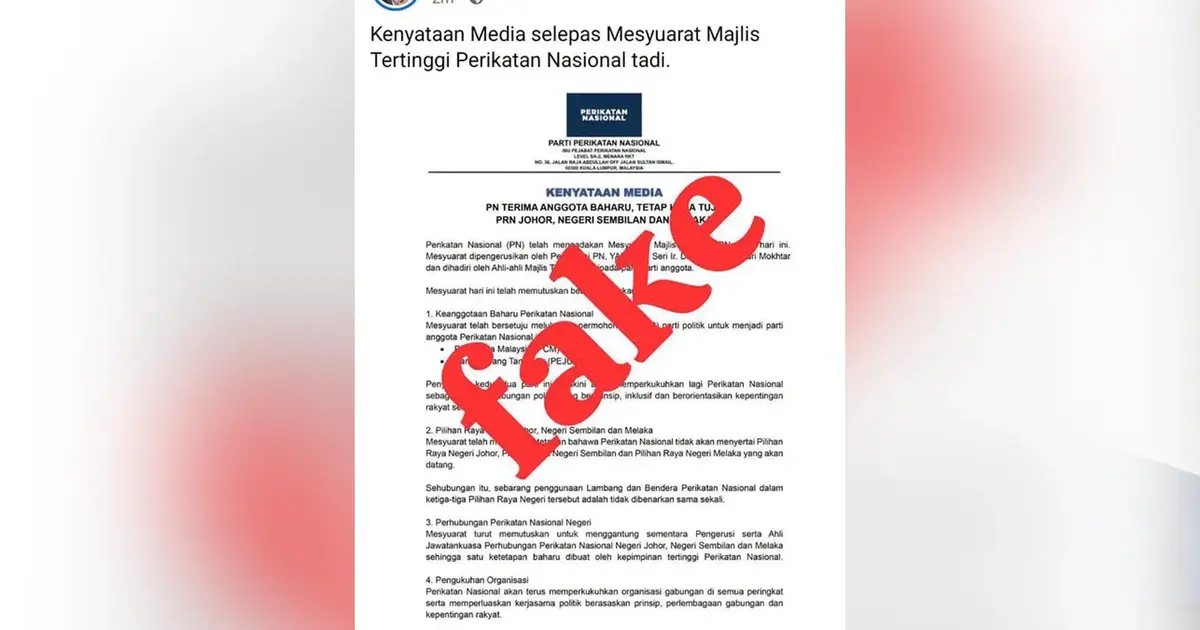
Perikatan Nasional moved quickly to extinguish what it characterizes as misinformation, issuing a categorical denial that the coalition plans to abstain from participation in three state legislative contests. The repudiation comes as a countermeasure against a statement attributed to the group that began circulating in digital spaces, prompting the leadership to intervene publicly and address what they view as a coordinated effort to spread false information about their electoral strategy.
The coalition's decisive response underscores the heightened sensitivity surrounding electoral participation and coalition dynamics in Malaysia's intensifying political landscape. For Perikatan Nasional, which has been positioning itself as an alternative to the Pakatan Harapan-led federal administration, any narrative suggesting reluctance or withdrawal from electoral contests carries substantial reputational consequences. The allegation, had it gained traction unchallenged, could have undermined the coalition's credibility among supporters and swing voters who increasingly view competitive state elections as the primary avenue through which opposition voices can challenge incumbent administrations.
The emergence of fraudulent statements attributed to political entities has become an established challenge within Malaysia's information ecosystem. Such fabrications typically exploit the velocity of social media distribution, where falsehoods can achieve significant circulation before fact-checking mechanisms or official denials catch up. By explicitly labeling the claims as "false and inaccurate," Perikatan Nasional sought to establish clear daylight between the bogus narrative and its actual organizational positions, signaling to supporters and media outlets that this represents disinformation rather than legitimate policy disagreement.
For Malaysian observers monitoring coalition stability and electoral competition, the incident reveals ongoing vulnerabilities in how political organizations authenticate their communications. The ease with which false statements can be fabricated and attributed to major political entities speaks to broader concerns about information integrity during election seasons, when stakes are heightened and partisan messaging becomes increasingly aggressive. This particular episode highlights why political parties must maintain robust communication channels and rapid response mechanisms to counter false attributions that could mislead the electorate.
The timing of such misinformation carries political weight within Malaysia's federal system, where state elections function as crucial benchmarks for measuring political momentum and coalition support. Three state elections occurring within the same cycle would represent a significant electoral undertaking, and any serious withdrawal would signal fragmentation or strategic repositioning. By preemptively denying such intentions, Perikatan Nasional sought to project organizational coherence and undiminished commitment to contesting across all available electoral arenas.
Perikatan Nasional's coalition structure, comprising multiple parties with distinct regional strongholds and voter bases, creates inherent complexity in electoral coordination. Any suggestion that the coalition might selectively participate in certain states while abandoning others invites questions about internal tensions, resource constraints, or strategic calculations that could undermine public confidence. The swift denial therefore served not merely to counter a particular false claim, but to reinforce broader messaging about the coalition's capacity to function as a unified political force capable of mounting comprehensive electoral campaigns.
The incident also reflects how digital misinformation has become an embedded feature of Malaysian politics, requiring constant vigilance from political organizations, media outlets, and citizens alike. State elections, with their more localized character, sometimes attract less intense media scrutiny than federal contests, potentially creating openings for false narratives to propagate. Perikatan Nasional's public response attempted to ensure that voters in affected states would not be swayed by erroneous information about the coalition's intentions or capacity to present candidates.
For political analysts observing Perikatan Nasional's strategic direction, the coalition has increasingly emphasized its readiness to challenge Pakatan Harapan across multiple electoral fronts, viewing state governments as platforms from which to build national momentum. The false statement suggesting selective non-participation contradicted this articulated strategy and would have provided ammunition to critics questioning the coalition's resolve or capacity. By firmly rejecting the claims, the coalition reinforced its public commitment to comprehensive electoral engagement.
Looking forward, this episode underscores why political organizations must invest in sophisticated communication infrastructure, including real-time monitoring of digital platforms where false attributions emerge. The speed with which Perikatan Nasional issued its denial—characterizing the statement as definitively "false and inaccurate"—suggests the coalition maintains awareness of online spaces where such misinformation spreads. This reactive capability, while important, remains less effective than proactive strategies designed to prevent fraudulent statements from achieving circulation in the first instance.
The broader implication for Malaysia's electoral environment extends beyond any single coalition or party. As voters increasingly navigate complex information landscapes during election periods, distinguishing between legitimate political disagreements and coordinated disinformation becomes progressively challenging. Perikatan Nasional's denial, though straightforward, contributes to an ongoing public conversation about information authenticity and the responsibilities of political entities to communicate transparently with constituents about their electoral intentions and strategic priorities.

