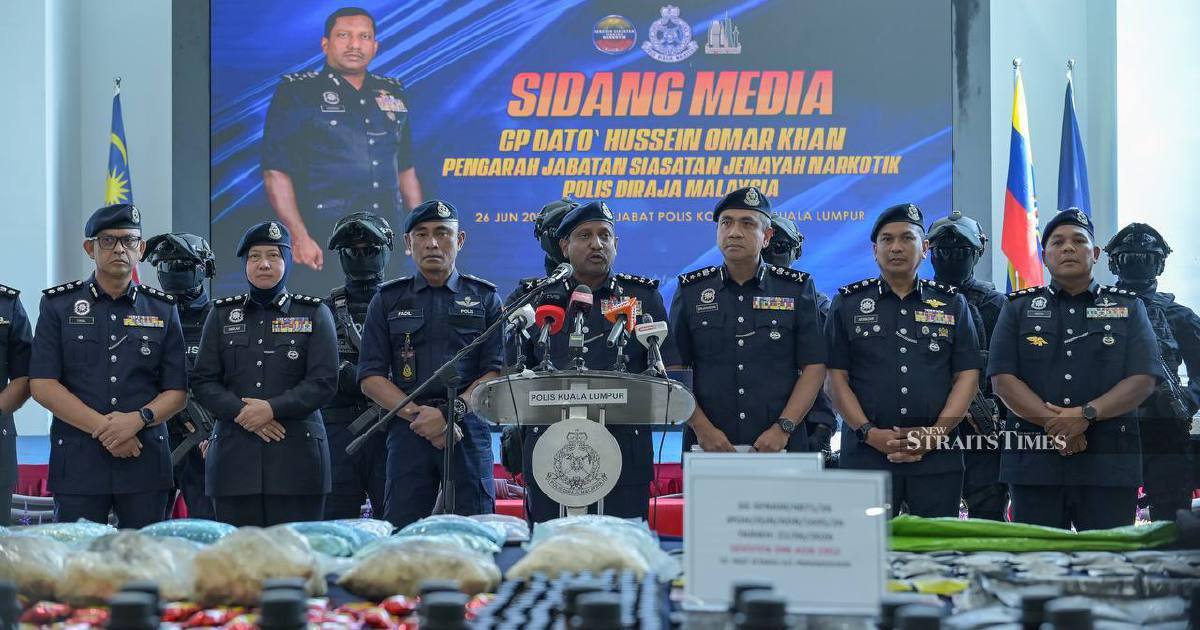
Malaysian police have successfully disrupted what authorities describe as a major attempt to flood the domestic drug market, with enforcement teams conducting three simultaneous raids in the Cheras district on June 20 that culminated in the seizure of narcotics estimated to be worth RM135.63 million. The operation, which resulted in seven arrests, represents a significant victory in the country's ongoing battle against organised drug trafficking networks that have been increasingly attempting to establish supply chains throughout urban centres.
The scale of the seizure underscores the sophisticated nature of drug distribution operations now active within Malaysia's borders. Intelligence-led policing enabled authorities to identify and target multiple locations simultaneously, preventing the suspects from moving or disposing of evidence during the enforcement action. This coordinated approach reflects evolving tactics within law enforcement, where strategic timing and simultaneous operations at connected sites have become essential tools in combating transnational and domestic trafficking organisations.
For Malaysian consumers and community safety advocates, the implications of such large-scale smuggling attempts are considerable. The apparent intention to deliberately increase drug supply on local streets suggests trafficking networks view Malaysia not merely as a transit point but as a primary market for consumption and resale. This shift in operational focus demonstrates how organised crime syndicates assess demand and profitability within different jurisdictions, with Malaysia's urban population representing an attractive target for expansion.
The Cheras location specifically has long served as a hub of commercial activity and residential density, making it a strategic distribution point for narcotics networks. The neighbourhood's infrastructure, transportation links, and population density provide ideal conditions for both storage and street-level sales operations. By targeting this district, police have addressed a potential bottleneck that could have supplied multiple downstream distribution channels throughout the Klang Valley and beyond.
The circumstances surrounding the arrest of seven suspects invite examination into recruitment patterns among trafficking organisations. These individuals were evidently positioned at different levels within the supply chain, from storage operators to potential street dealers. Understanding the organisational structure that connects these arrested persons to higher-level trafficking leadership remains crucial for subsequent investigations and potential dismantling of broader networks still operating.
The monetary valuation of RM135.63 million illustrates the economic magnitude of illicit drug trade activities within Malaysia. This figure represents not the street value at retail level, but the wholesale or bulk value of the seized substances, suggesting the actual impact on end consumers—had this operation succeeded—would have been considerably greater in terms of social costs, addiction rates, and downstream criminal activity. Such valuations also highlight how attractive the Malaysian market has become to international trafficking syndicates.
From a regional perspective, Malaysia's position as a significant trafficking hub continues to draw criminal organisations from across Southeast Asia and beyond. The country's geographic location, port facilities, and transportation infrastructure have historically made it vulnerable to smuggling operations. However, recent enforcement successes like the Cheras operation demonstrate that police capacity and intelligence networks are adapting to counter these threats more effectively.
The timing of public disclosure regarding this operation serves multiple purposes within law enforcement strategy. Announcing significant seizures strengthens public confidence in police capabilities whilst simultaneously sending deterrent messages to trafficking organisations. The specificity of the valuation and arrest numbers also provides concrete evidence of police effectiveness that contrasts with perceptions of organised crime's seemingly unchecked expansion in certain urban areas.
Investigators will now face the complex task of tracing connections between the arrested suspects and upstream trafficking sources. International cooperation with police forces in neighbouring countries and beyond may become necessary, particularly if evidence suggests involvement of transnational syndicates. Such investigations typically reveal supply chains originating from major production regions in the broader Asian context, potentially implicating networks that reach from source countries through multiple transit points to final distribution markets.
The broader context of Malaysia's drug enforcement landscape reveals an ongoing arms race between authorities and trafficking organisations. While this Cheras seizure represents a success, police officials acknowledge that the overall volume of narcotics entering Malaysia annually continues to expand, suggesting that enforcement victories, though significant, must be sustained and intensified to achieve meaningful reduction in supply and availability. The challenge extends beyond border interdiction to include disrupting domestic distribution infrastructure, addressing demand reduction, and systematically dismantling criminal organisations.
Moving forward, this operation may trigger additional investigations targeting individuals and organisations connected to the arrested suspects. Police intelligence divisions typically use significant seizures as starting points for mapping broader trafficking networks, potentially leading to cascading enforcement actions over subsequent months. The success in Cheras may also inform tactical adjustments in how police deploy resources across other high-risk districts where similar operations might be implemented. Ultimately, whilst the scale of this seizure is noteworthy, authorities acknowledge that sustained commitment across multiple enforcement dimensions remains essential to effectively counter Malaysia's growing drug trafficking challenge.

