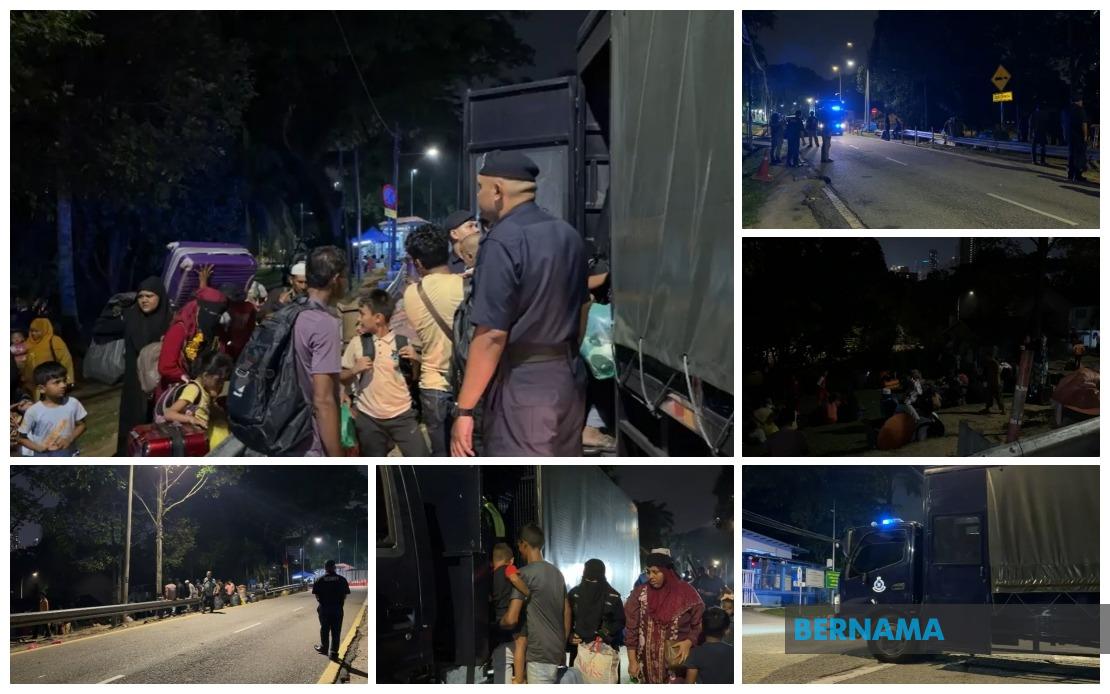
Kuala Lumpur police moved hundreds of Rohingya refugees from the United Nations High Commissioner for Refugees office on Jalan Bukit Petaling to the city's Police Contingent Headquarters on July 27 for documentation purposes and identity verification. The operation began at 8.20 pm, requiring four police trucks to transport the refugees, who arrived carrying luggage and personal belongings. The initial deployment of two vehicles proved inadequate given the volume of people and their possessions, necessitating additional transport resources.
Kuala Lumpur police chief Datuk Fadil Marsus confirmed to Bernama that all foreign nationals were transferred to the police headquarters that evening. The relocation followed a gathering at the UNHCR office, marking a significant enforcement action amid broader government efforts to manage refugee populations and maintain public order across the capital. Officials indicated that the refugees are being processed through identity verification procedures before further steps are taken by relevant state agencies.
The National Security Council is expected to take coordination responsibility on the following day to differentiate between refugees holding valid UNHCR documentation and those without proper credentials. This administrative distinction carries significant consequences. Those with legitimate refugee status and recognised UNHCR cards will be considered for suitable placement arrangements, while individuals lacking proper documentation or those unable to substantiate their refugee credentials will be transferred to the Immigration Department for processing at immigration depots pending eventual repatriation to their country of origin.
The enforcement approach reflects Prime Minister Datuk Seri Anwar Ibrahim's earlier hardline stance on refugee management. During public remarks, he declared that Malaysia's government will not tolerate any refugee group that disrupts public order or attempts territorial control within the country. This statement underscores the government's position that while Malaysia maintains humanitarian obligations, public security and orderly governance take precedence. He instructed enforcement agencies including the Royal Malaysia Police, the Immigration Department, and local municipal authorities to implement firm legal action against violators.
The timing and scale of this operation signal intensified government scrutiny of refugee movements and gatherings. The refugee group had travelled from a settlement in Penang to Kuala Lumpur aboard three buses earlier that day, relocating to the capital before assembling outside the UNHCR office. The journey itself suggests coordination, though authorities have not publicly detailed the motivation behind the movement or any specific demands made during the gathering.
This incident reflects mounting tensions surrounding refugee populations in Malaysia, particularly the Rohingya community displaced from Myanmar. Malaysia hosts one of Southeast Asia's largest refugee populations, with over 180,000 registered with the UNHCR, though actual numbers may be considerably higher. The Rohingya crisis, stemming from the 2017 military crackdown in Myanmar's Rakhine State that prompted mass exodus to neighbouring countries, continues to strain resources and challenge policy frameworks across the region.
The Malaysian government's enforcement response must be contextualised within broader demographic and security concerns. While Malaysia traditionally adopted a humanitarian approach to refugee inflows, particularly from Myanmar and Syria, recent years have witnessed policy recalibration. Government statements increasingly emphasise sovereignty, domestic security, and the need to prevent refugee gatherings that could trigger social tensions or be perceived as challenges to state authority.
The distinction between valid and invalid refugee documentation carries practical weight in Malaysia's refugee management system. UNHCR cards, though not providing citizenship rights, grant certain protections and facilitate access to education, healthcare, and formal employment channels. Individuals without documentation face heightened vulnerability to detention, deportation, and exploitation. The National Security Council's coordination role suggests that documentation verification will determine not merely administrative categorisation but fundamental access to safety and services within Malaysia.
This operation also reflects broader Southeast Asian regional challenges regarding refugee flows and burden-sharing. Countries including Thailand, Bangladesh, and Indonesia similarly struggle to accommodate displacement populations, and Malaysia's firm approach may influence regional policy discussions. The Rohingya situation remains unresolved at its source, with Myanmar's political instability and military governance preventing conditions suitable for voluntary repatriation. Consequently, Malaysia and neighbouring states remain transit points and de facto long-term hosts despite lacking formal resettlement frameworks.
The incident underscores tensions between humanitarian obligations, domestic public order concerns, and state security imperatives. Malaysia's enforcement agencies face genuine logistical challenges managing large displaced populations in urban centres, particularly in Kuala Lumpur where informal settlements create visible poverty and attract political attention. The police operation, while procedurally focused on documentation, carries symbolic weight regarding the government's determination to maintain administrative control and prevent unauthorised refugee mobilisation.
Moving forward, the documented identities and categorical determinations emerging from this processing exercise will likely shape policy implementation regarding refugee populations in Malaysia. Individuals with valid UNHCR status may experience enhanced monitoring or restrictions, while those facing repatriation procedures will confront uncertain outcomes given prevailing conditions in Myanmar. The operation demonstrates that while Malaysia maintains UNHCR cooperation and humanitarian standards, government enforcement priorities now centre on orderly management and preventing visible refugee concentration in capital city locations.

