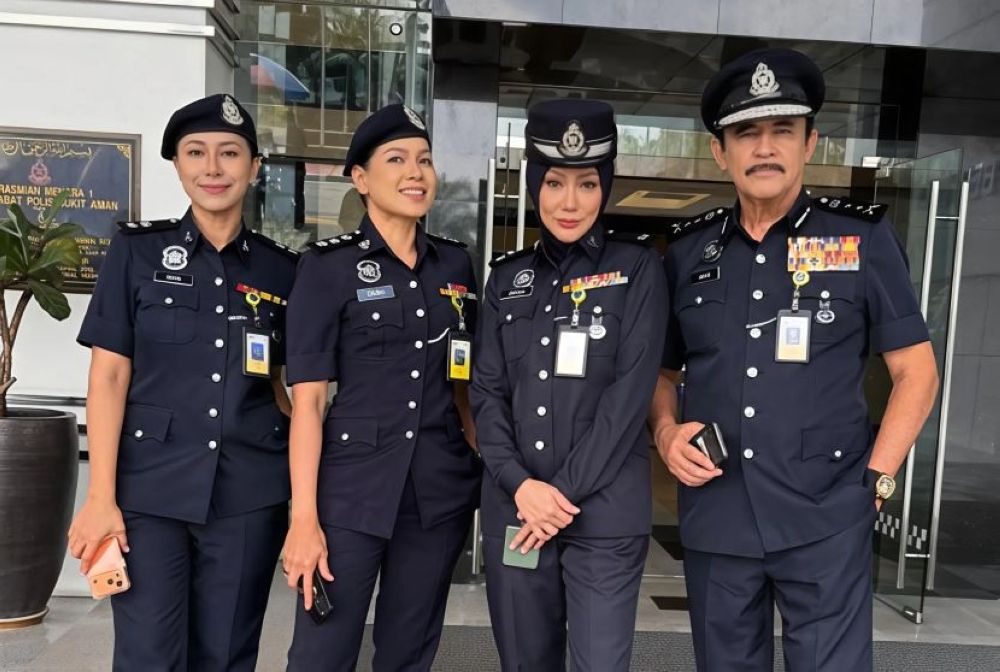
Datuk Yusof Haslam, the head of Skop Production, has made the decisive move to remove an actress from the highly anticipated revival series 'Gerak Khas 2.0' just days after the drama's premiere, following her involvement in a serious drug-related incident that has sent shockwaves through Malaysia's entertainment industry.
The actress in question was arrested during a police raid conducted by officers from the Dang Wangi district police headquarters on July 7, and subsequently tested positive for three different types of controlled substances. The arrest occurred mere days before the drama's public debut, placing the production team in an unprecedented situation where they had to balance their creative commitments with ethical and reputational concerns.
Although filming of the 26-episode series had already reached an advanced stage at 90 percent completion, Yusof made the determination that removing the actress's remaining content was the appropriate course of action. The actress still had scenes scheduled for episodes 23 and 24, which represent the final chapters of the narrative arc. Rather than attempt to edit around or redistribute her dialogue, the production team opted for a complete excision of all her outstanding footage, demonstrating their commitment to the decision despite the logistical inconvenience this entails.
In explaining the rationale behind this uncompromising stance, Yusof acknowledged that this turn of events fell entirely beyond the production's ability to anticipate or control. Had the production team possessed knowledge of the actress's involvement with drugs prior to casting decisions, he emphasized, she would never have been selected for the role. The actress had previously worked on Skop Production projects without incident, which made the subsequent revelation all the more disappointing and unexpected from the producer's perspective.
The removal carries particular symbolic weight given the nature of the drama itself. 'Gerak Khas 2.0' centers on law enforcement and police work, with the arrested actress having portrayed a police inspector character—a role that now becomes untenable to maintain given her legal troubles. This fundamental contradiction between the character she played and her real-world circumstances created an insurmountable obstacle to keeping her performance in the final cut. Yusof characterized the decision as necessary to preserve the credibility and integrity of the entire production, an essential consideration for a series so directly tied to Malaysia's police force and their public image.
The producer has also used this incident as a broader cautionary message directed at the entire entertainment community. During production, Yusof had consistently reminded the cast and crew about the imperative of maintaining disciplinary standards and avoiding any conduct that might compromise the drama's reputation or reflect poorly on the Royal Malaysia Police. The actress's arrest represents a stark demonstration that these warnings were not merely abstract guidelines but genuine concerns rooted in professional and institutional responsibility.
In response to the actress's subsequent appeals for reconsideration, Yusof maintained an inflexible position, rejecting all pleas and excuses. His statement that "it's too late" reflects both a practical assessment of the situation and a philosophical stance on accountability and consequences. He advised the actress to view this outcome as a critical life lesson, emphasizing that once a person commits a serious transgression, public memory tends to discount or overlook their previous accomplishments and positive contributions to their field.
Yusof's approach also touches on broader cultural and social dimensions that resonate throughout Malaysia's entertainment landscape. He observed that society, particularly in relation to female performers, carries stringent expectations regarding personal conduct and the places they frequent. Nightclubs and similar venues, in his assessment, carry particular risks for women in the public eye, as these locations can invite rapid social judgment and reputational damage. This observation reflects persistent double standards in how Malaysian society evaluates the behavior of male and female entertainers.
The producer drew an analogy to parental oversight, suggesting that even with the most conscientious supervision, individuals can still make choices that lead to serious consequences. Just as parents cannot monitor every action of their children, production companies cannot exercise total control over the private lives and decisions of cast members. This reality underscores the challenges that arise when high-profile figures in the entertainment industry face legal troubles, forcing productions to make difficult and sometimes costly corrective decisions.
The cast of 'Gerak Khas 2.0' includes established performers such as Hans Isaac, Erra Fazira, C. Kumaresan, and Salina Saibi, alongside police inspector characters portrayed by Tisha Shamsir, Nabiha Aimi, and Emily Elizabeth. The series represents a significant investment in Malaysian television production and carries substantial expectations for its reception, making the removal of substantial portions of filmed content a particularly grave business decision.
This incident carries implications extending well beyond the immediate production. It signals to the Malaysian entertainment industry that producers are willing to absorb substantial financial and creative losses rather than compromise on issues of integrity and institutional reputation. For aspiring and established performers alike, the case demonstrates that personal conduct can have severe professional consequences, particularly when working on high-profile projects with public institutional partners such as the police force. The ripple effects of this decision will likely influence how other productions manage similar crises in the future.

