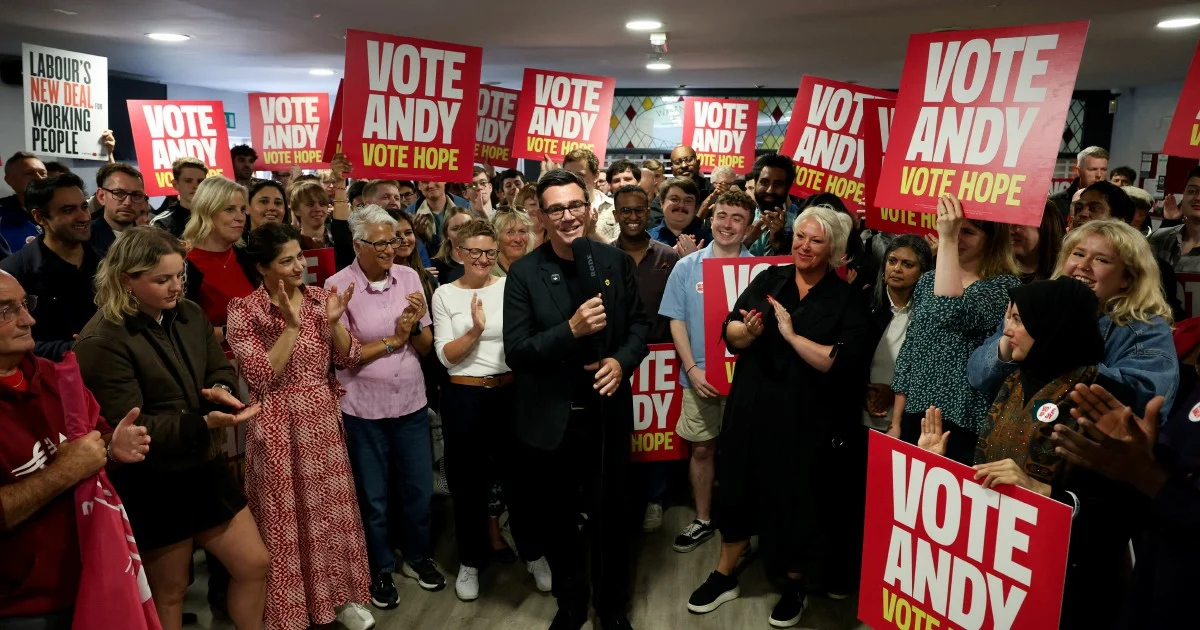
Andy Burnham's ambitions to eventually challenge Prime Minister Keir Starmer for Britain's top job may well hinge on circumstances largely beyond his control. If the Labour politician succeeds in capturing the Makerfield seat in Thursday's election, his victory could owe as much to infighting between populist right-wing parties as to his own political credentials or local appeal.
Burnham currently serves as Mayor of Greater Manchester, a position that has raised his profile significantly within Labour circles and beyond. His bid to return to Parliament through the Makerfield constituency represents a critical step toward positioning himself as a potential successor to Starmer, should the Prime Minister's tenure falter or conclude. The timing of this electoral contest coincides with broader fractures within Britain's conservative opposition, offering Burnham an unexpected advantage.
The Conservative Party and Reform UK, two distinct political entities competing for the same ideological space on the right of British politics, are engaged in substantial disagreement over strategy, leadership, and policy direction. This division has created what political analysts term a "split vote" scenario, wherein supporters of right-wing politics are distributed across multiple parties rather than consolidated behind a single standard-bearer. Such fragmentation historically benefits candidates from rival parties who can consolidate their own vote share more effectively.
In practical terms, Makerfield voters dissatisfied with Labour's governance but sympathetic to right-wing politics find themselves choosing between candidates representing the Conservatives and Reform UK. Rather than producing a unified challenge to Burnham's candidacy, this fragmentation means anti-Labour votes are divided, potentially allowing him to win with a lower overall vote share than might otherwise be necessary. Political strategists observe that such dynamics can dramatically shift electoral mathematics, particularly in closely contested constituencies.
The broader context of British politics reveals a party system in flux. Reform UK, under its various iterations and leadership, has attempted to position itself as a more authentic expression of populist sentiment than the traditional Conservative Party. This has created genuine tension within right-wing politics, as the two organizations compete for voters who feel increasingly alienated from Westminster establishments. The feuding between these camps has become sufficiently pronounced that cooperation or tactical voting between their supporters appears increasingly unlikely.
For Malaysian and Southeast Asian observers, this British scenario offers instructive parallels. Multi-party systems throughout the region frequently experience similar vote-splitting dynamics, where fragmented opposition allows dominant parties to maintain power despite declining vote shares. The Malaysian political experience, with its complex coalition arrangements and occasional fractures within opposition blocs, reflects comparable phenomena. Understanding how British voters navigate such choices illuminates challenges faced by democracies managing polarized political landscapes.
Burnham's potential electoral success in Makerfield would represent validation of a particular political strategy: consolidating centre-left support while allowing right-wing opponents to squabble amongst themselves. Should he succeed, his path toward the premiership would be clearer, as a Parliament seat is traditionally essential for aspiring prime ministers in the British system. His mayoralty has already established credentials in governance and regional management, and a parliamentary seat would provide the platform necessary for sustained challenge to Starmer's leadership.
The ideological divide within British right-wing politics reflects deeper tensions about national identity, immigration, economic policy, and Britain's international role. These disputes make genuine alliance between Conservatives and Reform UK difficult despite their shared opposition to Labour. Each party leadership calculates that maintaining distinct identity and organizational independence serves their long-term interests better than short-term tactical cooperation, even if such cooperation might help defeat Burnham locally.
Thursday's Makerfield election functions as a microcosm of these larger British political dynamics. Burnham's candidacy tests whether Labour can retain working-class constituencies despite perceived drift toward middle-class liberalism, a concern that reverberates across European social democratic parties. Simultaneously, the Conservative-Reform UK rivalry demonstrates how populist movements can fracture traditional party systems, creating both opportunities and vulnerabilities for established political forces.
Should Burnham prevail in Makerfield, observers will inevitably parse the results to understand whether his victory reflects genuine local support for his leadership vision or primarily represents a consequence of right-wing fragmentation. This distinction matters considerably for assessing his viability as a future prime ministerial candidate. A mandate built primarily on opponent disunity rather than positive endorsement provides less stable foundations for challenging an incumbent prime minister than votes cast affirmatively in his favour.
The election results will illuminate not merely Burnham's personal prospects but broader questions about Britain's political future. How thoroughly have right-wing parties fractured? Can they achieve reconciliation, or has the split become permanent? Will working-class constituencies continue supporting Labour despite economic pressures? These questions extend beyond Makerfield's boundaries to shape Britain's political trajectory for years ahead. Burnham's political fortunes are thus intertwined with answers to much larger questions about the nation's electoral landscape and ideological realignment.

