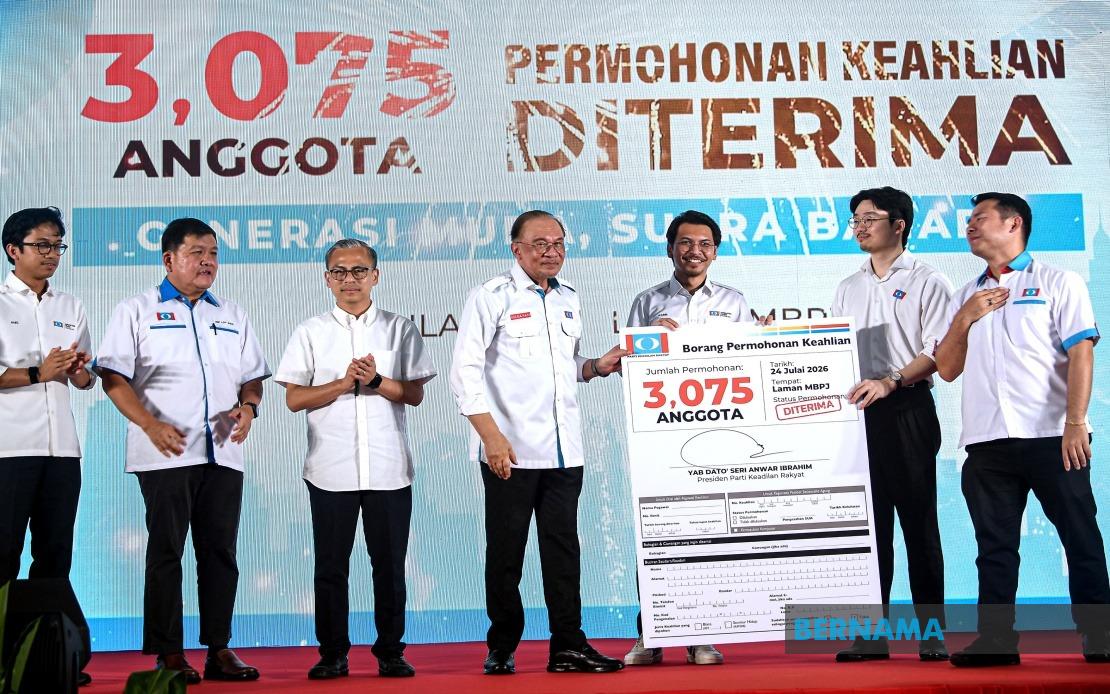
The federal government has committed RM44.5 million to tackle recurrent flooding in Petaling Jaya and Damansara through a coordinated programme spanning 30 targeted mitigation projects. Prime Minister Datuk Seri Anwar Ibrahim unveiled the substantial allocation during a youth engagement event at the Petaling Jaya Smart Centre on July 24, signalling Putrajaya's intent to address chronic waterlogging that has plagued these Selangor localities. The Implementation Coordination Unit (ICU) under the Prime Minister's Department will oversee the execution of these interventions, ensuring standardised delivery across both the federal and state administrative frameworks.
Government spokesperson Datuk Seri Fahmi Fadzil elaborated on the allocation structure during a media briefing following the Generasi Muda Suara Baharu Programme organised by Angkatan Muda Keadilan. The arrangement reflects a layered funding model, with the RM44.5 million foundation dedicated specifically to flood defence infrastructure. Beyond this cornerstone investment, an additional RM3 million has been earmarked for the Petaling Jaya parliamentary constituency to finance Projek Mesra Rakyat (PMR) community-focused initiatives and support the operational requirements of local non-governmental organisations. The Subang Jaya parliamentary division receives a separate RM1.5 million allocation for similar purposes, underscoring the government's commitment to embedding grassroots development within the broader infrastructure agenda.
The dual-track coordination mechanism established for managing these funds demonstrates evolving governance practices in major metropolitan regions. Both the Selangor ICU and the Federal ICU will jointly oversee the parliamentary constituency allocations, creating a framework designed to harmonise state-level implementation with federal standards and oversight protocols. This architecture has become increasingly common as Malaysian authorities recognise that effective urban flood management requires seamless integration between different administrative tiers. The approach effectively bridges potential gaps between federal resources and state-level execution capabilities, reducing duplication and accelerating project deployment in localities historically vulnerable to inundation.
Petaling Jaya and Damansara represent critical focal points for flood mitigation efforts in the Klang Valley conurbation, one of Malaysia's most densely populated and economically significant regions. Both areas have endured successive monsoon seasons punctuated by severe flooding events that disrupt commerce, damage residential and commercial infrastructure, and impose substantial costs on residents and businesses. The identification of these localities as flood hotspots reflects data-driven analysis rather than ad-hoc political gesturing, positioning the initiative within Malaysia's broader national disaster risk reduction framework. By concentrating resources on demonstrably vulnerable areas, the government aims to achieve measurable impact whilst establishing a replicable model for addressing similar challenges in other flood-prone Malaysian municipalities.
The thirty-project scope encompasses diverse interventions likely spanning drainage system upgrades, retention pond construction, riparian restoration, and smart water management technologies. The scale of investment suggests a holistic rather than superficial approach to hydrological challenges plaguing these constituencies. Effective flood mitigation in densely urbanised areas demands multifaceted solutions addressing upstream runoff management, intermediate conveyance capacity, and downstream detention capabilities. The concentration of funding indicates that planners recognise the complexity inherent in reversing decades of rapid, sometimes haphazard urban expansion that has compromised natural water absorption and flow characteristics across the Petaling Jaya and Damansara landscape.
Parallel to infrastructure commitments, the government has signalled renewed emphasis on youth political engagement through expanded grassroots mobilisation activities. The Petaling Jaya event witnessed 3,075 new members joining PKR, with Generation Z constituents predominating among the recruits. This influx reflects successful messaging targeting younger demographics increasingly concerned with climate resilience and environmental stewardship, issues intimately connected to effective flood management. The substantial youth recruitment demonstrates that infrastructure investment announcements resonate particularly strongly with younger voters when framed within their climate consciousness and urban livability concerns.
Party officials characterised the membership surge as validation of PKR's reformasi narrative among generational cohorts traditionally considered politically volatile or disengaged. The overwhelming youth participation at the Petaling Jaya Smart Centre gathering galvanised party strategists to expand the Jelajah AMK Gen Z national roadshow, described as an ongoing party-building initiative rather than electoral preparation. Fahmi's careful demarcation—explicitly distancing the campaign from imminent state or general elections—reflects sensitivities surrounding the optics of infrastructure announcements timed to coincide with mass recruitment drives. Nevertheless, the explicit acknowledgement of strengthened outreach efforts targeting younger demographics suggests that demographic realignment remains a central PKR strategic objective for the medium term.
The flood mitigation initiative sits within Malaysia's evolving approach to climate adaptation and disaster resilience in urbanised settings. Recent catastrophic flooding across Southeast Asia, including events in Thailand, Cambodia, and Peninsular Malaysia itself, has elevated public expectations for government proactivity in managing hydrological risks. The RM44.5 million commitment, whilst substantial, represents a fraction of total climate adaptation spending required across Malaysia's vulnerable municipalities. However, symbolic significance attaches to demonstrable resource allocation toward demonstrably problematic areas, particularly when accompanied by transparent coordination mechanisms and clear timeline expectations from executing agencies.
The ICU's expanded role in coordinating flood mitigation reflects broader institutional evolution within Malaysia's public administration. Once primarily a development project approval body, the ICU has incrementally expanded its remit to encompass complex cross-jurisdictional initiatives requiring synchronisation between federal departments and state authorities. This institutional repurposing addresses historical fragmentation in Malaysian governance where infrastructure projects often suffered from unclear accountability and delayed implementation when responsibilities spanned multiple administrative levels. By centring ICU coordination, the government positions itself to monitor progress systematically and intervene rapidly should implementation bottlenecks emerge.
For residents of Petaling Jaya and Damansara, the allocation announcement represents tangible recognition of longstanding grievances surrounding flood vulnerability. These constituencies contain substantial middle-class residential and commercial concentrations alongside critical economic infrastructure, making flood resilience directly relevant to economic productivity and property values. The government's commitment of dedicated capital signals that flood risks are no longer treated as inevitable features of monsoon seasons but as addressable technical challenges warranting sustained investment. Whether the announced projects materialise according to stated timelines and performance specifications will substantially influence public confidence in government delivery capacity regarding infrastructure development more broadly.

