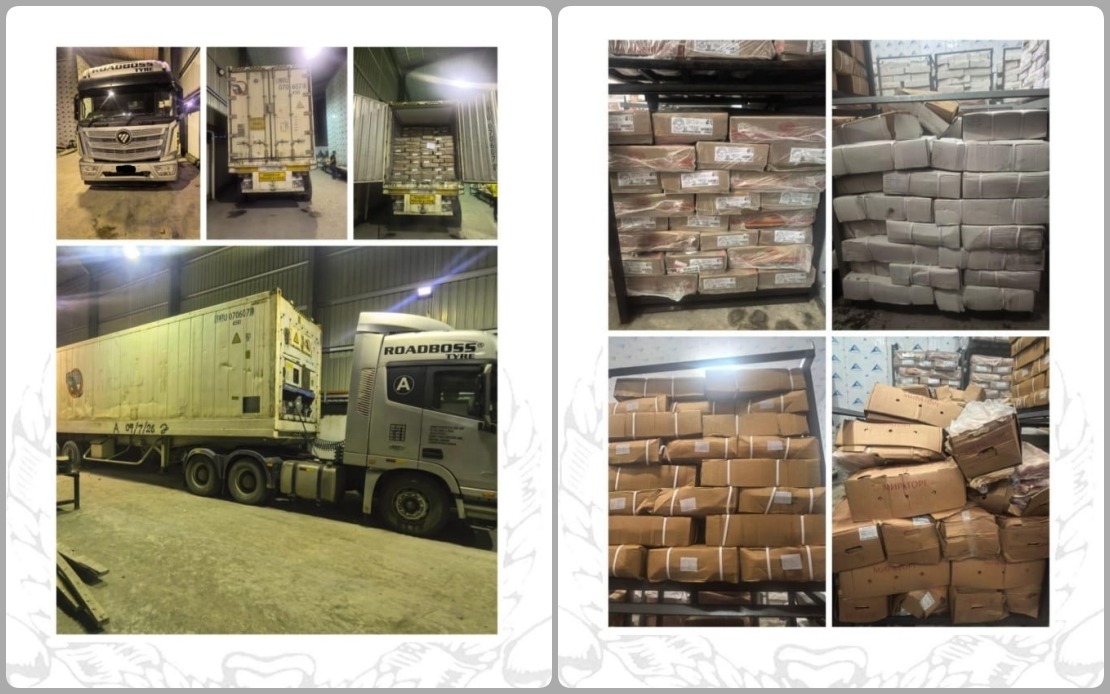
Law enforcement authorities in Malaysia have made a significant seizure of contraband frozen pork products valued at RM6.19 million following a coordinated raid on a warehouse facility in Miri, Sarawak. The operation, designated Op Taring Chiller, resulted in the arrest of a 26-year-old local resident on the evening of July 9, according to statements released by the Internal Security and Public Order Department (JKDNKA) leadership.
The discovery underscores persistent vulnerabilities in Malaysia's food supply chain, particularly regarding the importation and distribution of animal products that circumvent regulatory oversight. The sheer scale of the seizure—involving tens of thousands of kilograms of processed pork in various forms—suggests an organised smuggling operation rather than isolated non-compliance. Officials documented the recovery of 30,000 kilograms of cooked frozen pork large intestines, 18,000 kilograms of pork loin distributed across 15 pallets, 750 kilograms of pork occupying a single pallet, multiple pallets of bone-in pork bellies with rind intact, and frozen pork shoulder. The diversity and volume of products point to a structured commercial enterprise designed to supply restaurants, food processors, or retail outlets across the region.
The enforcement action was coordinated between the Wildlife Crime Bureau and Special Investigation Intelligence unit, operating under the JKDNKA framework, alongside local district police in Miri and the Sarawak Veterinary Services Division. This inter-agency approach reflects institutional recognition that food safety violations often intersect with smuggling networks and require specialised investigative capacity. The coordination between wildlife enforcement and veterinary services suggests that concerns extend beyond customs and tariff evasion to encompass animal health standards and halal certification integrity—matters of particular sensitivity within Malaysia's Muslim-majority context.
Investigators have proceeded under Sections 9(1) and 9(3) of the Veterinary Public Health Ordinance 1999, the legislative framework governing the importation and handling of animal products in Malaysia. Beyond criminal charges, authorities issued a compound notice valued at RM25,000 against the suspect, permitting the case resolution through financial penalty rather than mandatory prosecution—a mechanism often employed in commercial food safety violations where technical breaches may not warrant full criminal proceedings. This bifurcated enforcement approach balances deterrence against proportionality, though the substantial seizure value suggests the severity authorities attribute to the violation.
The Miri operation represents one component of a much broader enforcement campaign. According to departmental statistics, the Wildlife Crime Bureau and Special Investigation Intelligence division conducted 201 raids nationwide between January 1 and July 10 of this year alone, resulting in 375 individual arrests. These operations extended across multiple violation categories including non-duty-paid goods smuggling, leakage of price-controlled or government-subsidised commodities, frozen food product offences, wildlife trafficking, and electronic waste trafficking. The accumulated seizures from this six-month period exceeded RM264.86 million in estimated value, indicating that food product smuggling represents merely one facet of a diversified contraband economy operating across Malaysia.
The targeting of frozen pork products reflects particular enforcement priority given Malaysia's complex regulatory environment surrounding meat importation. As a country where Muslim consumers represent the majority population, the halal certification and traceability of all meat products carry both commercial and social significance. Smuggled products entering through unregulated channels bypass halal certification requirements, creating potential market adulteration and consumer deception. Additionally, the absence of valid permits means such products evade quarantine inspection protocols designed to prevent the introduction of animal diseases, creating potential biosecurity risks. These considerations extend beyond ordinary tariff collection to encompass consumer protection and public health dimensions.
The Sarawak location is significant within Malaysia's broader food import context. As an East Malaysian state with substantial port infrastructure in Miri and Kuching, Sarawak serves as a logical entry point for contraband originating from neighbouring jurisdictions or arriving through maritime routes. The state's geographic proximity to international waters and its position within regional supply networks make it particularly vulnerable to smuggling operations targeting the peninsular Malaysian market. Enforcement in Sarawak thus assumes strategic importance for protecting the integrity of Malaysia's wider food system.
The perpetrator's relative youth—at 26 years old—may reflect employment within a larger organisational structure rather than independent entrepreneurship. Contemporary smuggling operations, particularly those managing large-volume commodity shipments, frequently employ individuals in hands-on warehouse roles whilst maintaining distant ownership and decision-making structures. The arrest of operational personnel without concurrent disruption of the broader network suggests that investigative priorities may focus on supply interruption rather than dismantling organisational hierarchies, though authorities have not publicly confirmed whether the investigation extends beyond the apprehended individual.
The magnitude of the RM6.19 million seizure provides context for assessing the profitability and scale of food smuggling within Malaysia's underground economy. At typical wholesale pork prices, this quantity would represent substantial commercial value even before distribution markup. The operation's viability depends upon routing around legitimate import channels, evading tariff obligations, and marketing through informal distribution networks that either deliberately conceal product provenance from consumers or target establishments willing to purchase without documentation. The existence of sufficient demand to justify such large-scale operations indicates systemic weaknesses in supply chain verification throughout Malaysia's food retail and food service sectors.
Malaysian authorities have committed to escalating such enforcement operations, leveraging enhanced intelligence gathering and inter-agency coordination. The Royal Malaysia Police statement emphasising intensified efforts against smuggling and organised crime reflects institutional understanding that food product contraband frequently intersects with broader criminal networks involved in trafficking, money laundering, and other transnational illicit activities. The compartmentalisation of enforcement through specialised units like the Wildlife Crime Bureau enables development of investigative expertise and operational capacity that general police divisions might lack.
For Malaysian consumers and businesses, these enforcement operations carry practical implications. Strengthened scrutiny of frozen pork products in supply chains may initially constrain product availability or affect pricing in food service establishments, particularly those relying upon imported inputs. However, sustained enforcement raises the operational costs of smuggling, theoretically incentivising legitimate import channels and supporting compliance with regulatory frameworks. Consumers purchasing through licensed retailers benefit from enhanced assurance that products have undergone proper quarantine and certification processes, reducing foodborne illness risks and validating halal claims.
The operation also highlights ongoing challenges in border and port security management. The ability of such substantial shipments to reach warehouse facilities indicates either inspection gaps at entry points or coordination failures between maritime authorities and inland enforcement agencies. Addressing smuggling at scale requires capabilities beyond law enforcement—encompassing port infrastructure improvements, digital tracking systems, and intelligence-sharing protocols that Malaysian authorities continue developing.

