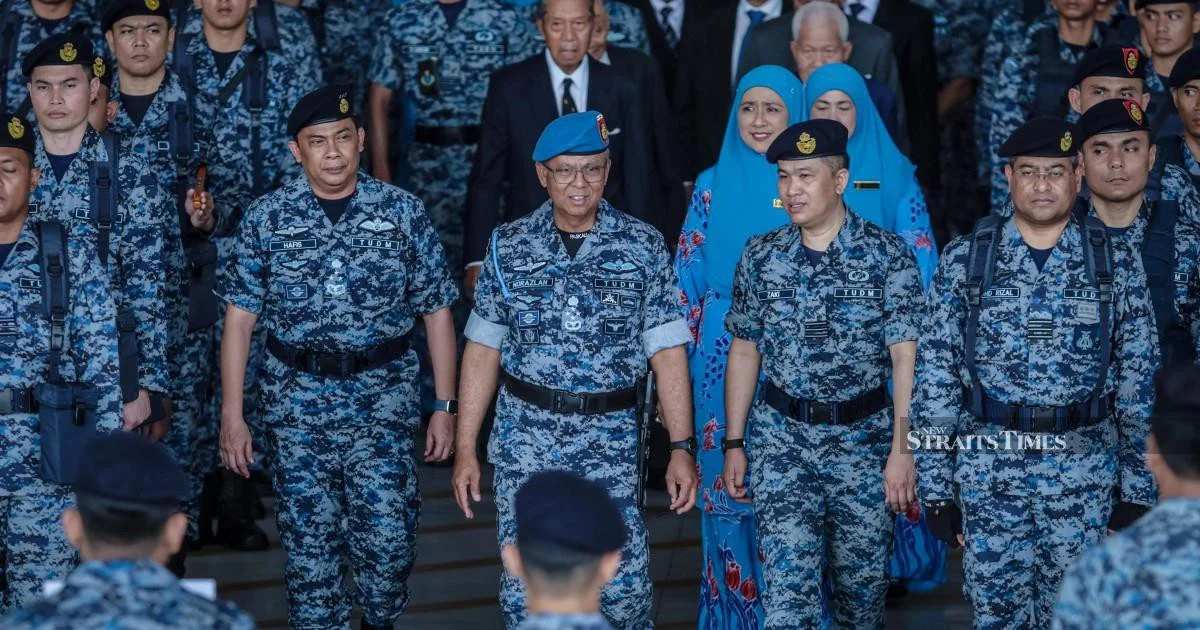
The Royal Malaysian Air Force leadership has made a forceful case for enhanced aerial capabilities as a cornerstone of maritime defence strategy, with commander General Tan Sri Muhamad Norazlan Aris warning that air superiority has become indispensable for protecting the country's vital sea corridors. Speaking at Subang, the RMAF chief articulated an increasingly urgent assessment of security threats to Malaysia's extensive maritime zones, positioning airborne defences as a non-negotiable element of national protection in an era marked by unpredictable geopolitical shifts across Southeast Asia and beyond.
The statement reflects deepening concerns within Malaysia's defence establishment about vulnerability along shipping lanes and exclusive economic zones where commercial activity, energy resources, and strategic interests converge. Malaysia's position along major international waterways—particularly the Straits of Malacca and the South China Sea—creates both economic opportunities and security imperatives that demand sophisticated monitoring and rapid response capabilities. The RMAF's emphasis on air power underscores recognition that maritime domains cannot be effectively secured through surface vessels alone, particularly when threats may emerge with minimal warning or involve sophisticated actors capable of sophisticated operations across vast oceanic areas.
The timing of the RMAF chief's remarks carries particular significance given the constellation of regional challenges. Competing territorial claims in the South China Sea, occasional incidents involving foreign military assets in Malaysian waters, and the broader militarisation of contested maritime zones have sharpened defence planners' focus on the gaps in existing protective capabilities. An air force equipped with adequate range, endurance, and sensor systems can project presence across broad expanses of ocean, respond rapidly to developing situations, and provide intelligence crucial for informed decision-making in maritime zones where Malaysia claims rights and responsibilities.
The strategic logic underlying the RMAF commander's position reflects standard maritime defence doctrine employed by coastal nations worldwide. Aerial platforms offer advantages that surface-based systems cannot replicate: they can conduct sustained patrols over vast areas, detect threats at significant distances, intercept aircraft or fast-moving vessels, and provide real-time surveillance to ground and naval command centres. For a nation like Malaysia with substantial maritime claims and numerous islands scattered across distant waters, these capabilities represent force-multipliers that stretch limited defence budgets further than alternative approaches might allow.
Regional geopolitical evolution has intensified these considerations. The ongoing strategic competition among major powers, increased military activity in Southeast Asian waters, and emerging security challenges such as irregular maritime activities have compelled Malaysia to reassess its defensive posture. Where previous decades might have permitted a more measured approach to air capabilities focused primarily on territorial air defence, contemporary circumstances demand forces capable of extended maritime surveillance, interdiction operations, and sustained presence across broad oceanic areas. The RMAF chief's public emphasis on this requirement signals both internal conviction about operational necessity and an effort to build political and public support for defence investments.
The challenge for Malaysian policymakers involves translating the RMAF's strategic assessment into concrete procurement and development decisions. Modern air defence capabilities require substantial financial commitment, technical expertise, and sustained logistical support that strain defence budgets in most Southeast Asian nations. Aircraft designed for maritime reconnaissance and response operations, whether fixed-wing patrol platforms or maritime helicopters, represent significant capital investments that compete with other pressing national priorities. The RMAF must therefore construct compelling cases for specific capability acquisitions while demonstrating how enhanced air power provides value exceeding alternative defence approaches.
The statement also implicitly addresses questions about force structure and operational readiness within the RMAF itself. The air force faces ongoing challenges in maintaining aging platforms, training adequately qualified personnel, and sustaining operations across the demanding maritime environment. The commander's public advocacy for strengthened air capabilities may reflect frustration with budget constraints that have historically limited the RMAF's development, or efforts to secure priority allocation of defence resources in competition with other services. Such internal dynamics often shape public declarations about strategic necessity, though the underlying concerns about maritime vulnerability remain legitimate regardless of bureaucratic considerations.
For Malaysia's neighbours and strategic partners, the RMAF chief's remarks carry secondary significance as indicators of Malaysian threat perception and defence priorities. Regional security dynamics are shaped partly through such official statements, which communicate commitment levels and capability intentions to both allies and potential adversaries. The emphasis on air power suggests Malaysia views maritime challenges as requiring sophisticated technological responses rather than primarily diplomatic or political solutions, a positioning that may influence how regional partners assess Malaysian intentions and priorities in multilateral forums addressing South China Sea security and maritime cooperation.
The international dimension also merits consideration. Defence capabilities and strategic doctrines do not develop in isolation; they are shaped by available technology, international arms markets, defence partnerships, and lessons observed from other nations' experiences. Malaysia's assessment of required air power likely reflects observations of how other regional and global actors employ aircraft for maritime operations, availability of systems that Malaysia can realistically acquire and operate, and technological trajectories that promise enhanced capabilities in the medium term. The RMAF's strategic positioning may therefore signal openness to defence partnerships, technology acquisitions, or operational arrangements that would enhance Malaysia's maritime air capabilities.
The longer-term implications of elevated focus on air power for maritime protection extend beyond immediate defence considerations to questions about Malaysia's strategic posture in an evolving region. Greater emphasis on aerial capabilities for maritime surveillance and response suggests a vision of Malaysian security resting partly on technological sophistication and sustained investment in force modernisation. This contrasts with approaches emphasizing diplomatic negotiation, multilateral cooperation mechanisms, or building consensus around regional norms—though the RMAF chief's statement does not preclude simultaneous pursuit of such approaches. The defence establishment's confidence in air power likely reflects both genuine operational requirements and strategic preferences shaped by institutional interests and professional military judgment.
Moving forward, the RMAF's advocacy for strengthened air capabilities will likely feature prominently in defence budgeting processes and strategic planning discussions. The commander's public statements establish baseline positions for subsequent negotiations over resource allocation and capability priorities. Whether Malaysia can translate this expressed commitment into actual force development depends on political will, budgetary capacity, and successful execution of procurement programmes that often encounter delays and cost overruns. The imperative identified by the RMAF leadership appears clear; whether Malaysia's political and financial systems will deliver corresponding capabilities remains an open question requiring sustained attention and commitment from successive government administrations.

