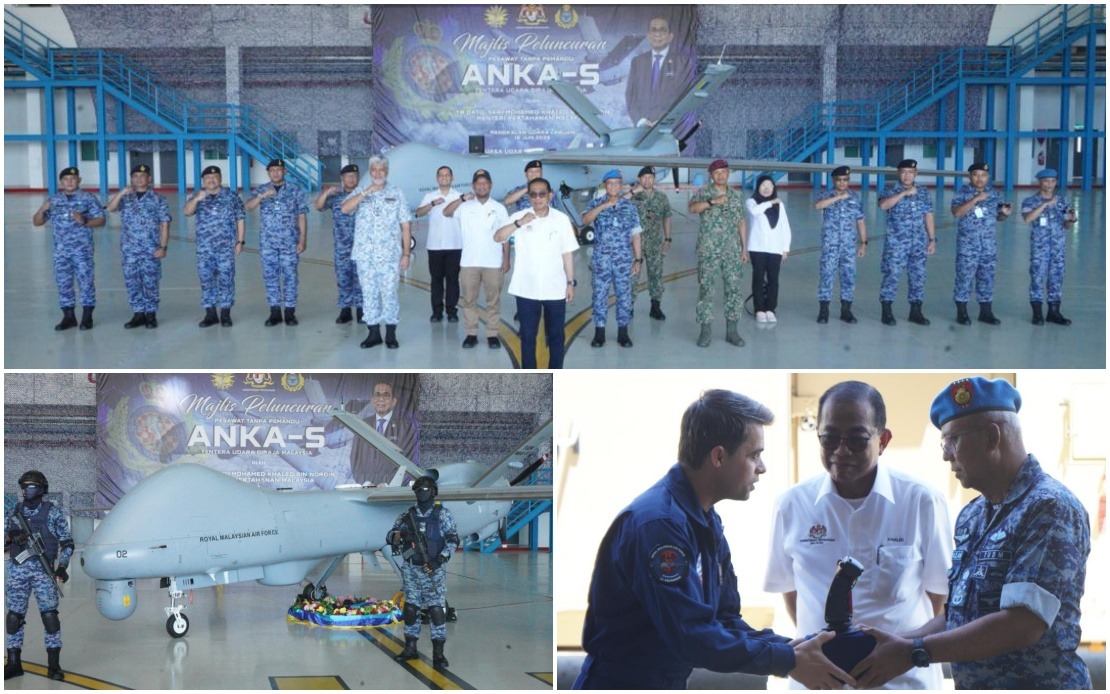
Malaysia has taken a significant step forward in maritime domain awareness by operationalising the ANKA-S Unmanned Aircraft System across its armed forces, a development that addresses longstanding gaps in surveillance coverage across one of the world's most strategically contested waters. Defence Minister Datuk Seri Mohamed Khaled Nordin unveiled the capability at the RMAF Labuan Air Base on June 16, emphasising that the system provides coverage previously unavailable to Malaysian defence planners and gives the country a critical intelligence advantage in safeguarding national interests.
The acquisition represents a substantial financial commitment, with Malaysia investing RM423.8 million to procure three of the Turkish-manufactured aircraft along with associated ground control infrastructure and two years of personnel training. This expenditure reflects the Malaysian government's determination to modernise its intelligence, surveillance and reconnaissance capabilities at a time when regional tensions and maritime disputes have intensified competition for control of critical sea lanes. The ANKA-S platform, a medium-altitude long-endurance system, fills a technological gap that has constrained Malaysia's ability to conduct sustained monitoring operations across its maritime zones without deploying more expensive manned aircraft or naval vessels.
Operational specifications of the ANKA-S make it particularly suited to Malaysia's geographic requirements and fiscal constraints. The aircraft can remain airborne for more than 24 hours at operational altitudes reaching 30,000 feet, enabling extended patrols that would be prohibitively expensive if conducted by fighter jets or maritime patrol aircraft. More significantly, the system can operate in conditions where visual detection remains difficult and can function regardless of weather patterns, addressing environmental challenges that have historically limited Malaysian surveillance effectiveness during monsoon seasons. These extended endurance capabilities translate directly into better temporal coverage of Malaysian maritime territories, particularly across the South China Sea where competing territorial claims and occasional unidentified vessel incursions demand constant vigilance.
The intelligence applications extend beyond simple detection. The ANKA-S system can accurately identify and track vessel profiles, providing Malaysian defence authorities with precise information about shipping movements and enabling rapid assessment of whether detected vessels constitute genuine security threats. This capability fundamentally changes how the RMAF can deploy its limited assets, moving away from unfocused patrol patterns that consume resources without generating actionable intelligence toward targeted responses based on confirmed detections. Consequently, the system promises significant operational efficiency gains that justify its substantial acquisition cost, as fewer expensive platforms need to be maintained in constant readiness.
Cost efficiency represents a critical strategic advantage for Malaysia's defence sector. By substituting unmanned systems for manned aircraft on surveillance missions, the RMAF can reduce operational expenditures while increasing patrol frequency and coverage breadth. Fuel consumption, aircrew requirements, maintenance burdens, and pilot fatigue all diminish when unmanned platforms conduct routine surveillance, allowing Malaysia to stretch its constrained defence budget further while maintaining heightened maritime awareness. This efficiency metric becomes increasingly important for Southeast Asian nations competing with wealthier powers to maintain credible military capabilities amid fiscal limitations.
The government's deliberate choice not to arm the ANKA-S aircraft carries significant diplomatic implications. Although the platform possesses weapons-carrying capability, Malaysian defence officials have elected to operate it unarmed as a signal of defensive intent. This decision, articulated by Defence Minister Mohamed Khaled, reflects calculated messaging designed to differentiate Malaysia's security posture from more assertive regional actors while maintaining operational flexibility. The distinction between capability and deployment demonstrates sophisticated strategic communication, allowing Malaysia to invest in advanced technology without triggering regional alarm or domestic opposition from nations concerned about militarisation of the South China Sea.
The Labuan Air Base deployment positions the ANKA-S system strategically within Malaysia's territorial framework. Labuan's location provides coverage across the South China Sea and Sulu-Sulawesi corridor, two areas critical to Malaysian maritime security and economic interests. The base's geographic position enables the system to conduct persistent surveillance across contested waters while maintaining rapid response capabilities for direct protection of Malaysian assets. This concentration of unmanned capability at a forward location enhances operational effectiveness while reducing transit times that would be necessary if aircraft were based on Peninsula Malaysia.
Malaysia's consideration of acquiring three additional ANKA-S aircraft under a proposed second phase suggests confidence in the system's performance and an appetite for expanded surveillance coverage. This expansion, to be submitted under the current national development planning framework, would double Malaysia's unmanned reconnaissance capacity and potentially enable simultaneous coverage across multiple operational zones. Such expansion would address the fundamental challenge facing Malaysia's defence establishment: maintaining effective surveillance across vast maritime territories with limited resources, a challenge that has intensified as regional maritime disputes have become more acute.
The immediate context for this capability enhancement reflects broader regional dynamics in Southeast Asia. The South China Sea remains a flashpoint for strategic competition, with multiple nations asserting overlapping territorial claims while external powers maintain significant military presence. For Malaysia, enhanced maritime surveillance provides practical tools for detecting and responding to intrusions while building an evidence base for asserting sovereign rights. The ANKA-S system enables Malaysian authorities to document maritime activities, track vessel movements, and gather intelligence that supports diplomatic positions regarding disputed territories.
Integration of the ANKA-S into operational structures required significant institutional preparation. The launch ceremony drew senior military leadership including the Chief of Navy, Chief of Air Force, and Joint Forces Commander, underscoring organisational buy-in across Malaysia's defence establishment. Witnesses to the demonstration at the Data Exploitation Centre observed live ISR missions conducted within operational areas, validating the system's readiness for full operational deployment. This ceremonial emphasis on military consensus reflects the importance Malaysian defence planners place on the new capability and the cross-service coordination required for effective unmanned operations.
The acquisition also reflects evolving global patterns in defence procurement. Malaysia's selection of the Turkish ANKA-S system rather than platforms from traditional suppliers demonstrates diversification of defence relationships and growing acceptance of non-Western unmanned technologies. This choice has regional implications, as it validates Turkish defence manufacturing capabilities and may influence procurement decisions across Southeast Asia. Other regional nations facing similar maritime surveillance challenges may view Malaysia's investment as an endorsement of the ANKA-S platform's reliability and operational effectiveness.
Looking forward, the ANKA-S deployment represents the foundation for Malaysia's unmanned reconnaissance architecture rather than its ultimate destination. Future upgrades could involve more advanced sensors, improved data processing capabilities, or integration with broader maritime domain awareness networks spanning multiple nations. The investment in ground control infrastructure and personnel training creates institutional capacity that can accommodate technological evolution without requiring wholesale organisational restructuring.
Ultimately, the ANKA-S system addresses a fundamental asymmetry that has constrained Malaysian defence operations: the ability to maintain persistent awareness across vast maritime territories without deploying expensive manned platforms continuously. By providing extended endurance, weather-independent operation, and accurate target identification, the system enhances Malaysia's ability to protect national interests while managing defence expenditures within realistic budget parameters. For Malaysian policymakers and regional observers, the ANKA-S represents the practical implementation of sophisticated defence modernisation adapted to regional requirements and financial constraints.

