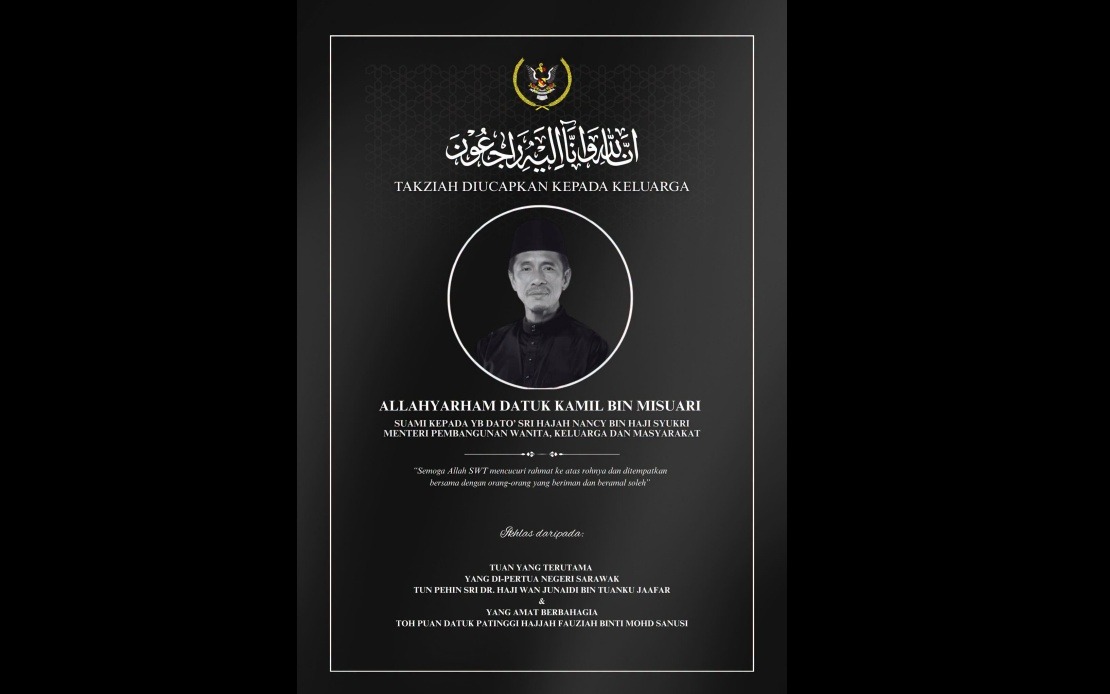
Tun Dr Wan Junaidi Tuanku Jaafar, the Yang Dipertua Negeri Sarawak, has expressed his deepest sympathies to Women, Family and Community Development Minister Datuk Seri Nancy Shukri following the passing of her husband, Datuk Kamil Misuari. The 65-year-old died at a medical facility in Kuala Lumpur on June 18, according to an announcement from the minister's office. A statement issued by Astana Sarawak conveyed the official condolences from Sarawak's chief executive and his wife, Toh Puan Fauziah Mohd Sanusi.
In his message of sympathy, the Yang Dipertua Negeri prayed that divine blessings would be granted to the deceased's soul, that his righteous deeds would be acknowledged, and that he would be placed among the virtuous. The statement further noted that Tun Dr Wan Junaidi and Toh Puan Fauziah extended their prayers that Datuk Seri Nancy and her family would find the inner strength, resilience, and patience necessary to navigate the difficult period of mourning that lay ahead. Such expressions of state support are customary when senior government officials experience personal loss, particularly those serving in prominent ministerial positions.
Datuk Kamil Misuari's remains were scheduled to be transferred to Kuching the following day, with his funeral rites to take place at Samariang Muslim Cemetery in the Sarawak capital. The arrangement to return the deceased to his home state reflects the family's ties to Sarawak, where many of Nancy's extended relatives and community connections remain strong. The repatriation process, while emotionally significant for the grieving family, also underscores the practical considerations that arise when prominent figures pass away, requiring coordination between federal and state authorities.
The couple had been married since 1985, building a life together spanning nearly four decades. Their union was blessed with three children, who will now navigate their loss alongside their mother during this challenging period. Datuk Kamil's long marriage to Nancy, who has held various ministerial portfolios over her political career, meant he had been part of the higher echelons of Malaysia's political establishment for many years, though largely in a private capacity.
Nancy Shukri's role as Women, Family and Community Development Minister places her among Malaysia's prominent female political figures. The ministry oversees significant portfolios related to family welfare, women's empowerment, and community development across the country. The loss of a spouse while holding such a demanding public position presents particular challenges, as Shukri must continue her ministerial responsibilities while grieving privately. Her colleagues in government have acknowledged this difficult balance by extending formal expressions of support.
The death of Datuk Kamil Misuari also touches on broader themes about the personal lives of Malaysia's political leadership and how public figures manage private tragedies. Members of the cabinet and government officials face unique pressures when experiencing loss, as their grief occurs within the public domain, with formal condolences from state institutions forming part of the record. This formality, while important for acknowledging the deceased and supporting the bereaved, also reflects Malaysia's hierarchical governmental structures and protocols surrounding ministerial-level losses.
Sarawak's gesture through the Yang Dipertua Negeri represents recognition of the connection between federal and state leadership structures. Though Nancy Shukri is based in Kuala Lumpur as a federal minister, her family's ties to Sarawak—evident from the decision to lay Datuk Kamil to rest there—mean that state-level acknowledgement of his passing carries genuine significance. The involvement of Sarawak's chief executive in conveying official sympathies demonstrates the courtesy and respect that characterizes interactions between senior government figures across Malaysia's federal system.
The circumstances surrounding Datuk Kamil's death at a Kuala Lumpur hospital, followed by his repatriation to Sarawak, highlight patterns common among Malaysia's political elite, whose professional lives are often centered in the capital while family roots and burial preferences remain in their home states. This geographical dimension of grief and remembrance is particularly pronounced in Malaysian society, where connections to one's state of origin remain deeply important even after decades of residence elsewhere.
As Nancy Shukri mourns her husband's loss, her experience reflects the intersection of personal tragedy and public duty that characterizes life in Malaysia's senior political circles. The formal condolences from the Yang Dipertua Negeri and other state leaders serve not only to express sympathy but also to signify institutional recognition of the minister's continued service during a period of personal difficulty. The support extended by Sarawak's leadership, in particular, acknowledges the enduring bonds between the state and its native sons and daughters who have gone on to serve in national roles.

