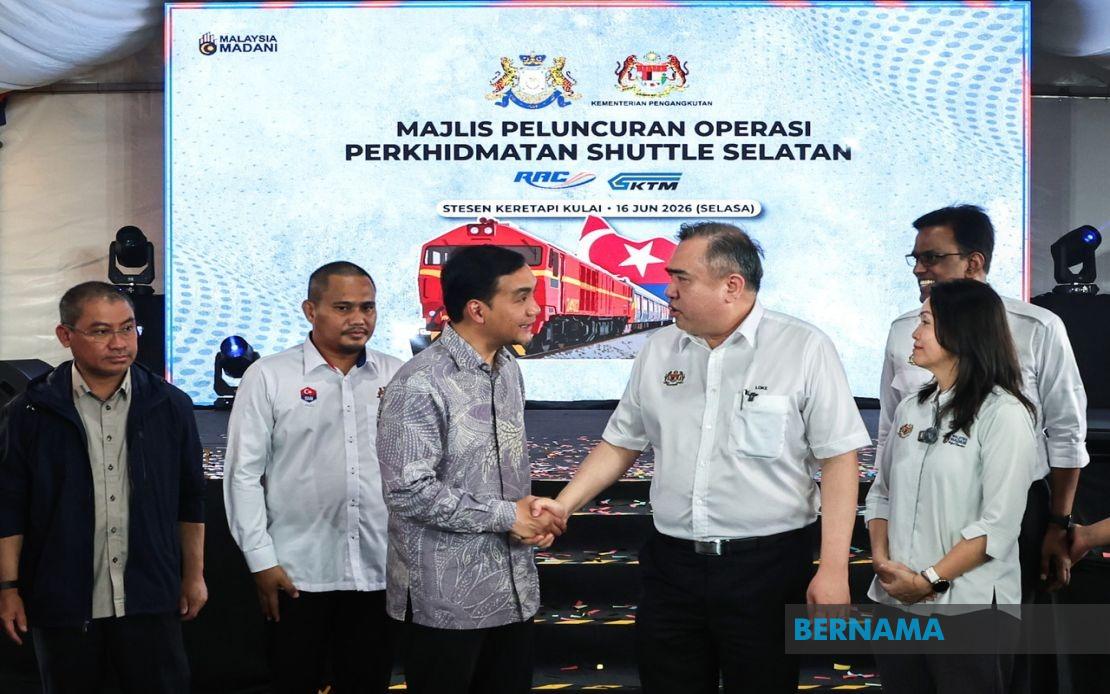
The Shuttle Selatan service, a regional rail initiative spanning Kulai, JB Sentral and Pasir Gudang, commenced operations this week, positioning itself as a significant transport solution for a population base exceeding two million residents across southern Johor. Transport Minister Anthony Loke inaugurated the service at Kulai KTM station, underscoring the government's commitment to strengthening public transit infrastructure in one of Malaysia's most economically dynamic regions. The launch reflects a broader strategic effort to enhance connectivity between residential concentrations, commercial districts and industrial clusters that form the economic backbone of Johor's continued expansion.
Initially, two core routes structure the service network: the Kulai-JB Sentral-Kulai corridor and the Kempas Baru-Pasir Gudang-Kempas Baru line. These pathways represent critical linkages addressing commuter patterns within the state's established population and employment centres. Journey times prove competitive with existing transport modes, with the Kulai to JB Sentral segment requiring approximately 40 minutes, while the Kempas Baru to Pasir Gudang run takes between 40 to 45 minutes. Such efficiency gains reflect investment in rail-based infrastructure designed to reduce travel times and enhance passenger comfort relative to conventional road-based alternatives.
The government has signalled ambitious territorial expansion through planned extension of service lines from Paloh to Kulai via intermediate stations at Kluang, Renggam and Layang-Layang. This projected growth would substantially broaden geographic coverage and capture additional commuter populations across Johor's southern districts. Complementing route expansion, three additional stations—Taman Daya, Bandar Baru Sri Alam and Pasir Putih—remain under development planning. These infrastructure additions seek to democratise access to rail transport, ensuring that smaller residential enclaves benefit from modern public mobility options rather than remaining peripheral to urban transit networks.
Facilitating seamless journeys requires attention to first- and last-mile connectivity challenges that frequently constrain public transport adoption. The transport ministry has therefore implemented an integrated support ecosystem comprising feeder bus services, coordination with Bas.My route networks, a dedicated shuttle at Kempas Baru station, and park-and-ride facilities anchored at AEON Bandar Dato' Onn. This multi-modal approach acknowledges that rail services alone prove insufficient; complementary transport layers must connect residential and workplace origins to rail stations, removing friction from passenger journeys and rendering public transport genuinely competitive with private vehicle use.
To accelerate behavioural shifts toward public transport patronage, the government introduced the Commuter MADANI Shuttle Selatan Card programme. The initiative distributed 3,000 cards at no cost to Johor residents, each card loaded with RM50 purchasing power permitting unlimited travel on Shuttle Selatan services for designated periods. The Railway Assets Corporation committed more than RM150,000 as financial incentive backing this subsidy structure, effectively reducing perceived costs and trials barriers for potential passengers evaluating transit alternatives. Such demand-stimulation measures reflect recognition that infrastructure provision alone generates insufficient adoption without addressing psychological and economic barriers that favour established commuting habits.
Johor's rapid industrialisation, diversifying economic base and expanding footprint across industrial manufacturing, logistics operations, port facilities, tertiary education campuses and international trade activities create mounting transport demand that existing infrastructure struggles to accommodate efficiently. The state's growth trajectory, among Malaysia's fastest-expanding regional economies, generates increasing complexity in mobility requirements spanning workers, students, suppliers and customers distributed across multiple nodes. Shuttle Selatan responds directly to this operational necessity by establishing rail-centred connectivity between residential populations and distributed economic activity clusters, reducing congestion pressures on road networks while enhancing worker accessibility to employment opportunities.
The service architecture explicitly targets strengthening connections amongst three functionally distinct zones: Kulai's emerging residential and industrial periphery, JB Sentral's consolidated urban commercial core, and Pasir Gudang's established petrochemical and manufacturing concentration. By linking these complementary zones through rapid rail transit, the service facilitates labour market integration, enabling workers based in outer residential areas to access JB Sentral's commercial employment and downstream industrial opportunities in Pasir Gudang. This geographical connectivity hypothesis recognises that regional economic dynamism depends upon efficient internal mobility permitting human capital deployment across distributed production and service locations.
Implementation success reflects sustained cooperation amongst the Ministry of Transport, Keretapi Tanah Melayu Berhad (KTMB) as operational entity and the Railway Assets Corporation (RAC) managing institutional frameworks. This governmental and quasi-governmental alignment demonstrates coordinated commitment to infrastructure delivery, suggesting that political prioritisation and organisational alignment can translate into operational outcomes. For Malaysian readers and Southeast Asian observers, the Shuttle Selatan launch illustrates how medium-scale rail infrastructure investments, when integrated with complementary services and incentive mechanisms, can generate transport alternatives in metropolitan and sub-metropolitan contexts increasingly constrained by private vehicle congestion.
The broader implications extend beyond Johor's immediate transport challenges. The service represents experimentation with rail-centric urban mobility models gaining traction across Southeast Asia as urbanisation and congestion prompt alternatives to automobile-dependent development patterns. Success metrics from Shuttle Selatan—measured through ridership adoption, revenue sustainability and commuter satisfaction—will inform future regional public transport investment strategies across Malaysia and neighbouring economies. Furthermore, the subsidy programme and multi-modal integration framework offer templates potentially applicable to other Malaysian states expanding transit networks, suggesting that Shuttle Selatan functions simultaneously as practical transport solution and policy innovation demonstrating viable approaches to regional connectivity challenges that transcend Johor's particular context.

