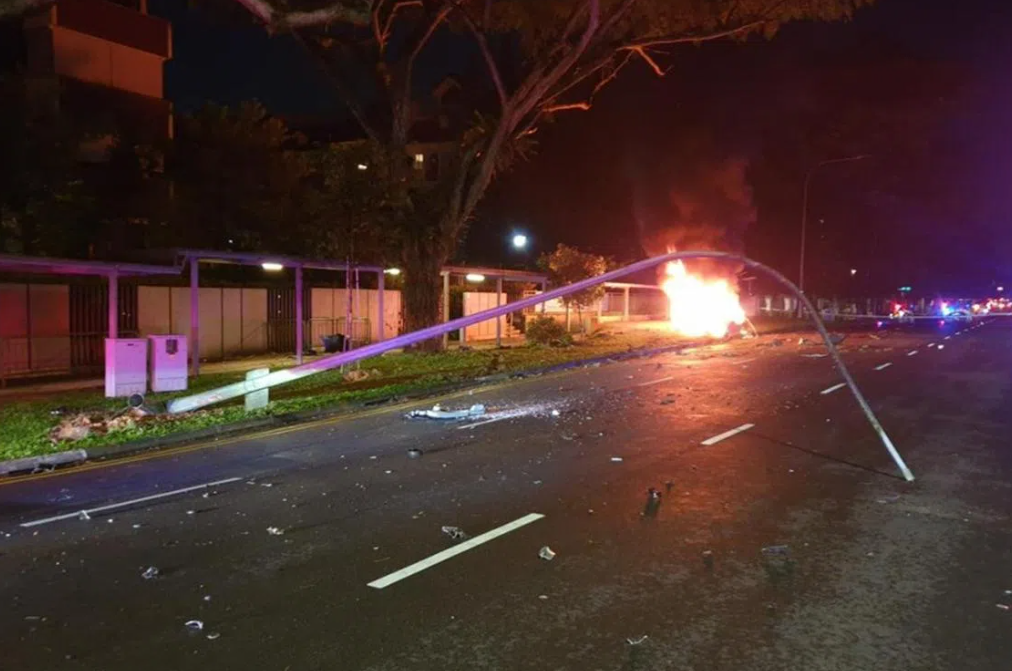
A Singaporean man has been charged with drink driving and five related offences following a reckless driving incident in March that endangered schoolchildren on a bus and resulted in his vehicle catching fire. Aaron Tan Yao Cong, 29, faces serious criminal charges after the early morning collision on Bukit Timah Road on March 6, 2024, which left a nine-year-old and a ten-year-old passenger requiring medical attention alongside the bus driver.
The incident began at 5.50am when Tan ignored a traffic sign instructing drivers to proceed straight along Cavenagh Road towards Bukit Timah Road. Instead of complying, he negotiated a left bend and drove directly into oncoming traffic, eventually stopping on the left side of the two-lane road. Despite this initial dangerous manoeuvre, the situation escalated dramatically within minutes. Tan and three passengers managed to escape from his vehicle at this stage, but his actions did not end there.
At 6am, as police officers approached the stationary vehicle, Tan inexplicably accelerated away from the scene. Over the next sixteen minutes, he drove recklessly along Bukit Timah Road towards Upper Bukit Timah Road, weaving dangerously between vehicles and maintaining an average speed of 114kmh between Coronation Road and Anamalai Avenue. His erratic driving pattern suggested either complete disregard for road safety or a driver impaired by substance use.
The collision itself occurred at the junction of Sixth Avenue at 6.16am when Tan failed to stop at a red traffic light. His vehicle struck a private bus that was executing a U-turn at the intersection. The impact was sufficiently severe to cause Tan's car to hit a nearby lamp post immediately afterwards, triggering a fire that engulfed the vehicle. Tan and his three passengers evacuated safely, though the occupants of the bus—the driver and his two young passengers aged nine and ten—required hospital treatment for injuries sustained in the crash.
Forensic evidence gathered following Tan's arrest revealed alcohol consumption significantly above Singapore's legal driving limit. Tan initially refused to submit to a breathalyser test at the scene, a refusal that itself constitutes a separate criminal offence. Subsequent blood analysis showed his blood alcohol concentration at approximately 148 milligrams per 100 millilitres of blood, nearly twice the prescribed legal limit of 80 milligrams per 100 millilitres. This chemical evidence of impairment helps explain the dangerous nature of his driving pattern that morning.
Tan's criminal history aggravates his current predicament considerably. Court documents reveal that he was previously convicted of drink driving in 2019, along with a separate conviction for driving without due care and attention in the same year. This prior record means prosecutors can pursue enhanced sentencing for repeat offences across multiple charges he now faces. He appeared in court on Thursday, June 18, where he was formally charged with five distinct offences: drink driving, dangerous driving causing hurt, leaving a vehicle in a position likely to cause danger to others, failing to cooperate with breathalyser testing, and driving against the flow of traffic.
Tan did not indicate how he intended to plead to any of the five charges during his initial court appearance. His case has been adjourned until July 16, when further proceedings are scheduled. The delay provides time for defence counsel to review evidence and for prosecutors to consolidate their case documentation.
The potential penalties Tan faces are substantial and reflect Singapore's serious approach to drink-driving offences, particularly those endangering vulnerable road users. For the drink-driving charge as a repeat offender, he faces up to two years imprisonment and a fine of up to S$20,000. The dangerous driving causing hurt charge carries imprisonment for up to two years, a fine of S$10,000, or both, with repeat offenders facing enhanced penalties of up to S$20,000 in fines and two years imprisonment.
Additional charges carry more modest but still significant penalties. Leaving his vehicle in a position likely to cause danger exposes him to up to three months imprisonment, a S$1,000 fine, or both. His refusal to provide a breath specimen when legally required attracts up to six months imprisonment, a S$5,000 fine, or both, with repeat offenders facing up to one year imprisonment and S$10,000 in fines. The charge of driving against traffic flow carries up to three months imprisonment and S$1,000 fine for a first offence, or up to six months imprisonment and S$2,000 fine for repeat offenders.
The case highlights the cascading dangers created by impaired driving at high speeds in urban environments. Tan's actions placed not only himself and his three passengers at risk but also innocent civilians—particularly children—who were simply commuting on public transport. The involvement of young passengers underscores why enforcement of drink-driving laws remains critical across Southeast Asia, where road safety records remain a concern for many nations.
For Malaysian road safety advocates, the Singapore case provides a sobering reminder of enforcement mechanisms and sentencing frameworks that prioritise deterrence. While Malaysia has its own drink-driving laws and penalties, comparative analysis of enforcement outcomes in jurisdictions like Singapore can inform discussions about whether current Malaysian penalties sufficiently deter recidivist offenders. The fact that Tan had prior drink-driving convictions yet continued this behaviour suggests that penalties in some jurisdictions may not yet achieve optimal deterrent effect.
The incident also raises questions about how rapidly-evolving transportation patterns intersect with road safety. The involvement of a school bus carrying young passengers points to the particular vulnerability of designated school transport routes and timetables, which criminal actors or impaired drivers might inadvertently target during early morning hours when traffic is lighter and speeds consequently higher. Public transport operators and school administrators throughout the region may review their safety protocols in light of such incidents.

