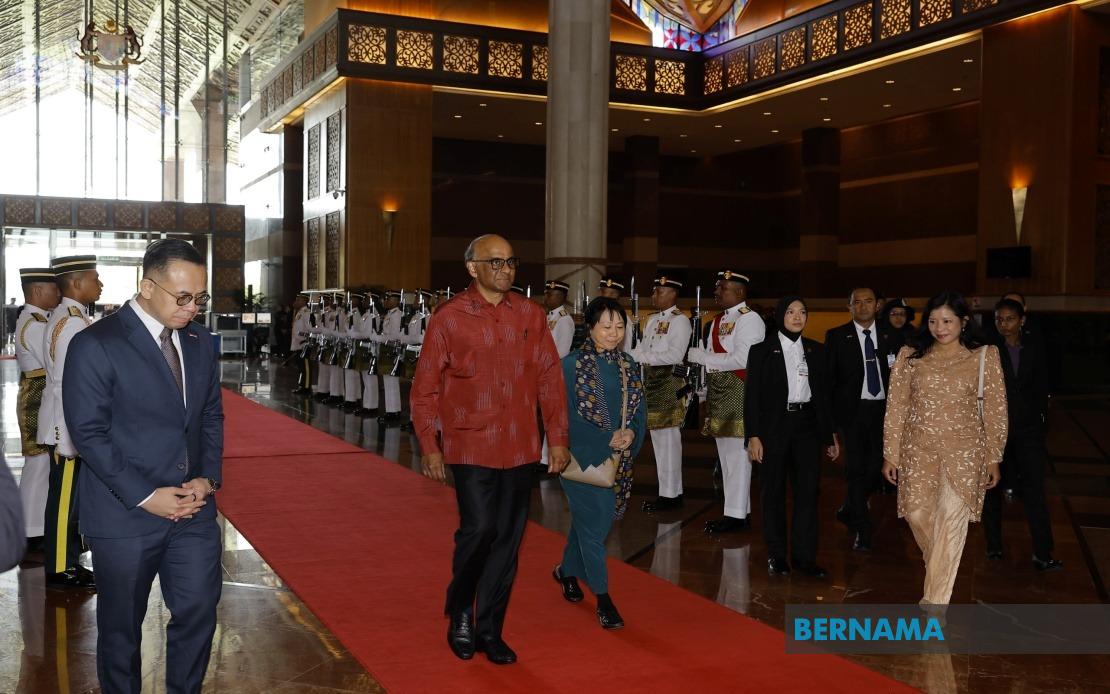
Singapore President Tharman Shanmugaratnam and his delegation departed Malaysia on Monday afternoon, marking the end of a significant three-day state visit that has reinforced the diplomatic bonds between the two neighbouring nations. Tharman, accompanied by his spouse Jane Ittogi, left from Kuala Lumpur International Airport Terminal 1 at 2.20 pm on a commercial flight returning to Singapore, bringing to a close a carefully choreographed exchange that highlighted the enduring partnership between two of Southeast Asia's most economically advanced countries.
The departure was marked with ceremonial protocol befitting a visiting head of state. Upon arriving at the Bunga Raya Complex at KLIA at 1.45 pm, Tharman was accorded a static Guard of Honour comprising two officers and 26 personnel from the First Battalion of the Royal Ranger Regiment under the command of Captain Muhammad Hanafi Ja'afar. Minister of Entrepreneur and Cooperatives Development Steven Sim attended the farewell ceremony, representing the Malaysian government in bidding the Singapore delegation goodbye.
This state visit, which commenced on Sunday following an invitation from His Majesty Sultan Ibrahim, King of Malaysia, carries particular significance as it represents Tharman's inaugural official visit to Malaysia since he assumed the presidency of Singapore on September 14, 2023. The timing and substance of the visit underscore the importance that both nations attach to maintaining robust governmental connections at the highest levels, particularly given their geographical proximity and deeply intertwined economic interests.
The visit functions as a formal reciprocation of Sultan Ibrahim's state visit to Singapore on May 6 and 7, 2024, reflecting a tradition of regular high-level exchanges that characterise Malaysia-Singapore relations. These reciprocal visits serve as opportunities for both countries to reaffirm their commitment to cooperation across multiple domains, from trade and investment to security and cultural exchange. The continuity of such state visits demonstrates that despite occasional tensions, the two nations maintain structured diplomatic channels and mutual respect.
During his time in Malaysia, Tharman participated in a series of official engagements that showcased the breadth of bilateral interaction. On Monday, he was accorded a full state welcoming ceremony, a formal recognition that underscored Malaysia's hospitality and respect for the visiting dignitary. This was followed by a formal audience with Sultan Ibrahim at Istana Negara, a key meeting where matters of national importance and bilateral interest are typically discussed.
The Singapore President also received a courtesy call from Prime Minister Datuk Seri Anwar Ibrahim, an engagement that allowed the two leaders to discuss matters of mutual concern and shared interest. The presence of Foreign Minister Datuk Seri Mohamad Hasan, Investment, Trade and Industry Minister Datuk Seri Johari Abdul Ghani, and Entrepreneur and Cooperatives Development Minister Steven Sim at this meeting reflected the significance attached to the engagement, with ministers representing portfolios critical to bilateral relations including diplomacy, commerce, and economic development.
Beyond the federal level, the visit extended to state-level engagement, demonstrating the comprehensive nature of Malaysia-Singapore interaction. On the final full day of his visit, the Sultan of Selangor, Sultan Sharafuddin Idris Shah, granted an audience to Tharman at Istana Alam Shah. Such engagements at the state level are important as they foster people-to-people and institution-to-institution connections that supplement federal diplomatic efforts and strengthen the overall bilateral relationship.
The structure and progression of Tharman's visit reflect established protocols for state visits between Malaysia and Singapore, countries that despite their small individual sizes wield disproportionate influence in regional affairs. Both nations are founding members of the Association of Southeast Asian Nations and play crucial roles in regional stability, trade, and security architecture. Visits at the presidential and monarchical levels serve to signal the health and trajectory of bilateral relations to both domestic and international audiences.
From a Malaysian perspective, hosting Singapore's head of state reinforces the country's role as a responsible regional actor and underscores its commitment to maintaining stable, mutually beneficial relations with its closest neighbour. Singapore, as a small island city-state, relies heavily on cooperative relations with surrounding nations for access to water, trade routes, and regional stability. Malaysia, with its larger territorial expanse and population, has an interest in ensuring that bilateral relations remain constructive and free from discord that could disrupt trade, investment flows, or regional security.
The visit occurs against a backdrop of Malaysia and Singapore navigating various outstanding issues and shared challenges, from maritime boundary considerations to water agreements and transport connectivity. Through state visits and high-level engagements, both countries maintain the diplomatic machinery necessary to address disagreements through dialogue rather than confrontation. The presence of senior ministers from commerce and trade portfolios suggests that economic cooperation remains a primary focus of bilateral engagement.
For Southeast Asia more broadly, the maintenance of strong Malaysia-Singapore relations has significance beyond the bilateral context. The two countries' ability to cooperate effectively contributes to broader regional stability and demonstrates that nations with differing characteristics—Malaysia as a multiethnic federal monarchy and Singapore as a city-state republic—can build lasting partnerships based on mutual interest and shared values. Their relationship serves as a model for constructive engagement within a region characterised by diverse political systems and historical experiences.
As Tharman returned to Singapore following the conclusion of his visit, both nations could regard the exchange as a successful affirmation of their commitment to deepening ties across economic, cultural, and diplomatic spheres. The visit reinforced that despite occasional public disagreements on specific issues, Malaysia and Singapore remain committed to a framework of cooperation that benefits both populations and contributes to regional prosperity and stability.

