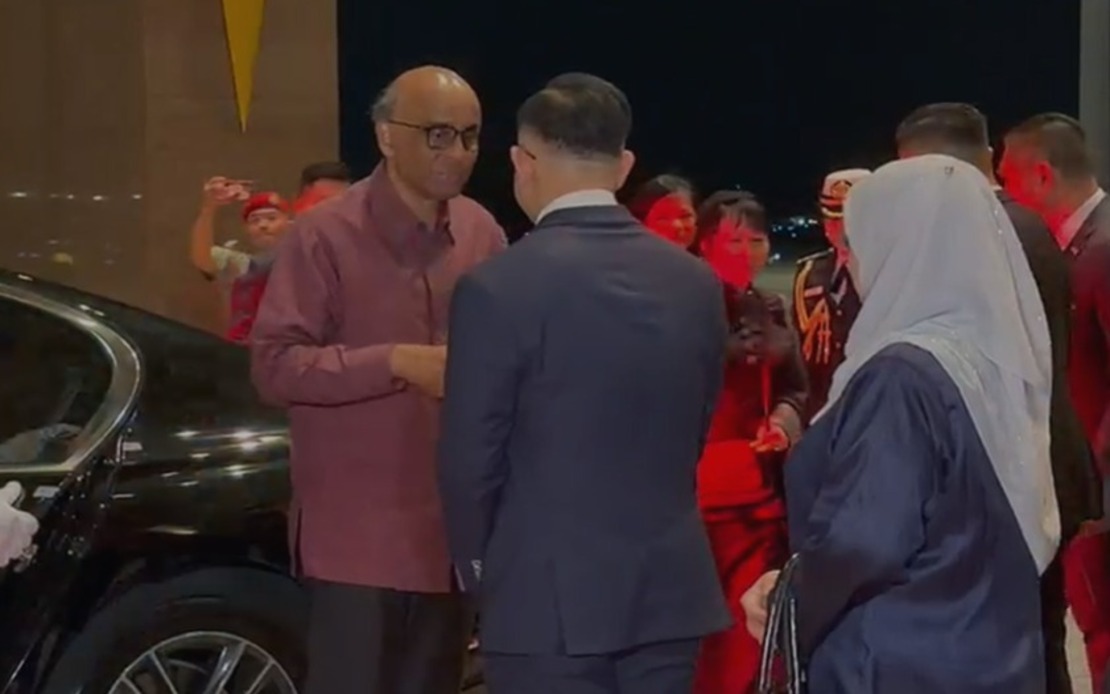
Singapore President Tharman Shanmugaratnam touched down at Kuala Lumpur International Airport on Friday evening, beginning a three-day state visit to Malaysia that runs through July 15. Accompanying him is his spouse, Jane Ittogi, as the presidential entourage arrived at Terminal 1 at 9.19 pm following an invitation extended by His Majesty Sultan Ibrahim, King of Malaysia. The visit marks a significant diplomatic engagement between two of Southeast Asia's most economically developed nations, coming as both countries navigate evolving regional dynamics and deeper cross-border integration.
Official ceremonies marked the arrival, with a ceremonial guard of honour comprising personnel from the First Battalion of the Royal Ranger Regiment lined up to receive the distinguished guests. Minister of Entrepreneur and Cooperatives Development Steven Sim Chee Keong served as the receiving minister, underscoring the economic dimensions of the visit. Singapore High Commissioner to Malaysia Vanu Gopala Menon was similarly present, reflecting the diplomatic weight attached to this engagement. The formal reception protocol demonstrated the respect accorded to the Singapore presidency and the importance both governments place on maintaining warm bilateral relations.
This state visit carries particular symbolic significance as Tharman's inaugural trip to Malaysia in his official capacity since assuming the presidency on September 14, 2023. His assumption of office represented a notable transition in Singapore's political leadership, and this Malaysian visit provides an early opportunity to reinforce connections between the two heads of state and their respective administrations. The timing of the visit, coming roughly nine months into his presidency, reflects both nations' commitment to maintaining the momentum in their relationship despite the regular transitions that occur in political leadership.
According to the Malaysian Ministry of Foreign Affairs, the visit is structured to reinforce what officials describe as the enduring partnership between Singapore and Malaysia, with scheduled engagements designed to demonstrate the breadth of cooperation. Tomorrow's agenda includes a State Welcoming Ceremony at Istana Negara followed by a formal audience with His Majesty. The evening programme will feature a State Banquet honouring the Singapore president and his delegation, with Prime Minister Datuk Seri Anwar Ibrahim scheduled to pay a courtesy call. These ceremonial and official engagements reflect standard protocol but equally serve to reaffirm political will and personal relationships at the highest levels.
The economic dimension of the Malaysia-Singapore relationship provides crucial context for understanding the importance of such high-level visits. Singapore stands as Malaysia's second-largest global trading partner, while simultaneously holding the position of Malaysia's most significant trading partner within the ASEAN bloc. This dual position reflects the intensity and breadth of commercial activity flowing across the shared border and maritime boundaries. The two economies are deeply intertwined through investment flows, labour mobility, and supply chain integration that have developed over decades of close cooperation.
Bilateral trade figures underscore this economic interdependence with striking clarity. In 2025, total bilateral commerce reached RM402.35 billion, equivalent to approximately US$93.97 billion, registering growth of 1.5 per cent against the previous year. More impressively, the five-month period from January through May 2026 recorded trade valued at RM189.90 billion (US$47.87 billion), representing a robust 14.5 per cent increase compared to the corresponding months in 2025 when trade stood at RM165.93 billion (US$37.65 billion). These acceleration trends suggest strengthening economic momentum and expanding commercial opportunities between the neighbours.
The growth trajectory evident in recent trade data carries implications for both economies and for the broader Southeast Asian region. For Malaysia, the expansion of commerce with Singapore reflects opportunities in financial services, petrochemicals, manufacturing, and technology sectors where complementarities exist. For Singapore, trade with Malaysia remains critical to accessing raw materials, securing manufacturing hinterland, and maintaining supply chain resilience. The acceleration in growth rates between 2025 and the first half of 2026 suggests that trade recovery is moving beyond mere stabilisation into genuine expansion, potentially driven by post-pandemic normalisation and increased regional confidence in bilateral arrangements.
From a Malaysian perspective, maintaining and deepening the Singapore relationship carries strategic weight extending beyond pure economics. The city-state functions as a critical regional financial hub and technology centre, and sustained engagement provides pathways for Malaysian businesses to access global markets and expertise. Equally, the relationship requires careful management given historical sensitivities and occasional divergences in approaches to regional issues. High-level visits such as Tharman's state visit serve to reinforce institutional bonds and provide forums where both governments can address concerns and identify new areas for cooperation.
The current geopolitical environment adds salience to this visit. Regional concerns about supply chain resilience, technological competition, and maritime security have intensified since the pandemic. Both Malaysia and Singapore share interests in maintaining freedom of navigation, particularly through critical waterways including the Strait of Malacca, and in ensuring that regional disputes are managed through established diplomatic channels rather than unilateral actions. The state visit provides an occasion to discuss such strategic matters beyond formal trade negotiation frameworks.
Looking beyond the immediate agenda, the visit also reflects broader ASEAN dynamics and both countries' roles within that grouping. Singapore and Malaysia, despite their different political systems and development models, have consistently worked to advance ASEAN interests and maintain the grouping's centrality in regional architecture. President Tharman's visit offers opportunities to coordinate positions on emerging regional issues and to reinforce the relevance of ASEAN cooperation in an increasingly complex geopolitical landscape.
The structure of the visit, with its blend of ceremonial engagements and substantive business meetings, suggests that both governments intend to use the occasion for more than symbolic purposes. While the formal ceremonies acknowledge the importance of the relationship and demonstrate respect for Singapore's presidency, the substantive meetings between senior officials will likely address specific cooperative initiatives, investment approvals, and strategic discussions that drive tangible results. Such visits typically generate agreed statements or joint declarations outlining shared priorities and new commitments across various sectors.
As Malaysia and Singapore navigate an evolving regional environment characterised by technological change, economic restructuring, and shifting geopolitical alignments, sustained engagement at the highest levels remains essential. President Tharman's three-day visit exemplifies this commitment and provides an opportunity for both nations to reaffirm their dedication to deepening partnership while addressing contemporary challenges. The strong trade growth evident in recent data suggests that the economic foundations supporting the relationship remain robust, while the ceremonial aspects of the visit reinforce the political will necessary to maintain this important bilateral arrangement.

