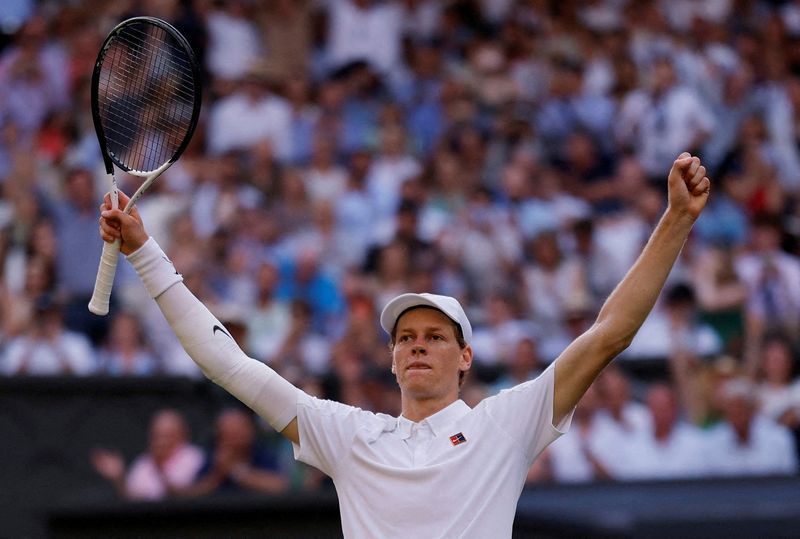
Jannik Sinner arrives at Wimbledon with considerably diminished momentum, the defending champion now burdened by doubt after a stunning collapse at the French Open disrupted what had seemed an unstoppable ascent through professional tennis. The world number one's carefully constructed image of dominance—built on a 30-match winning streak that began in February—crumbled spectacularly when he exited Roland Garros in the second round last month, forcing the 24-year-old to confront uncomfortable questions about whether his physical condition can withstand the unique demands of Grand Slam competition.
The Italian's struggles in Paris stemmed from the punishing schedule that preceded the tournament rather than any fundamental weakness in his game or mental fortitude. According to veteran analyst Mats Wilander, the seven-times Grand Slam champion had simply exhausted himself through competing intensively over two months with insufficient recovery time. Wilander's assessment suggests that Sinner's French Open exit represented burnout rather than a shift in the broader competitive landscape, though the timing proved particularly damaging given the psychological weight carried by defending a major championship.
Sinner deliberately opted to skip warm-up tournaments before Wimbledon begins at the All England Club on Monday, a strategic decision that speaks to his coaching team's recognition that rejuvenation trumps tournament preparation. This unconventional approach underscores the severity of his physical depletion and signals confidence that rest and focused practice will restore him to the standard that made him the circuit's most feared player through the first half of 2024. Yet the decision also creates an opening for rivals who will scrutinize carefully how the defending champion adapts to grass during his first competitive matches in weeks.
Despite these complications, Wilander maintains that Sinner remains the man to beat in the absence of injured rival Carlos Alcaraz, whose victories at Wimbledon in 2023 and 2024 had established him as the surface's most dominant force. However, Wilander cautioned that grass presents inherent unpredictability—a surface where even the world's finest players must continuously adjust their games. The All England Club's lightning-fast courts reward aggressive serving and net play in ways that differ sharply from the methodical baseline exchanges that defined Sinner's clay-court brilliance.
No figure looms larger over Sinner's title defence than Novak Djokovic, whose legendary movement and return-of-serve capabilities make him formidable on grass despite his 39 years. The Serbian legend seeks both an eighth Wimbledon championship—which would match Roger Federer's unparalleled record—and an elusive 25th Grand Slam title outright. With time clearly running out during the twilight of his extraordinary career, Wimbledon represents perhaps his final realistic opportunity to achieve both milestones simultaneously.
Djokovic's own French Open exit in the early rounds might ordinarily suggest fading form, yet former champion Andy Roddick dismissed such conclusions as premature. Speaking on his podcast, Roddick argued that Djokovic approaches Wimbledon with fresh hunger and clarity about his remaining window for glory, viewing the grass-court fortnight as genuinely winnable despite the presence of Sinner. Roddick's reasoning rested on Djokovic's unmatched grass-court credentials and the psychological advantage of perceiving an opponent—however temporarily—as vulnerable rather than invincible.
Alexander Zverev emerges as perhaps the most improved contender following his breakthrough French Open victory, which delivered the German his first Grand Slam title at age 29. The American-born player's powerful serve and improving movement translate ideally to grass conditions, precisely the attributes that Boris Becker identified as decisive at Wimbledon. Becker, himself a six-times major winner, provocatively suggested that Zverev now represents the tournament favourite given Alcaraz's absence and genuine uncertainty surrounding Sinner's readiness.
Becker's assessment carries weight because it reflects understanding of grass-court requirements that transcend mere rankings. The surface rewards specific skill sets—explosive serving, aggressive net approach, decisive striking—that Zverev possesses in abundance. Becker noted that possessing an elite serve essentially grants any player a semi-final berth at Wimbledon, provided they execute fundamentally sound grass-court strategy. Zverev certainly qualifies on that criterion, making his transition from clay-court success arguably more straightforward than Sinner's.
Alcaraz's injury-enforced absence creates a structural vacuum in the draw that shapes the competitive landscape dramatically. The Spaniard's dominance over the preceding two Wimbledons represented a generational statement about superiority on the fastest surface, and his removal genuinely opens pathways for a broader range of challengers. American prospects including Ben Shelton, Taylor Fritz, and Frances Tiafoe suddenly command more realistic title scenarios than they might otherwise enjoy, while Roland Garros runner-up Flavio Cobolli leads an emerging wave of players positioned to advance deeper than typical.
This expanded competitive window raises intriguing possibilities for unpredictability at the Championships. Whereas Alcaraz's presence might have narrowed the tournament to a confrontation between established elite players, his absence permits the emergence of less predictable champions. The grass may yet humble Sinner and frustrate Djokovic's ambitions while Zverev consolidates his breakthrough, or alternatively the defending champion might employ the respite to reestablish his authority with renewed intensity and conviction.

