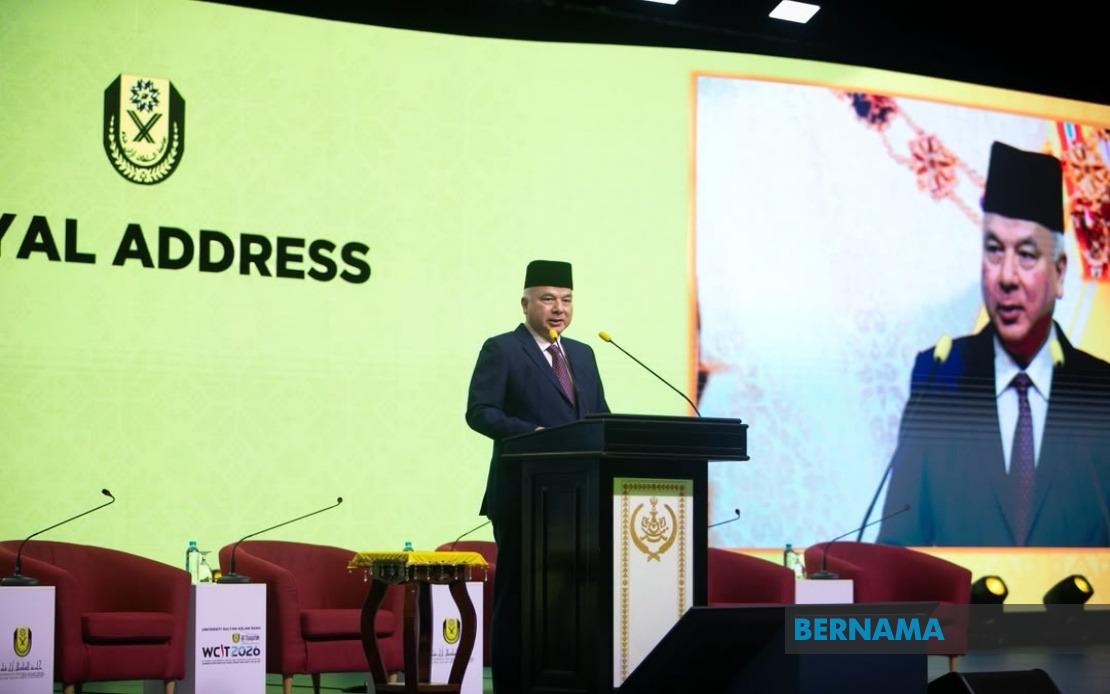
In a keynote address at Malaysia's premier gathering on Islamic thought, Sultan Nazrin Shah has repositioned the definition of national security away from conventional military and counter-terrorism measures towards the more fundamental issue of social unity and citizens' sense of belonging. Speaking at the 8th World Conference on Islamic Thought and Civilisation in Ipoh on July 21, the Sultan of Perak articulated a vision of security that transcends the traditional boundaries of border defence and cyber-threat management, arguing instead that the resilience of a nation ultimately hinges on whether its people feel genuinely included in its political and economic structures.
The Sultan's intervention comes at a critical moment for Southeast Asia, where rapid economic change, demographic shifts, and the rise of identity-based politics have strained the social fabric of several nations. Malaysia, with its multicommunal character and history of intercommunal tensions, serves as a particular test case for whether diverse societies can be bound together through institutions and shared values rather than through coercive state apparatus. Sultan Nazrin's framing suggests that no amount of security spending or surveillance infrastructure can substitute for the organic trust that emerges when citizens across ethnic and religious lines perceive themselves as having equal stakes in national prosperity and governance.
A particularly sharp warning in the Sultan's remarks targeted the weaponization of religion for sectarian or factional political advantage. He cautioned explicitly against "the manipulation of faith to justify division rather than unity, exclusion rather than the very inclusion" that contemporary governance should aspire to achieve. This rebuke carries particular resonance in Malaysian politics, where religious issues have repeatedly become flashpoints for mobilization by competing political actors. By framing such exploitation as antithetical to both Islamic principles and national integrity, Sultan Nazrin positioned himself as defending a pluralist interpretation of Islam against its more exclusionary variants—a stance that carries considerable moral weight in Malaysia's constitutional monarchy system.
The Sultan advanced a sophisticated argument linking national integrity to security by insisting that a country secure from external threats yet plagued by internal corruption and systemic injustice has merely "postponed its reckoning." This formulation challenges the conventional security establishment's focus on external and military threats by suggesting that the real vulnerability lies in the delegitimation of institutions through corruption or perceived favouritism. For Malaysia's policymakers, this reasoning implies that anti-corruption efforts and equitable economic development are not merely governance priorities but rather essential components of national defence strategy.
Central to Sultan Nazrin's vision is the concept that unity rooted in genuine shared belonging proves far more durable than unity enforced through coercion. He emphasized that every community must see itself "reflected fairly in its laws, its economy, its schools, and its leadership." This benchmark for genuine inclusion extends beyond token representation to substantive participation in economic opportunities and legislative processes. For Malaysian readers accustomed to debates over affirmative action, economic equity, and political representation, this framing resets the conversation by suggesting that the alternative to inclusive institutions is not merely social friction but eventual state fragility.
The Sultan pivoted to education as the primary mechanism through which the human capital necessary for modern security challenges can be developed. He called for investment in schools and universities that do not merely expand capacity but fundamentally restructure how knowledge is transmitted and skills are cultivated. His particular emphasis on strengthening both sciences and mathematics alongside humanities and arts reflects a recognition that purely technical education, stripped of ethical and cultural grounding, cannot produce the kind of critical thinking required in rapidly changing societies.
A striking element of the Sultan's remarks concerns the obsolescence of industrial-era educational models in the age of artificial intelligence. He argued that rote memorization and standardized testing, adequate for an earlier economy, fail spectacularly in a world where information retrieval is instantaneous and nearly costless. This observation carries particular salience for Malaysia, which has invested heavily in centralized curricula and examination systems. Sultan Nazrin's implicit critique suggests that such approaches may be actively counterproductive in preparing young Malaysians for competition in AI-driven global economies where uniquely human capacities—critical thinking, ethical reasoning, creativity, adaptability—become the true scarcity.
The Sultan further argued that properly conceived Islamic education, grounded in both revelation and rational inquiry, has always cultivated precisely these human capacities that artificial intelligence cannot replicate. This framing attempts to position Islamic educational traditions not as antagonistic to modernity but as inherently aligned with the adaptive, reflective thinking that contemporary challenges demand. For Malaysia's Muslim-majority population navigating questions about the relevance of Islamic institutions in secular knowledge domains, this reframing offers intellectual scaffolding for integration rather than compartmentalization.
The Sultan also emphasized the dignity and investment needed for technical and vocational pathways, arguing that a skilled tradesperson should be valued equivalently to a doctor or engineer. This egalitarian stance regarding different career trajectories reflects broader recognition that knowledge-based economies require diverse skill distributions and that artificial hierarchies among educational paths create both practical inefficiencies and social resentment. For Malaysia, which faces skills shortages in vocational sectors even as universities produce graduate unemployment, this perspective suggests that prestige hierarchies may be actively harming human capital development.
The attendance of senior government officials—Deputy Prime Minister Datuk Seri Fadillah Yusof, Perak Menteri Besar Datuk Seri Saarani Mohamad, and Higher Education Minister Datuk Seri Dr Zambry Abd Kadir—at this conference signals official endorsement of the Sultan's vision, though implementation remains uncertain. The remarks by the Sultan effectively set an ambitious intellectual standard against which Malaysia's actual security and education policies can be measured, creating potential tension between the aspirational framework he outlined and the institutional inertia that typically governs policy continuity.
Sultan Nazrin's address ultimately reframes security discourse from a state-centric, militarized paradigm towards a human-centered, socially embedded understanding. By insisting that true security is inseparable from integrity, inclusion, and the cultivation of adaptive human capacities, he has articulated a vision that demands not merely more defense spending but fundamental recalibration of how Malaysia invests in education, manages ethnic and religious relations, and distributes economic opportunity. Whether Malaysian policymakers can translate this framework into concrete institutional change will determine whether the nation successfully navigates the interconnected challenges of social cohesion and economic competitiveness in coming decades.

