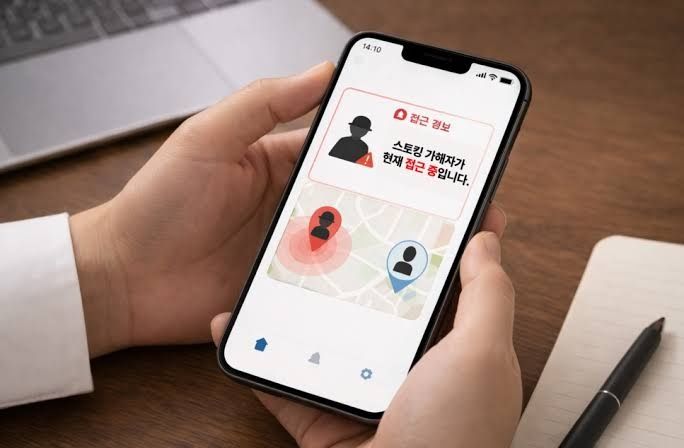
South Korea took a significant step toward modernising victim protection infrastructure on June 24 with the introduction of a mobile application that provides stalking victims with live access to the whereabouts of individuals wearing court-ordered electronic monitoring devices. The system, operated by the Ministry of Justice, represents a technological response to persistent gaps in existing safeguard mechanisms that have failed to prevent tragedy in numerous high-profile cases. The application allows victims to track a suspected stalker's current position and observe their direction of movement in real time, creating a digital buffer between vulnerable individuals and those who have demonstrated predatory behaviour.
The development emerges from growing recognition that conventional victim protection measures have proven insufficient in the face of Korea's persistent stalking epidemic. For years, authorities had distributed smartwatch-type emergency alert devices to at-risk victims, enabling them to trigger immediate police responses when threatened. Yet these passive systems, which depend on victims recognising danger and actively summoning help, have repeatedly failed to prevent fatal outcomes. Government data compiled by Representative Lee Gwang-hee of the ruling Democratic Party of Korea revealed a sobering reality: between 2021 and August 2025, twenty-three victims were either murdered or subjected to attempted murder despite being equipped with these emergency alert devices. This failure rate underscored the urgent need for a more proactive monitoring mechanism that places information directly into victims' hands rather than relying solely on reactive emergency services.
To strengthen enforcement capacity, South Korea began integrating electronic ankle monitoring into its stalking prevention framework during 2024, introducing these devices in particularly dangerous cases through court-mandated orders. Unlike the emergency alert devices, which operated passively, ankle monitors create a permanent record of a suspect's movements and enable continuous supervision. The new mobile application builds directly on this foundation, transforming surveillance data into actionable intelligence accessible to victims themselves. This represents a philosophical shift in victim protection strategy—from waiting for authorities to intervene after danger materialises, to empowering targets with information that allows them to anticipate threats and adjust their behaviour accordingly.
The initiative reflects broader societal concern about stalking prevalence in South Korea, where online harassment and persistent pursuit cases have proliferated alongside increased digital connectivity. Unlike Western jurisdictions where restraining orders and no-contact provisions form the backbone of victim protection, Korea's approach now incorporates technological monitoring as a core element. The tracking application essentially extends the court's oversight into victims' pockets, creating a continuous notification system that alerts them when a suspect approaches their location or exhibits patterns of movement that suggest intent to pursue contact. This capability could prove particularly valuable in preventing the escalation from psychological intimidation to physical violence.
However, the system's rollout required careful navigation of privacy and civil liberties concerns that accompany any government-mandated location tracking programme. To address legitimate apprehensions about surveillance overreach and the potential misuse of location data, the Ministry of Justice undertook a comprehensive revision of regulations governing electronic monitoring in December 2025. These revised protocols establish boundaries around who may access location information, how long data may be retained, and what safeguards prevent unauthorised viewing or secondary disclosure. The balance between victim protection and suspect rights remains delicate—while the individual wearing the monitor is subject to court supervision as consequence of allegations, maintaining transparency and preventing mission creep into broader surveillance remains essential.
The implementation of this application also signals recognition that South Korea's legal framework requires modernisation to match contemporary threat patterns. Traditional criminal justice approaches were designed for an era when stalking largely involved physical proximity and visible pursuit. Contemporary stalking, however, frequently involves digital harassment, coordinated online campaigns, and hybrid approaches combining virtual and physical intimidation. A real-time location application addresses only the physical surveillance component, but it represents acknowledgment that victims themselves must become information partners in their own protection rather than passive objects waiting for the state to protect them.
Looking ahead, the government has announced plans to introduce additional systemic reforms. Beginning in April 2027, the Justice Ministry intends to establish a direct petition mechanism allowing stalking victims to apply directly to courts for restraining orders, circumventing the requirement to work through law enforcement agencies as intermediaries. This reform addresses another significant bottleneck in the current system—police agencies sometimes decline to file formal restraining order requests based on their own assessment of case severity, potentially leaving victims without legal recourse even when they believe threats are escalating. By enabling direct victim petitions, the reform democratises access to judicial protection and reduces the discretionary power of law enforcement officials to determine whose cases merit formal intervention.
For Malaysia and other Southeast Asian jurisdictions grappling with similar stalking and harassment challenges, South Korea's approach offers instructive lessons despite significant cultural and legal differences. The willingness to deploy technology as a protective tool, combined with careful privacy safeguards and systematic victim empowerment, suggests a framework worth examining. Many regional countries face inadequate victim protection infrastructure and rely primarily on criminal prosecution after harm occurs rather than prevention beforehand. South Korea's integrated model—combining electronic monitoring, real-time tracking applications, and direct court access—demonstrates how technology can be harnessed to shift protection from reactive to proactive, provided appropriate oversight mechanisms accompany such systems.
The success of South Korea's initiative will likely depend on consistent implementation, regular review of the technology's effectiveness, and continued refinement based on victim feedback and outcome data. Early months of the application's deployment will reveal whether real-time location access genuinely deters stalking behaviour or simply provides valuable early warning that victims can use to secure themselves. Additionally, the system's effectiveness may vary significantly depending on whether courts consistently impose electronic monitoring in appropriate cases and whether victims actually receive devices and access to the application.

