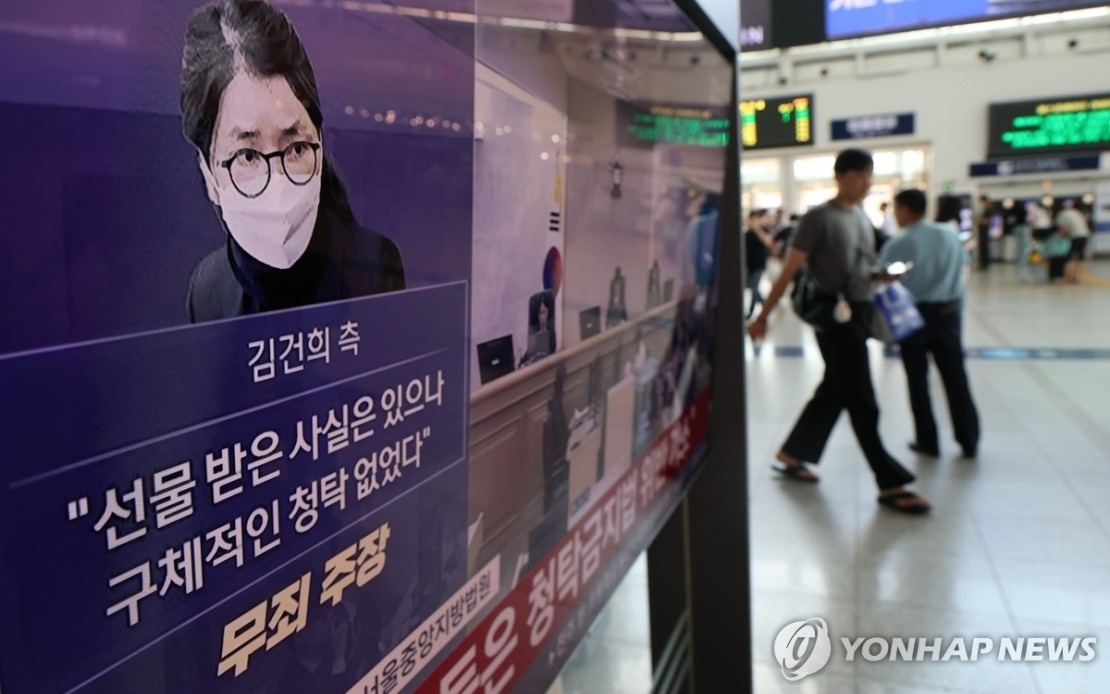
A Seoul court has handed down a seven-year prison sentence to Kim Keon Hee, wife of ousted former President Yoon Suk Yeol, for accepting expensive gifts in exchange for securing government positions and business advantages for well-connected individuals. The Seoul Central District Court delivered its verdict on Friday after finding the former first lady guilty on all corruption charges, marking a significant moment in South Korea's ongoing efforts to hold senior figures accountable for misconduct.
The court determined that Kim accepted gifts worth approximately 300 million won throughout the period of her husband's presidency, which lasted from May 2022 until his removal from office in April 2025. Among the items she obtained were luxury goods such as a Van Cleef & Arpels necklace, high-end jewellery, a Dior bag valued at 5.4 million won, and a Vacheron Constantin watch. These gifts were presented to her by various businesspeople, company executives, and government officials seeking her intervention in securing desirable positions or advancing their personal interests.
Presiding judge Cho Sun-pyo delivered a scathing assessment of Kim's conduct, emphasizing that she had fundamentally betrayed the responsibilities inherent in her position. The judge stated that rather than upholding the dignified standards expected of a first lady, Kim exploited her proximity to power purely for personal enrichment. His remarks underscored a broader concern in South Korea about how family members of high-ranking officials can leverage their influence to extract favours from those seeking preferential treatment or advancement.
The specific transactions detailed during the trial revealed a systematic pattern of gift-giving in return for tangible benefits. One prominent case involved Kim receiving valuable jewellery from a construction company chairman in exchange for helping secure a government position for the chairman's son-in-law. In another instance, she accepted a golden turtle ornament from Lee Bae-yong, former head of the National Education Commission, following his appointment to that role. A pastor provided a luxury handbag, while an unnamed businessman presented the Vacheron Constantin timepiece. Additionally, in February 2023, Kim was accused of receiving an artwork by renowned artist Lee Ufan from a former prosecutor in return for assistance in securing him a nomination for election.
The judge noted that Kim's attempts to minimize her culpability by returning some gifts once investigations commenced or by falsely claiming she had purchased items herself demonstrated her clear awareness of the illegality underlying her actions. The court found these efforts to obstruct justice particularly troubling, as they revealed consciousness of wrongdoing and a deliberate strategy to conceal evidence. This assessment carries significant weight in South Korean legal tradition, where acknowledgment of wrongdoing and cooperation with authorities are considered mitigating factors.
Special counsel Min Joong-ki's investigative team had sought a harsher sentence of seven-and-a-half years, viewing the evidence as warranting the maximum punishment. Nevertheless, the court's seven-year sentence represents a substantial custodial term that signals serious judicial disapproval of the former first lady's conduct. The decision aligns with growing public expectations in South Korea that even the highest-ranking officials and their family members should face meaningful consequences for corruption.
The court also imposed sentences on several other individuals implicated in the scheme. The construction company chairman received a one-year suspended prison term, while the businessman who gifted the watch was sentenced to ten months suspended imprisonment. A pastor faced a monetary fine of 8 million won. These differentiated sentences reflect the court's assessment that while others participated in offering bribes, Kim bore primary responsibility as the government insider who leveraged her position for personal advantage.
Kim's legal troubles extend well beyond this conviction. An appeals court previously sentenced her to four years imprisonment in a separate corruption case, indicating a pattern of judicial findings against her. The accumulation of these sentences reflects the scope of investigations into her conduct and the judiciary's determination to address misconduct at the highest levels of government. Should she be required to serve consecutive sentences, her total prison time could exceed a decade.
Further complications await Kim as she faces trial regarding her alleged involvement in a scheme wherein members of the Unification Church were reportedly pressured to join the opposition People Power Party ahead of the 2022 presidential election. This case concerns efforts to manipulate the party's primary process to ensure Yoon's nomination, suggesting potential criminal conspiracy and abuse of political power. The complexity and number of cases facing the former first lady underscore how thoroughly authorities have scrutinized her activities.
The conviction carries broader implications for South Korean democracy and governance. The case demonstrates that even individuals occupying the most elevated positions within the presidential household can face criminal prosecution and substantial punishment, a principle that strengthens institutional checks on power. However, the reliance on courts to enforce accountability rather than preventive ethical standards raises questions about systemic safeguards that might prevent such misconduct before it occurs.
For regional observers, particularly in Southeast Asia where questions about presidential family conduct periodically surface, the South Korean outcome illustrates how a mature democracy with independent judicial institutions can address corruption among high-ranking officials. The transparency of the proceedings, the televised hearing, and the detailed public explanation of the court's reasoning demonstrate mechanisms that transcend mere symbolic accountability.
Kim's legal team has announced intentions to appeal the conviction, potentially extending the legal saga further. The case will likely remain contentious, with supporters of Yoon potentially viewing the prosecution as politically motivated while critics see it as essential accountability. Regardless of the appeal outcome, the seven-year sentence represents a defining moment in how South Korea's legal system treats corruption at the highest levels, establishing precedent that may influence future prosecutions of senior officials and their families.

