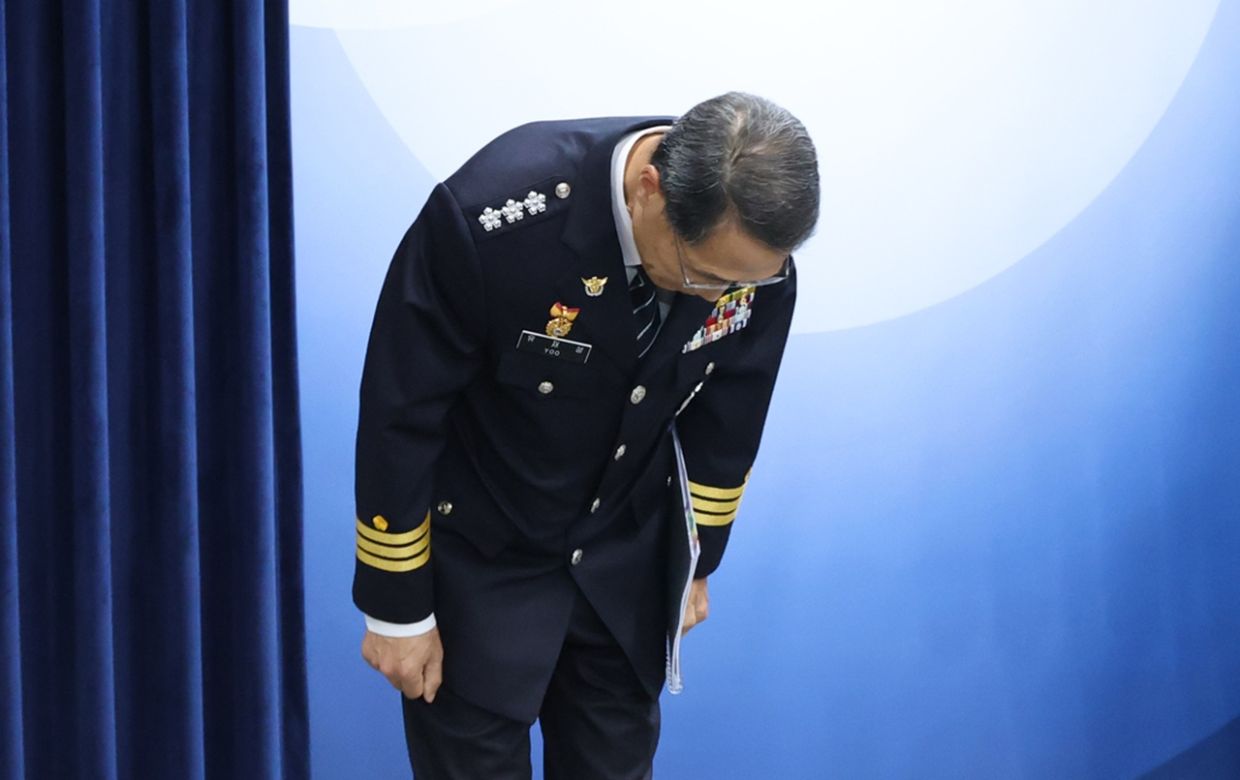
The South Korean National Police Agency is embarking on a significant institutional overhaul following explosive allegations of collusion and investigative misconduct. Acting National Police Agency Commissioner General Yoo Jae-sung laid out an ambitious reform agenda during a Monday press briefing at the Government Complex Seoul, acknowledging the gravity of public dissatisfaction with the force's handling of the case against murder suspect Jang Yoon-gi. The announcement represents an attempt to restore faith in law enforcement after widespread criticism over how police managed the investigation into Jang, arrested for allegedly killing a teenage girl in Gwangju during May.
At the heart of the scandal lies an especially troubling allegation: that police investigators leaked sensitive information about their inquiry directly to Jang's father, a serving police officer, while simultaneously failing to properly preserve and secure crucial evidence. Such behaviour represents a fundamental breach of investigative integrity and raises urgent questions about systemic vulnerabilities within South Korea's law enforcement hierarchy. The apparent exploitation of family connections to obstruct justice has ignited considerable public outrage and prompted calls for senior officials to resign. Despite this political pressure, Commissioner Yoo insisted that he would "faithfully carry out his duties without clinging to his position," signalling a willingness to remain accountable while pushing forward with institutional changes.
The reform package outlined by Yoo demonstrates the scope of problems the agency acknowledges. A new investigative reform task force will launch before month's end, comprising between seven and ten members with outside experts comprising more than half the panel. This external involvement is crucial, as it introduces independent voices into what has historically been an insular decision-making process. The task force will focus on two critical areas: first, overhauling personnel structures to eliminate improper relationships between officers and local communities that can create conflicts of interest; and second, completely redesigning how police handle cases involving vulnerable populations, particularly children and marginalized individuals who require heightened protection.
Beyond the task force, the government is establishing a dedicated internal affairs investigation unit under the National Office of Investigation with explicit authority to pursue serious duty-related crimes committed by police personnel at all ranks. This horizontal accountability mechanism removes the traditional vertical oversight structure where higher-ranking officers investigate their subordinates, a system that created opacity and enabled cover-ups. The unit's creation represents acknowledgment that police cannot effectively police themselves through conventional management channels. Its broad mandate signals serious intent to prosecute misconduct regardless of an officer's seniority or connections.
Perhaps most significant is a proposed oversight body under the Korean National Police Commission that would comprise approximately one hundred civilian investigators. These external monitors would examine alleged human rights violations and investigative misconduct, fundamentally altering the balance between internal and external accountability. Commissioner Yoo emphasized that this civilian body must have real enforcement teeth—its findings should directly lead to personnel changes and disciplinary action rather than serving as symbolic oversight. However, implementation requires amending the Police Act, and Yoo indicated that the police will participate actively in legislative discussions, suggesting potential negotiations over the new body's actual powers and independence.
The rotation system expansion reveals practical tensions within these ambitious reforms. Currently, superintendent-level officers undergo nationwide rotations to prevent localized power consolidation, with some senior inspectors also rotating. Expanding this system to all ranks could theoretically reduce corruption by preventing long-term relationships that enable collusion. However, such wholesale rotation creates substantial logistical and financial burdens. Official residences are provided to transferring senior officers, but extending this benefit to lower ranks would require significant budget increases and raise fairness concerns among officers who don't qualify. Commissioner Yoo's decision to gather opinions from rank-and-file officers before implementing comprehensive rotation reflects recognition that police reform requires buy-in from those it affects, not merely top-down decree.
For Malaysian and Southeast Asian observers, South Korea's approach offers both encouragement and caution. The willingness to involve external civilian oversight bodies and implement structural reforms demonstrates that democracies can respond effectively to institutional crises. However, the careful pace of implementation—rolling out feasible measures first while task forces deliberate on complex details—suggests that genuine institutional change typically unfolds over years rather than months. The fact that a murder investigation could become a vehicle for police corruption in a relatively developed nation underscores how quickly public trust erodes when investigative integrity is compromised, particularly in cases involving vulnerable victims.
The case against Jang Yoon-gi itself will continue separately while these systemic reforms proceed. Commissioner Yoo indicated that the police will await final findings from the special investigation team before concluding their internal inspection of Jang's father and determining follow-up disciplinary measures. This sequencing ensures that addressing systemic failures doesn't delay accountability for individuals allegedly involved in the specific collusion. The distinction between institutional reform and individual accountability proves essential; the reforms risk appearing performative without genuine consequences for those who exploited existing loopholes.
What emerges from this episode is a broader picture of how modern democracies struggle with the paradox of police reform. Police institutions require considerable autonomy to function effectively, yet unchecked autonomy creates space for exactly the kind of collusion revealed here. South Korea's multi-layered approach—internal affairs units, external task forces, civilian investigation bodies, and rotation policies—attempts to create overlapping accountability mechanisms rather than relying on any single reform. Whether this polyphonic oversight system proves more effective than the previous vertical hierarchy will depend substantially on implementation details and whether civilian investigators genuinely receive necessary resources and institutional support.
The timing of these reforms also matters geopolitically. South Korea's efforts to strengthen democratic institutions and rule of law send signals to citizens and regional partners about commitment to good governance. As other Southeast Asian nations grapple with their own law enforcement challenges, South Korea's transparent acknowledgment of systemic problems and willingness to involve external oversight could influence regional approaches to police accountability. Conversely, if these announced reforms ultimately prove superficial—with civilian bodies lacking real power or with subtle resistance from police management preventing genuine change—the episode will demonstrate the limits of reform when institutional cultures resist external accountability.
The path forward requires sustained attention beyond the initial announcements. Commissioner Yoo's commitment to regaining public trust through "sweeping reforms" will ultimately be judged not by the comprehensiveness of announced measures but by their actual implementation and measurable impact on investigative practices. For now, the reforms represent sincere acknowledgment that South Korea's police system requires fundamental recalibration, though the deeper test lies in whether institutions that benefited from the previous structure can genuinely embrace meaningful change.

