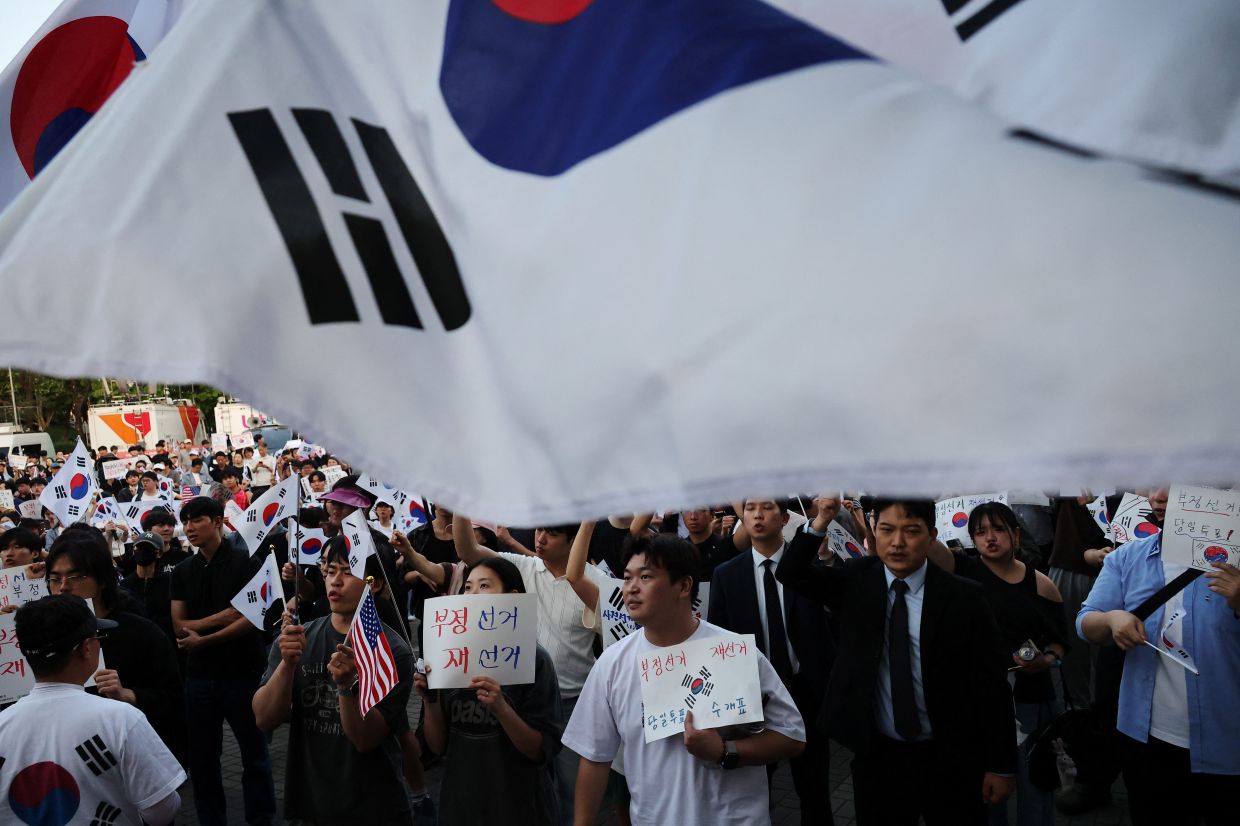
South Korea's President Lee Jae Myung finds himself navigating treacherous political waters as he attempts to balance public accountability for significant election management failures against what he characterises as unfounded conspiracy theories about rigged voting. Speaking through social media on June 15, Lee acknowledged the legitimate grievances of citizens whose voting rights were compromised during the June 3 local elections, yet simultaneously cautioned protesters that their methods must respect the boundaries of lawful conduct and the rights of uninvolved parties.
The tension underlying Lee's remarks reflects a genuine dilemma facing Seoul's leadership. The June 3 elections were marred by documented ballot paper shortages and voting management problems that forced temporary suspensions and delays at certain polling stations, creating a crisis of confidence in the electoral process that no democratic government can dismiss lightly. Lee's recognition of this breakdown is unambiguous—he has characterised it as a serious failure of the National Election Commission that fundamentally undermines the right to vote, which he describes as the bedrock of democratic governance. This acknowledgment is significant because it validates public concern and justifies demands for comprehensive investigation and systemic reform.
However, the protests have evolved beyond peaceful advocacy for accountability. According to reports Lee cited, demonstrations centred around Olympic Park's handball arena—which served as the vote-counting centre and ballot storage facility—have disrupted multiple sports organisations headquartered within the complex. These disruptions have prevented administrative staff from carrying out essential work, with tangible consequences for South Korean athletes unable to complete paperwork necessary for international competition participation. This transformation of legitimate protest into obstruction of unrelated activities represents precisely the boundary Lee seeks to establish between justified criticism and lawlessness.
Lee's instruction to police reflects this boundary-drawing. He has ordered investigations not merely into those who physically blocked access to facilities, but also into individuals who conspired to organise such obstruction. This two-pronged approach aims to distinguish between spontaneous civic anger and coordinated interference with public services. The distinction matters because it allows Lee to simultaneously validate underlying concerns about election integrity while delegitimising protest tactics that extend beyond advocacy into coercion. By involving prosecutors and police, he seeks to demonstrate that accountability flows in multiple directions—towards both the National Election Commission and towards those whose response to official failure crosses into illegality.
Yet Lee walks a careful line in dismissing what he terms conspiracy theories about systematic election rigging. He has observed that some protesters have escalated beyond documenting management failures to advancing claims of intentional electoral manipulation. Lee explicitly rejects such allegations as baseless, warning that those spreading such theories have threatened police officers, conducted unauthorised searches, and impeded official functions. This rhetorical separation between legitimate criticism of NEC incompetence and illegitimate accusations of deliberate fraud serves multiple purposes simultaneously. It preserves the space for genuine democratic accountability while establishing a legal and institutional floor that cannot be crossed without consequences.
The president's remarks, delivered while presiding over a meeting via video link from the Vatican, carry weight partly because they were accompanied by concrete institutional actions. Lee has called upon the National Election Commission to cooperate fully with parliamentary investigations scheduled to begin imminently. Simultaneously, he has urged the joint investigation team comprising prosecutors and police to accelerate their fact-finding efforts without granting any sanctuary—language that suggests neither official nor activist immunity from legal scrutiny. These parallel investigative processes theoretically provide pathways for accountability that do not depend upon confrontational street politics or unsubstantiated allegations.
For Malaysian observers, the South Korean situation offers instructive parallels and contrasts. Like Malaysia, South Korea maintains sophisticated electoral institutions that must command public confidence to retain legitimacy. The June 3 failures—ballot shortages, voting delays, logistical mismanagement—represent precisely the kinds of administrative breakdowns that can undermine faith in democratic processes. However, Lee's response differs markedly from approaches that some regional governments have adopted. Rather than dismissing concerns as sedition or unpatriotic criticism, he explicitly validates the public's right to demand accountability while establishing clear legal and procedural mechanisms for pursuing it. This approach implicitly assumes that democratic legitimacy requires responsiveness to justified grievance rather than suppression of dissent.
The institutional architecture Lee invokes—parliamentary investigation, joint prosecutorial inquiry, transparent fact-finding—mirrors mechanisms that other established democracies employ to manage electoral crises. His insistence upon both accountability and legal restraint reflects a judgement that sustainable democratic legitimacy cannot rest upon either official stonewalling or mob rule. By characterising the moment as an opportunity to strengthen democratic institutions rather than merely to punish failure, Lee frames accountability as constructive rather than retributive. Whether this framework can satisfy public demands for justice while maintaining social order remains uncertain, but the attempt itself demonstrates a sophisticated understanding of democratic governance under stress.
The specific issue of ballot paper shortages deserves emphasis because it strikes at the fundamental right to vote. When citizens arrive at polling stations to discover insufficient ballots, their right to participate in elections is directly violated regardless of intent. Lee's unequivocal acknowledgment of this violation demonstrates that even elected officials aligned with the party in power recognised the severity of the breach. This cross-partisan acknowledgment may constrain the ability of supporters to dismiss the failures as inconsequential or exaggerated, potentially creating political space for genuine reform of electoral administration.
Looking forward, the credibility of Lee's call for restraint will depend upon whether investigators impartially determine responsibility without political bias, and whether the National Election Commission implements structural changes to prevent recurrence. If parliamentary and prosecutorial investigations are perceived as serving predetermined political outcomes rather than pursuing truth, the distinction Lee sought to establish between legitimate reform demands and conspiracy theories will collapse. Public confidence in democratic institutions rests finally upon consistent application of rules regardless of political affiliation, a principle that transcends the specific circumstances of South Korean elections to resonate throughout the democratic world.

