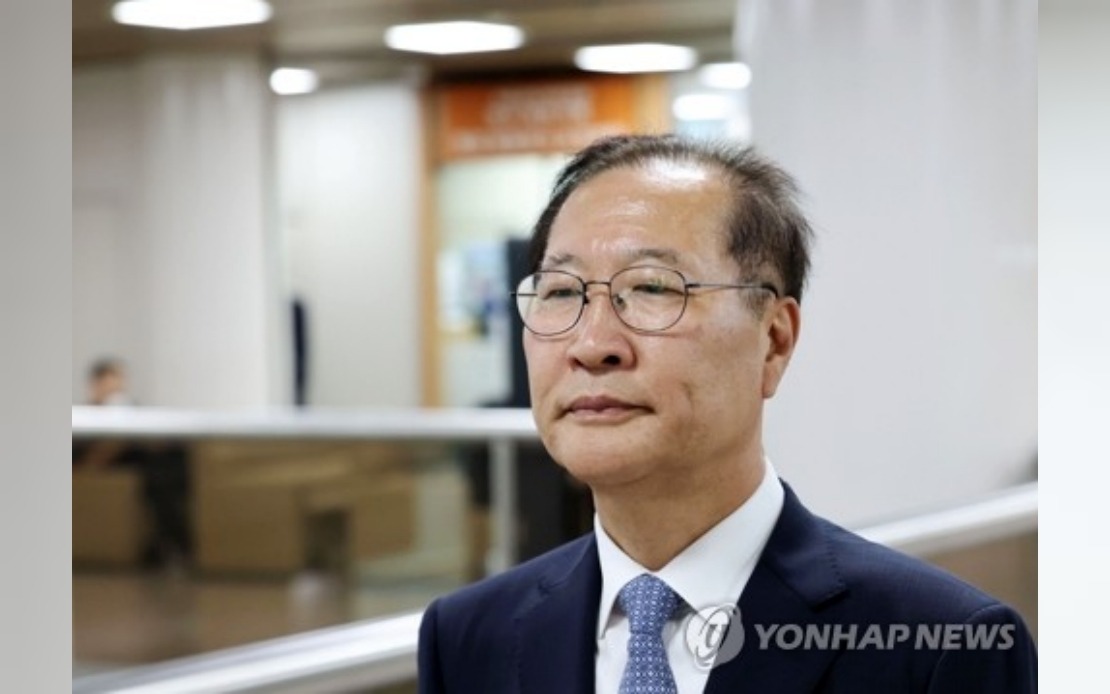
South Korea's former Justice Minister Park Sung-jae has been sentenced to 25 years in prison following his conviction on insurrection charges tied to President Yoon Suk Yeol's short-lived martial law declaration last December. The Seoul Central District Court's verdict on Monday exceeded the 20-year term prosecutors had requested, underscoring judicial concern about the severity of Park's participation in what the court determined was an unconstitutional power grab. Park was immediately remanded in custody, with the court citing fears he might attempt to suppress evidence related to the case.
The charges against Park centred on his actions immediately following Yoon's martial law proclamation on December 3, 2024. As the country's top law enforcement official, Park convened a senior ministry meeting ostensibly to coordinate responses to the emergency declaration. However, prosecutors and the court found the true purpose was far more sinister. The gathering allowed Park to direct the dispatch of prosecutors to units tasked with implementing martial law operations, evaluate whether existing detention facilities could accommodate the numerous political figures and business leaders anticipated to be arrested under the emergency powers, and mobilise ministry personnel responsible for implementing international travel restrictions on targeted individuals.
The court's reasoning reveals the depth of institutional complicity the prosecution sought to expose. Park's actions were not peripheral to Yoon's plan but rather essential infrastructure supporting it. As the country's chief prosecutorial officer, his involvement legitimised the extraordinary measures in the eyes of lower-ranking officials and signalled that the justice system would function as a tool for the insurrection rather than a check upon it. The judiciary's characterisation of Park as someone who had abandoned his constitutional duty in favour of advancing what appeared to be a viable coup attempt carries particular weight given his formal responsibility to uphold the rule of law.
Park's conviction places him alongside other prominent members of the former president's cabinet who have faced similar judicial reckoning. Former Prime Minister Han Duck-soo and former Defence Minister Kim Yong-hyun have both been convicted on insurrection charges. These cascading convictions of top-level officials suggest a systematic rather than merely opportunistic conspiracy to subvert democratic governance. The pattern demonstrates that Yoon's martial law bid was not an isolated act of executive overreach but rather involved coordinated participation across multiple security and administrative portfolios.
President Yoon himself received a life sentence in February after being found guilty of leading the insurrection. That judgment, which Yoon has appealed, established the foundational liability for the entire scheme. His conviction effectively determined that the martial law declaration itself constituted an illegal attempt to seize absolute power, making all subordinate actions in support of it inherently criminal. The verdicts against cabinet members like Park then operationalise that determination by holding specific officials accountable for their roles in executing Yoon's unconstitutional plan.
For Malaysian and broader Southeast Asian observers, South Korea's handling of this constitutional crisis carries instructive implications. The case demonstrates how institutional safeguards and judicial independence can function as correctives even after democratic norms have been severely tested. Despite the executive's initial assertion of emergency powers, courts ultimately rejected the martial law framework and prosecuted those responsible. This outcome contrasts sharply with scenarios in other democracies where similar executive overreach has been successfully consolidated or where institutional resistance has proved insufficient.
The court's dismissal of additional anti-graft charges against Park reveals the boundaries the special counsel maintained in pursuing accountability. Park had allegedly misused his position in May 2024 to conduct improper investigations into corruption allegations against Yoon's wife, Kim Keon Hee, following her request. By rejecting these charges as falling outside the special counsel's mandate, the court highlighted that the judicial process, while forceful on insurrection matters, operated within circumscribed investigative authority. This restraint, paradoxically, strengthens the legitimacy of the convictions that were handed down, suggesting that courts applied rigorous evidentiary and jurisdictional standards rather than pursuing politically motivated prosecutions.
Park's legal team has signalled an immediate appeal, contending that the judgment lacks factual and legal foundation. This response reflects the broader contestation surrounding South Korea's reckoning with the martial law episode. Yoon's own appeal suggests the former president and his associates view the convictions as politically motivated rather than as legitimate accountability. Whether appellate courts will sustain, modify, or overturn these sentences remains consequential for South Korea's constitutional order. An appellate reversal would suggest that courts view martial law as a permissible executive prerogative under certain circumstances, a conclusion that would fundamentally alter the state's constitutional architecture.
The special counsel's team indicated it would not appeal Park's sentence, effectively accepting the 25-year term as proportionate punishment. This prosecutorial stance implies confidence that appellate courts, if they review the matter, will sustain the conviction and sentence. The team's statement emphasising Park's duty to resist unlawful martial law declarations and defend constitutional order articulates a theory of executive accountability that extends beyond Yoon himself to officials who facilitate unconstitutional governance. In this framework, subordinate officials cannot escape responsibility by claiming they merely executed superior orders.
Park's conviction assumes particular importance given his position as Justice Minister. The justice system occupies a theoretically neutral stance, serving all branches of government impartially. By participating in the martial law scheme, Park corrupted this institutional neutrality and transformed prosecutorial power into a weapon of authoritarian consolidation. Courts recognised this institutional betrayal as especially egregious, perhaps contributing to the sentence that exceeded prosecutorial recommendations. The verdict implicitly states that law enforcement officials occupy a heightened position of trust and face elevated culpability when they abuse it.
The international dimensions of South Korea's prosecution of the martial law conspirators merit attention for regional observers. Democracies worldwide have struggled with questions of accountability following failed or partial democratic backsliding. Some have pursued comprehensive prosecutions; others have negotiated amnesty arrangements prioritising reconciliation over justice. South Korea's approach combines prosecutorial vigour with procedural regularity, pursuing serious charges through established judicial mechanisms while respecting evidentiary burdens and jurisdictional limits. This model may offer templates for other democracies confronting similar constitutional violations.
Looking forward, Park's appeal process will determine whether his 25-year sentence stands. The Supreme Court's eventual decision on the case will establish precedent regarding the accountability of senior officials for complicity in unconstitutional executive action. For South Korea and the region, the outcome carries implications extending beyond one individual conviction to fundamental questions about institutional resilience, constitutional enforcement, and the price officials must pay for abandoning democratic governance. The judicial system's willingness to prosecute cabinet-level figures suggests that democratic restoration in South Korea remains an active, contested process rather than a settled historical fact.

