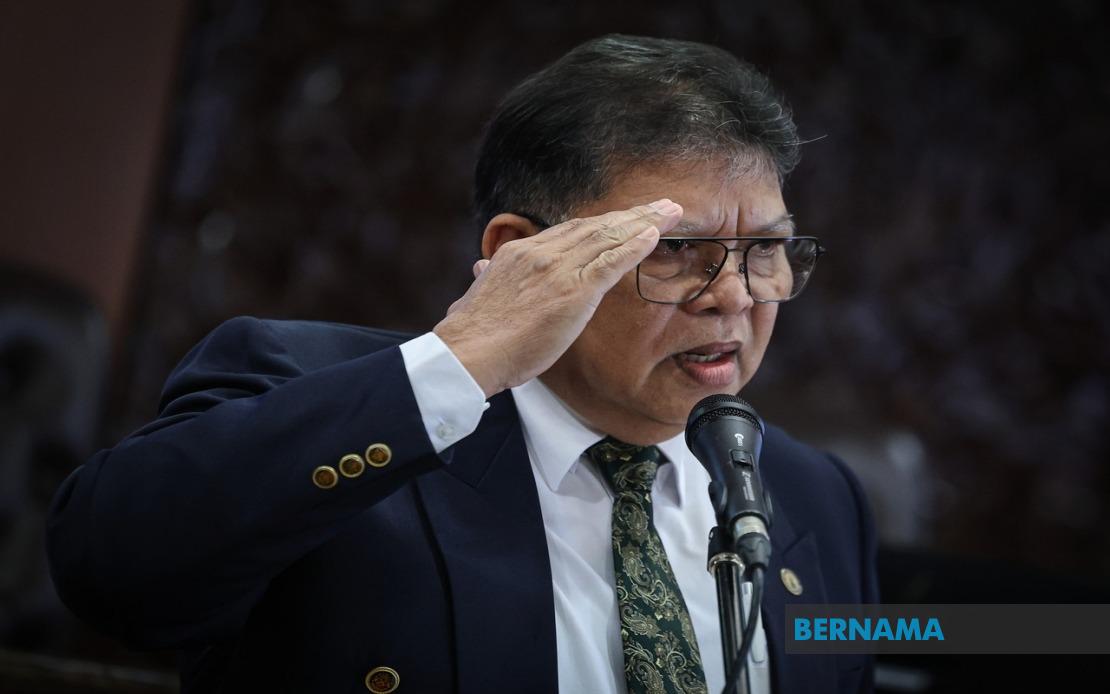
Dewan Rakyat Speaker Tan Sri Johari Abdul has championed the adoption of proportional representation as a mechanism to forge a more inclusive political landscape that reflects Malaysia's ethnic and religious plurality. His remarks, delivered during a Harmony Symposium held at the Parliament building, underscore growing concerns about the viability of minority political representation within the existing electoral framework as the nation's demographic composition undergoes significant transformation.
Johari's intervention into this contentious debate carries particular weight given his institutional position overseeing parliamentary proceedings. He stressed that proportional representation would cultivate a generation of young political leaders whose backgrounds and perspectives authentically embody the nation's multicultural character. The Speaker's framing transcends narrow partisan advantage, instead positioning electoral reform as essential infrastructure for Malaysia's long-term social cohesion and democratic legitimacy.
The demographic imperative underpinning Johari's argument warrants careful examination. Drawing on population projections, he highlighted that Bumiputera Malays are expected to constitute 77 per cent of Malaysia's population by 2050, a figure that carries profound implications for electoral politics under the existing first-past-the-post system. This trajectory creates a mathematical problem: with such overwhelming demographic concentration, the geographic dispersion of minority communities means increasingly fewer constituencies will contain populations where minorities represent electoral majorities capable of determining electoral outcomes through traditional constituency-based voting patterns.
The Speaker posed a pointed rhetorical question about the implications of minority political marginalisation. His concern extends beyond Westminster procedural matters to encompass the broader social contract binding Malaysia's diverse communities. Should parliamentary representation become unattainable for significant population segments, the legitimacy of legislative bodies to speak authoritatively on matters affecting the entire nation erodes. Johari's warning suggests that allowing minority voices to diminish through demographic happenstance rather than deliberate policy choice risks creating grievances that corrode national unity.
Johari explicitly rejected presentism in favour of long-term strategic thinking about Malaysia's constitutional and democratic future. He urged policymakers and citizens alike to transcend immediate political calculations and yesterday's conflicts, instead adopting a temporal horizon spanning the next five to 100 years. This temporal reframing proves crucial: discussions of electoral architecture and democratic representation should not remain hostage to contemporary partisan positioning but rather anticipate governance challenges that demographic shifts will generate.
The diversity of Malaysia's ethnic landscape compounds the urgency of Johari's argument. With 77 ethnic groups calling Malaysia home, no simplistic binary characterisation of majority-minority relations captures the nation's actual complexity. Minority communities themselves encompass profound internal diversity—indigenous peoples, Indian Malaysians, Chinese Malaysians, and numerous other groups possess distinct historical experiences and contemporary interests. Electoral systems that gradually eliminate minority parliamentary representation risk ossifying majority-minority relations into zero-sum competition rather than facilitating the intricate negotiations through which plural societies traditionally accommodate competing interests.
Johari framed the challenge as fundamentally one of mutual understanding and reciprocal role-recognition. Both majority and minority communities must consciously grasp their responsibilities in a shared political project. Proportional representation could theoretically facilitate this consciousness by ensuring that legislative chambers remain genuinely representative of the nation's demographic and cultural composition. When minorities retain meaningful parliamentary presence, majority and minority legislators must engage in genuine coalition-building and compromise rather than treating legislative dominance as permanent entitlement.
The symposium at which Johari delivered these remarks facilitated broader engagement with harmony and representation questions. Syahredzan Johan, chairman of the Malaysia Cross-Party Parliamentary Group on Racial and Religious Harmony and Member of Parliament for Bangi, participated in proceedings aimed at translating parliamentary discussions into concrete policy recommendations and institutional mechanisms. This coordination between parliamentary leadership and civil society actors suggests that conversations about electoral reform have begun permeating official deliberative spaces previously resistant to fundamental constitutional reconsideration.
Syahredzan's articulation of the KRPPM-KKA's mission encompasses both legal reform and practical coalition-building across governmental, parliamentary, civil society, and educational sectors. The emphasis on institutional cooperation reflects understanding that electoral system change, were it to occur, could not function as mere technical adjustment divorced from broader cultural, legal, and educational transformation. Proportional representation without complementary reforms to political party cultures, parliamentary norms, and civic literacy might simply relocate rather than resolve tensions inherent in plural democracies.
For Southeast Asian observers and Malaysian stakeholders, Johari's intervention signals that fundamental debates about democratic architecture and minority protection have entered the mainstream policy discourse. These conversations carry ramifications extending far beyond Malaysia itself. Regional democracies grappling with similar ethnic and religious diversity increasingly confront questions about whether existing electoral frameworks adequately protect minority interests or alternatively entrench majoritarian dominance over time. Malaysia's potential exploration of proportional representation could influence thinking across Southeast Asia about alternative democratic configurations.
The proposal nonetheless confronts substantial obstacles rooted in Malaysia's political economy and constitutional structure. First-past-the-post systems create entrenched interests among beneficiary parties and established political operators. Constitutional amendment requirements for electoral system changes impose high supermajority thresholds precisely designed to prevent rapid transformation of political foundations. Geographic and demographic realities create complex tradeoffs between proportional representation and other democratic values such as geographic representation and constituency accountability.
Johari's positioning himself as a principled advocate for proportional representation and minority protection establishes an important marker in Malaysia's ongoing democratic conversation. Whether his rhetoric translates into concrete legislative proposals, constitutional amendment attempts, or sustained civil society mobilisation remains uncertain. Yet his willingness to articulate the case for electoral system reform—grounded in demographic realities, constitutional principles, and long-term national interest rather than narrow partisan calculation—helps legitimise conversations previously marginalised as impractical or destabilising. The next phase of this debate will reveal whether parliamentary leadership's acknowledgment of electoral reform possibilities matches appetite for the difficult political work necessary to actualise such transformation.

