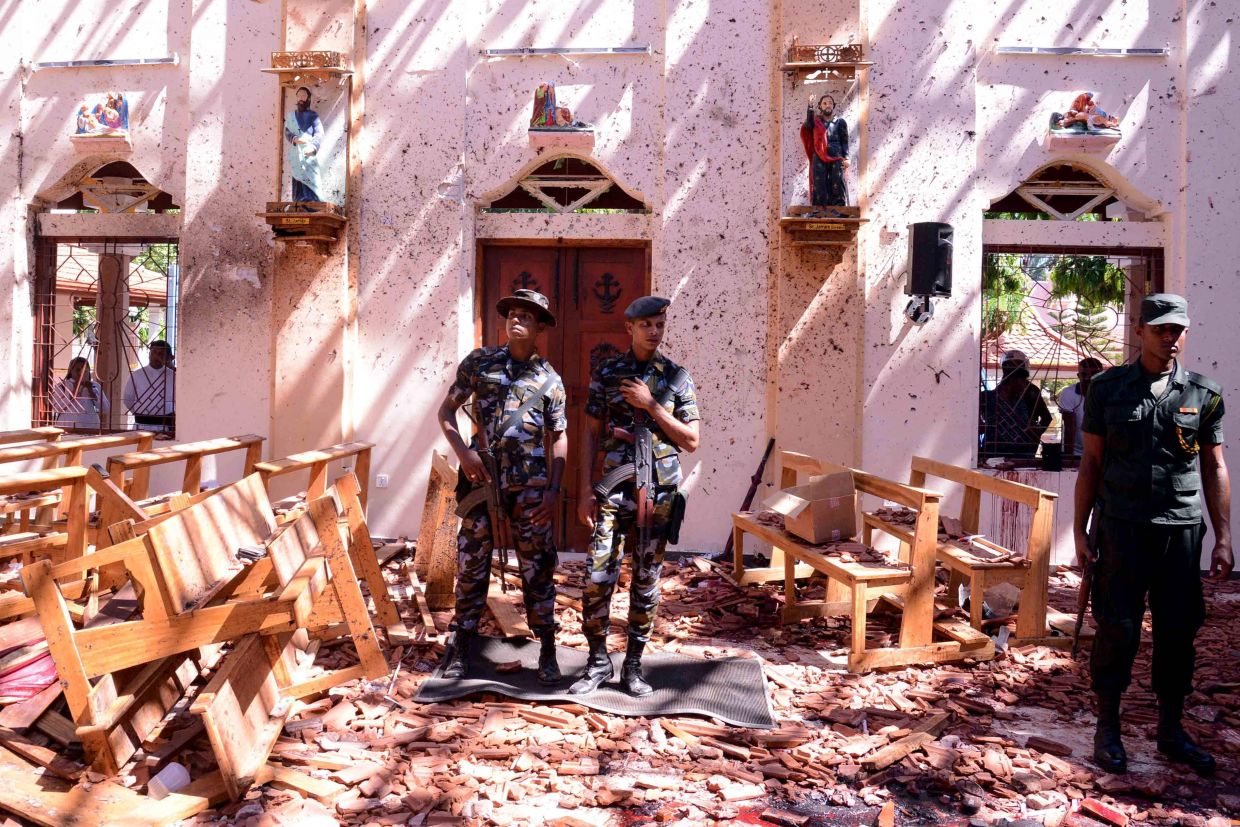
Sri Lanka's government has dramatically pivoted from its original account of the 2019 Easter bombings, now accusing former intelligence chief Suresh Sallay of orchestrating the island's deadliest attack against civilians. The retired major general, who spent his career warning international audiences about terrorism's dangers at the Pentagon and United Nations, was arrested in February under anti-terrorism laws and faces accusations that he strategically directed the coordinated assaults. The reversal represents one of the most extraordinary reversals in a terrorism investigation, transforming a celebrated security expert into the alleged architect of mass violence that claimed 279 lives and wounded over 500 people on April 21, 2019.
The Easter Sunday attacks shook Sri Lanka's international standing, with suicide bombers striking three luxury hotels and three churches in coordinated strikes that killed nationals from multiple countries including Australia, Britain, China, Denmark, the Netherlands, Japan and the United States. The 45 foreign fatalities underscored the attacks' reach beyond Sri Lanka's borders, drawing global scrutiny to the island's security apparatus. Initial official narratives blamed Sunni Muslim extremists inspired by the Islamic State group, a characterization that seemed to align with the coordinated nature of the bombings and their targeting of Christian places of worship during a major religious holiday.
However, investigations conducted over subsequent years unraveled the straightforward terrorism narrative, revealing instead a far more complex picture involving alleged deep state involvement. Questions emerged almost immediately about why Indian intelligence warnings preceding the attacks went unheeded, and how the bomber network managed to evade detection despite apparent prior knowledge in security circles. These inconsistencies prompted investigators to examine whether the attacks represented intelligence failure or something more deliberate. As inquiries progressed, they exposed troubling connections between the bombers and at least two state intelligence agencies, suggesting institutional knowledge that extended beyond conventional operational channels.
Public Security Minister Ananda Wijepala became the first government official to publicly name Sallay as the alleged mastermind when he addressed parliament in June. Wijepala claimed that Sallay had conspired with Islamic extremists and strategically directed them toward executing the attacks, further alleging that the former spy chief met with Muslim men just three weeks before the bombings to gather information about potential targets. These specific allegations transformed the investigation from a hunt for religious extremists into an examination of potential state orchestration, raising uncomfortable questions about what role powerful figures within the security establishment might have played.
Critics and investigative journalists have constructed a narrative suggesting that the attacks served a political purpose within Sri Lanka's power structures. According to this analysis, the bombing network may have been cultivated deliberately to create an enemy threat that could justify expanding the state's security apparatus and elevating particular political leaders as strong-armed defenders of national security. The timing proved advantageous for Gotabaya Rajapaksa, who won the presidency later that same year by campaigning on a pledge to crush Islamist extremism with the same ruthlessness he had demonstrated against Tamil rebels during the preceding decade's civil conflict. Investigators have reportedly told the court that the alleged plot aimed to generate chaos and position Rajapaksa as the sole leader capable of restoring order through military dominance.
This analysis gains credibility from historical precedent within Sri Lanka's security establishment. Rajapaksa administrations have previously acknowledged that the state cultivated relationships with jihadist figures during the 1983-2009 civil war, funding these groups to gather intelligence on Tamil separatists. Though government officials maintain that these militants subsequently betrayed their handlers and carried out the Easter attacks independently, critics argue the arrangement demonstrates a willingness within the state security apparatus to manipulate extremist groups for political advantage. The pattern suggests institutional knowledge and experience in managing such networks, making allegations of deliberate cultivation during 2019 less implausible than they might initially appear.
Sallay himself presents a compelling figure whose arc reveals much about Sri Lankan security culture and its connections to regional institutions. As a Muslim officer married to a Buddhist woman with a Catholic mother who has appealed to Pope Francis for his release, Sallay embodied the religious pluralism that defines modern Sri Lanka, where Buddhists comprise nearly 70 percent of the 22 million population, with Hindus, Sunni Muslims and Christians comprising the remainder. His international credentials were substantial: he served in Sri Lankan diplomatic missions in France and Malaysia, studied at India's prestigious National Defence College as well as Madras University, and attended Britain's University of Bradford. These assignments reflected the kind of cosmopolitan security professional typical of Sri Lanka's post-independence officer class.
Sallay built a reputation as an expert on the very phenomenon he now stands accused of engineering. The Defence Ministry's Institute of National Security Studies records that he delivered a 2003 address at the Pentagon titled "Suicide Terrorism and its Impact," establishing himself as a serious analyst of militant violence. As recently as 2023, he spoke at United Nations headquarters about terrorism as "one of the greatest challenges" to international security, specifically highlighting how social media and digital platforms enable radicalization and extremism. His remarks referenced attacks including those in Sri Lanka itself, creating an ironic juxtaposition with his current predicament. These speeches demonstrate that Sallay cultivated an identity as a thoughtful security analyst committed to understanding and combating the very forces he allegedly set in motion.
Paradoxically, Sallay thrived professionally under the Rajapaksa administration despite now facing accusations of orchestrating attacks that benefited that same political dynasty. After Gotabaya Rajapaksa's 2019 election victory, Sallay was appointed to head the State Intelligence Service, becoming the first military officer to hold that position. This appointment placed him at the apex of Sri Lanka's intelligence apparatus during the period when investigations suggest the Easter bombing network operated. His subsequent actions as spy chief included ordering the arrest of Muslim human rights lawyer Hejaaz Hizbullah in 2020, accusing Hizbullah of masterminding the Easter attacks. That arrest now appears in retrospect as potentially deflecting attention from other quarters, and Hizbullah's eventual release after 22 months without evidence of wrongdoing cast doubt on the prosecution's investigative integrity.
Sallay himself has not been formally charged despite his February arrest, and he continues to deny any involvement in the bombings. His case remains in preliminary hearings, with court appearances scheduled to determine whether sufficient evidence exists to proceed with formal charges. His legal situation reflects the broader uncertainty surrounding the Easter bombing investigation, which has evolved from a straightforward terrorism case into an examination of alleged state conspiracy. The absence of formal charges after months of detention raises questions about the strength of evidence against him and whether the legal system possesses sufficient grounds for conviction or whether the arrest primarily serves to remove him from circulation during a sensitive political period.
The case's broader significance extends beyond Sri Lanka's borders, carrying implications for how Southeast Asian democracies handle terrorism investigations and state accountability. The willingness of a government to retroactively accuse its own intelligence chief of orchestrating major attacks suggests either genuine discovery of criminal conspiracy or political motivation to rewrite historical narratives. For Malaysia and other regional nations with complex security apparatus managing multiple intelligence agencies, the Sri Lankan case illustrates both the vulnerability of such institutions to being weaponized for political purposes and the challenges in investigating attacks when the state itself becomes implicated. The investigation's trajectory demonstrates how initial explanations of terrorist attacks can unravel when scrutiny deepens, revealing institutional dynamics that complicate straightforward security narratives.

