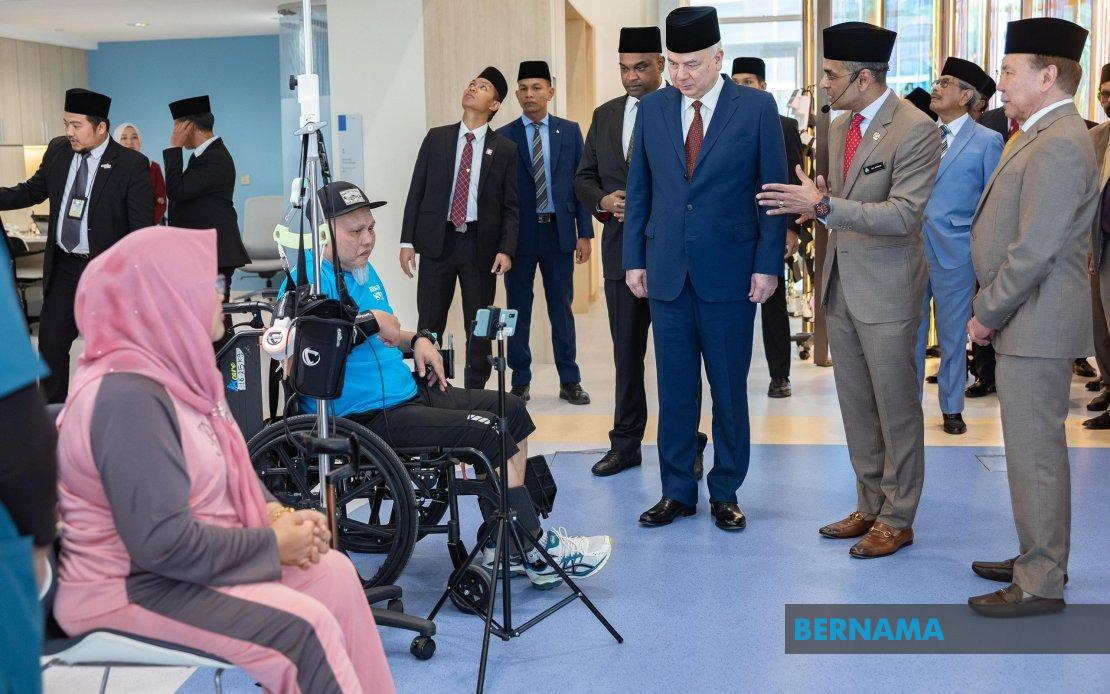
Sultan Nazrin Shah of Perak officially inaugurated the Social Security Organisation's (PERKESO) Neuro-Robotics and Cybernetics Rehabilitation Centre in Meru Raya on June 16, signalling a turning point in Malaysia's modernisation of rehabilitation and social healthcare infrastructure. The facility, whose striking architectural design drew inspiration from the intricate traditions of gold-thread embossing, has been formally designated the Pusat Rehabilitasi Perkeso Sultan Nazrin Shah in recognition of the royal patron's commitment to advancing worker welfare and social protection systems across the nation.
The inauguration ceremony assembled senior government figures and royal dignitaries, including Raja Muda Perak Raja Jaafar Raja Muda Musa and Raja Di Hilir Perak Raja Iskandar Dzulkarnain Sultan Idris Shah. Perak Menteri Besar Datuk Saarani Mohamad and Human Resources Minister Datuk Seri R. Ramanan attended the event, underscoring the centre's significance within Malaysia's broader labour and welfare policy agenda. The convergence of state and federal representation reflected the collaborative approach required to sustain such institutional investments in occupational health recovery and reintegration.
In his keynote remarks, Sultan Nazrin articulated a vision extending far beyond technological infrastructure. He stressed that the centre's fundamental value derives from the multidisciplinary teams operating within its walls—neurologists, physiotherapists, occupational specialists, vocational trainers, social workers and mental health professionals working in concert. This integrated model represents a deliberate departure from fragmented, siloed approaches to rehabilitation, instead positioning the centre as a holistic recovery ecosystem where technological innovation complements, rather than displaces, human expertise and compassionate care.
The monarch reframed rehabilitation within a broader national development paradigm. Rather than treating workplace injury and neurological recovery as isolated medical concerns, Sultan Nazrin positioned them as matters of fundamental social policy and national progress. His remarks underscored that true advancement cannot rest solely on infrastructure projects or GDP growth; instead, meaningful societal development must encompass robust mechanisms for preserving the dignity of citizens confronting illness, disability and economic hardship. This philosophical underpinning carries particular resonance in Southeast Asia, where rapid industrialisation has expanded workplace risks while social safety nets remain unevenly developed.
The centre's genesis traces to initiatives undertaken by Ipoh Barat Member of Parliament M. Kulasegaran during his tenure as Human Resources Minister from 2018 to 2020, establishing the facility as a product of sustained policy commitment across electoral cycles. Sultan Nazrin highlighted the transformative potential embedded in the centre's services: for stroke survivors, it promises restoration of motor function and mobility; for workers with neurological injuries, it offers pathways to reclaim physical and cognitive capacity; for traumatic brain injury patients, it provides therapeutic support addressing memory, speech and psychological reconstruction. By articulating these concrete therapeutic trajectories, the Sultan communicated that recovery, whilst challenging, remains achievable with appropriate intervention and technological support.
A critical dimension of Sultan Nazrin's address focused on post-rehabilitation employment integration—a structural gap often overlooked in disability services throughout the region. He explicitly commended PERKESO's partnership with 7-Eleven to provide workplace training and employment placement opportunities for programme graduates. This collaboration addresses a fundamental barrier to independence: the transition from clinical recovery to genuine economic reintegration. Without employment pathways, even successfully rehabilitated individuals risk sliding into dependency or marginalisation, negating the therapeutic gains achieved during their recovery journey.
The Sultan's call for expanded private sector engagement represents a deliberate effort to distribute responsibility for disability inclusion beyond government structures. By framing corporate participation as both social responsibility and moral imperative, he invited Malaysian businesses to view rehabilitation support and employment creation not as charitable ventures but as integral components of legitimate corporate citizenship. Such messaging carries weight in Malaysia's evolving corporate social responsibility landscape, where companies increasingly recognise that inclusive practices enhance workforce resilience and organisational reputation.
Underlying the Sultan's remarks lay an implicit critique of prevailing social attitudes toward disability. His appeal to eliminate prejudice and stigma acknowledged that technological sophistication and medical expertise alone cannot succeed without corresponding shifts in societal perspectives. In Malaysia and across Southeast Asia, where informal attitudes often shape employment prospects more decisively than formal protections, such royal articulation of anti-discrimination principles carries influence disproportionate to legal frameworks. The Sultan's endorsement may catalyse broader cultural conversations about disability inclusion within Malaysian workplaces and communities.
The centre's opening represents a significant investment in occupational health recovery infrastructure at a moment when Malaysia's industrialised workforce faces mounting neurological and traumatic injury risks. Stroke, acquired brain injury and spinal cord trauma constitute leading causes of disability among working-age populations in the region, yet rehabilitation capacity remains constrained relative to demand. By establishing this specialised facility, PERKESO addresses a critical gap in the nation's health system architecture, positioning Perak as a regional hub for advanced neuro-rehabilitation and potentially attracting patients and referrals from neighbouring states and countries.
Sultan Nazrin's emphasis on second chances and dignity speaks to a humanitarian framework often marginalised in development discourse focused on productivity metrics and fiscal efficiency. His insistence that national progress encompasses protecting the vulnerable and providing recovery pathways for those affected by injury or illness articulates a social contract fundamentally different from purely market-driven approaches. This vision aligns with emerging consensus among regional policymakers that sustainable development requires attention to social cohesion, dignity preservation and inclusive economic participation—dimensions that extend beyond conventional GDP calculations.
The Neuro-Robotics and Cybernetics Rehabilitation Centre symbolises Malaysia's ambition to integrate cutting-edge technology within compassionate healthcare delivery. Yet the project's ultimate success depends not merely on equipment sophistication but on whether rehabilitated workers secure meaningful employment, whether discrimination against disabled persons diminishes, and whether employers recognise hiring rehabilitated workers as both ethical responsibility and business opportunity. The Sultan's framing of these interconnected challenges suggests awareness that technological infrastructure, whilst necessary, proves insufficient without corresponding shifts in employment practices, social attitudes and corporate commitment to inclusive workplaces. As other Southeast Asian nations contemplate similar rehabilitation investments, Malaysia's experience with this facility may offer valuable lessons regarding the structural and cultural conditions required for rehabilitation systems to translate medical recovery into genuine economic and social reintegration.

