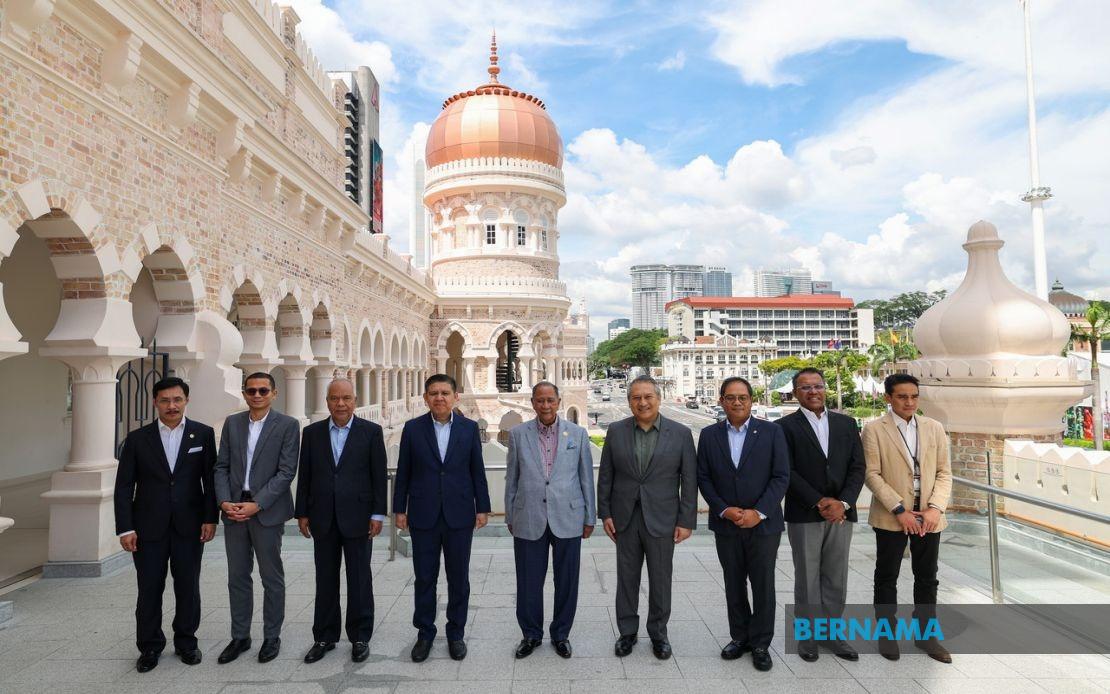
The Sultan of Kedah, Al Aminul Karim Sultan Sallehuddin Sultan Badlishah, made a ceremonial visit to the Sultan Abdul Samad Building in Kuala Lumpur on June 24, reaffirming the royal family's role in supporting the nation's heritage preservation efforts. Arriving at approximately 10.30 am, His Royal Highness was greeted by Khazanah Nasional's managing director Datuk Amirul Feisal Wan Zahir, alongside senior officials including chief corporate officer Datuk Mohamed Nasri Sallehuddin and head of real assets Selvendran Katheerayson.
The Sultan's itinerary encompassed a comprehensive tour of the building's renovated facilities, beginning with the Confluence Hall, which functions as a dedicated exhibition space documenting Kuala Lumpur's origins and urban evolution. During this portion of the visit, Think City senior manager Mariana Isa provided detailed explanations of the gallery's carefully curated exhibits, allowing His Royal Highness to gain insight into the historical narratives and developmental milestones presented within the space.
Following the initial galleries, the royal delegation proceeded to the Visionary Hall, where interactive models and multimedia presentations illustrate the capital's transformation across different periods. These contemporary display methods represent an important shift in how heritage institutions engage with visitors, moving beyond traditional static exhibits to create immersive experiences that appeal to diverse audiences. The Sultan also accessed the distinctive balcony overlooking the Porte Cochere, an architectural feature that offers commanding views of the building's iconic frontage and the surrounding Kuala Lumpur streetscape.
The visit encompassed a visit to the School of Hard Knocks, an initiative operated under the Royal Selangor umbrella, before concluding with a light luncheon. His Royal Highness departed the premises at approximately 1.15 pm, completing a three-hour engagement that underscored the significance attributed to the building by Malaysia's royal institutions.
Khazanah Nasional has positioned the Sultan Abdul Samad Building not merely as an architectural conservation project but as a comprehensive effort to preserve and communicate Malaysian national history. According to Datuk Amirul Feisal, the organisation's mandate extends well beyond structural restoration to encompass the active interpretation and presentation of historical narratives relating to Kuala Lumpur, Selangor, and the broader Malaysian developmental trajectory. This multifaceted approach recognises that heritage preservation serves functions beyond aesthetics, acting as a repository of collective memory and national identity.
Since opening its doors to the public on February 2, the Sultan Abdul Samad Building has attracted approximately 200,000 visitors, indicating substantial public interest in the heritage site and its programming. This visitor volume suggests that the restoration and repurposing of the building has successfully transformed it into a relevant contemporary destination rather than merely preserving it as a historical monument. The number reflects effective marketing and programming strategies that appeal to both domestic and international tourists seeking authentic encounters with Malaysia's political heritage.
Datuk Amirul Feisal characterised the royal visit as deeply meaningful, emphasising that His Royal Highness's presence constituted recognition of Khazanah Nasional's stewardship efforts. He articulated that the visit carried symbolic weight extending beyond ceremonial protocol, representing institutional acknowledgement of heritage preservation as a legitimate and important national undertaking. The statement reflected broader themes regarding the intersection of royal patronage, cultural preservation, and state-led heritage management in contemporary Malaysia.
The building's historical significance derives from its role as the seat of colonial and post-colonial administration. Originally designated the Secretariat Building during the British administration period, it served as the operational centre for government functions. Most memorably, it witnessed the pivotal moment when the Union Jack was lowered and the Federation of Malaya flag was raised for the first time in 1957, a symbolic transition that marked the transition from colonial rule to independent nationhood. These associations embed the structure within narratives of national sovereignty and self-determination.
The restoration project itself represents a substantial commitment to heritage conservation. In January 2024, His Majesty Sultan Ibrahim, the King of Malaysia, formally inaugurated the completion of Phase One restoration works, which had consumed eleven months of intensive conservation labour. The work was undertaken through the Khazanah Heritage Fund programme, indicating dedicated financial resources allocated toward heritage preservation at the national level. This phased approach suggests that additional restoration phases may be contemplated for future implementation.
The Sultan Abdul Samad Building exemplifies the evolving relationship between Malaysia's political establishment and its architectural heritage. Rather than allowing significant historical structures to deteriorate or fall into disuse, as has occurred with numerous heritage sites across the region, Malaysia's leadership has invested in their restoration and adaptive reuse. This approach generates contemporary utility while preserving historical authenticity, creating spaces that serve both educational and recreational functions for modern audiences.
For Southeast Asia more broadly, the Kuala Lumpur model presents instructive lessons regarding heritage management. Many regional capitals contain significant colonial-era administrative buildings that face uncertain futures as cities modernise and urban land values increase. The decision to transform the Sultan Abdul Samad Building into a public-accessible heritage destination rather than converting it into commercial office space reflects a particular set of national priorities regarding historical preservation and public access to heritage.
The visit by the Sultan of Kedah positions the heritage building as a site of broader royal and institutional significance. While Kuala Lumpur itself is located within Selangor, the presence of the ruler of another state underscores the building's importance within pan-Malaysian consciousness rather than merely local or state-level significance. This framing suggests that heritage institutions in Malaysia increasingly function as expressions of national unity and shared historical consciousness, bringing together different state administrations in recognition of common historical narratives.

