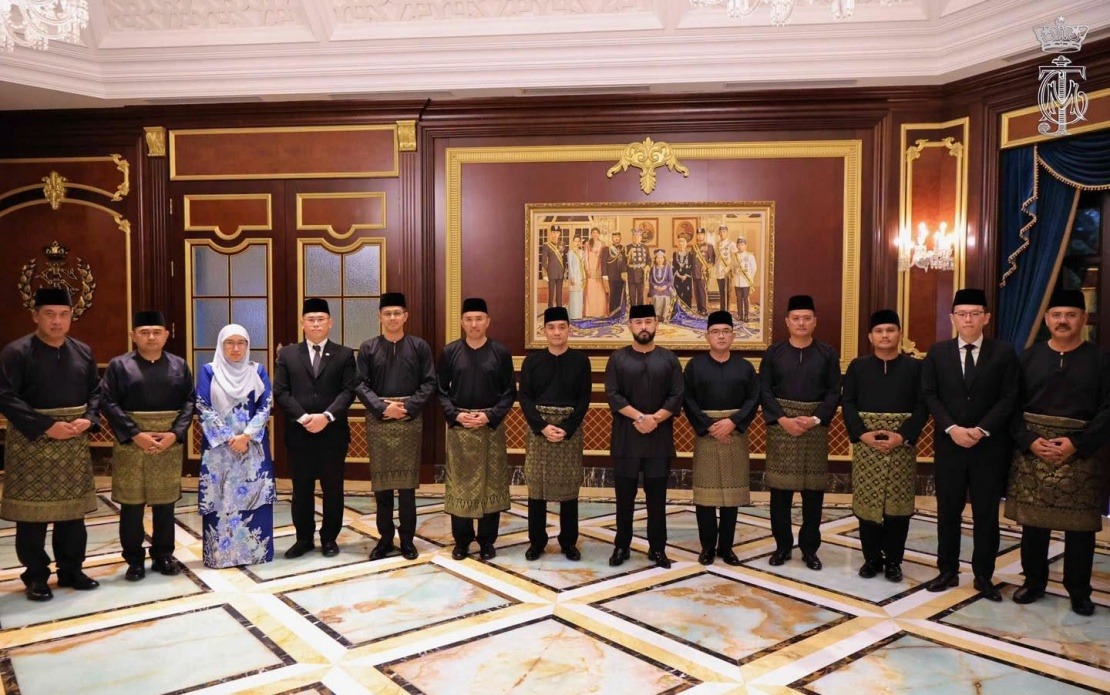
Ten Johor assemblymen took their oaths of office on July 18 before the Regent of Johor, Tunku Mahkota Ismail, at Istana Bukit Serene, formally establishing the new state executive leadership team. The ceremony marked a significant milestone in Johor's post-election governance, reflecting the outcome of the 16th state election which delivered a commanding mandate to the Barisan Nasional coalition.
The assembled Exco brings together a mix of experienced administrators and fresh political talent. Mohd Hairi Mad Shah representing Larkin, Datuk Mohd Jafni Md Shukor from Bukit Permai, Mohd Fared Mohd Khalid of Semerah, Ling Tian Soon from Yong Peng, Lee Ting Han representing Paloh, and Mohamad Fazli Mohamad Salleh from Bukit Pasir constitute the returning or established members of the council, bringing continuity to the state's administrative apparatus.
Four newly sworn members represent fresh additions to Johor's executive governance structure. Md Israk Abdullah from Kukup, P. Pannir Selvam representing Perling, Hasrunizah Hassan from Pulai Sebatang, and Muhammad Naqib Md Ghazali of Panti complete the ten-person contingent. Their inclusion signals BN's commitment to broadening representation and bringing diverse perspectives into state-level decision-making, particularly the elevation of Hasrunizah Hassan, representing advancement for women in Johor's top administrative tier.
The swearing-in ceremony underscored the formal constitutional processes integral to Malaysia's parliamentary system. The attendance of Menteri Besar Datuk Onn Hafiz Ghazi, Royal Court Council Yang Dipertua Datuk Dr Abdul Rahim Ramli, and State Secretary Datuk Mohammed Ridha Abd Kadir demonstrated the ceremonial weight accorded to the occasion, reinforcing both the legitimacy of the new administration and the constitutional monarchy's central role in state governance.
Datek Onn Hafiz's recent installation as Johor Menteri Besar for his second consecutive term preceded this Exco ceremony by merely one week, reflecting the swift consolidation of BN's electoral triumph into governing structures. The Machap assemblyman's overwhelming re-election with a 15,375-vote majority illustrated the strength of his personal mandate alongside the coalition's broader appeal across the state.
The magnitude of BN's electoral performance cannot be understated within Johor's political context. Securing 48 of 56 available state assembly seats provides the coalition with substantial room for legislative manoeuvre and reduces the likelihood of internal defections or external challenges to government stability. This supermajority contrasts sharply with earlier political volatility that characterized Johor politics during the post-2018 period, when coalition dominance faced unprecedented tests.
For Malaysian observers and regional analysts, Johor's political consolidation carries implications extending beyond state boundaries. As the nation's second-largest state by population and a significant economic powerhouse anchoring Malaysia's southern region, stable governance and coherent policy direction in Johor influence investor confidence and interstate coordination on shared developmental concerns. The swift formation of an Exco following Onn Hafiz's installation demonstrates administrative competence in translating electoral mandates into functioning governance apparatus.
The composition of this Exco reflects calculated political balancing. The representation of assemblymen from constituencies spanning Johor's diverse geography—from the coastal Paloh and Kukup seats to the urbanized Larkin and Perling constituencies—ensures that regional interests enjoy voice within state-level executive deliberations. This geographic inclusivity matters considerably in a state encompassing distinct economic zones, from Johor Bahru's urban sophistication to the agricultural and industrial districts of Kluang, Mersing, and the Muar areas.
The inclusion of both established political figures and newer representatives also reflects generational transition within BN's Johor machinery. While senior figures bring institutional memory and established networks, newer members like Md Israk, Pannir Selvam, Hasrunizah, and Muhammad Naqib potentially signal BN's effort to refresh its political brand and appeal to constituencies seeking both stability and innovation in governance approaches.
This Exco formation occurs within Malaysia's broader political context of coalition realignment and institutional consolidation. The relative stability achieved in Johor contrasts with ongoing political dynamics in other states, positioning Johor as a comparative anchor of BN strength. For surrounding states managing their own coalition arrangements, Johor's governance model and the effectiveness of this newly constituted executive council will be observed for lessons regarding coalition management and executive coherence.
Looking forward, this Exco's capacity to address Johor's substantive development agenda—encompassing infrastructure modernization, economic diversification, social welfare provision, and environmental management—will ultimately determine whether the current political mandate translates into tangible governmental achievement. The diversity within this council regarding both experience levels and geographic representation provides both opportunity for comprehensive problem-solving and potential challenge in achieving consensus on competing regional priorities.
The formal oath-taking ceremony thus represents not merely ceremonial conclusion to election processes, but the foundation upon which Johor's governance for the coming term will rest. How effectively this ten-person council functions in pursuing state interests while maintaining coalition cohesion will significantly influence both Johor's developmental trajectory and broader perceptions of BN's capacity for effective governance in major states.

