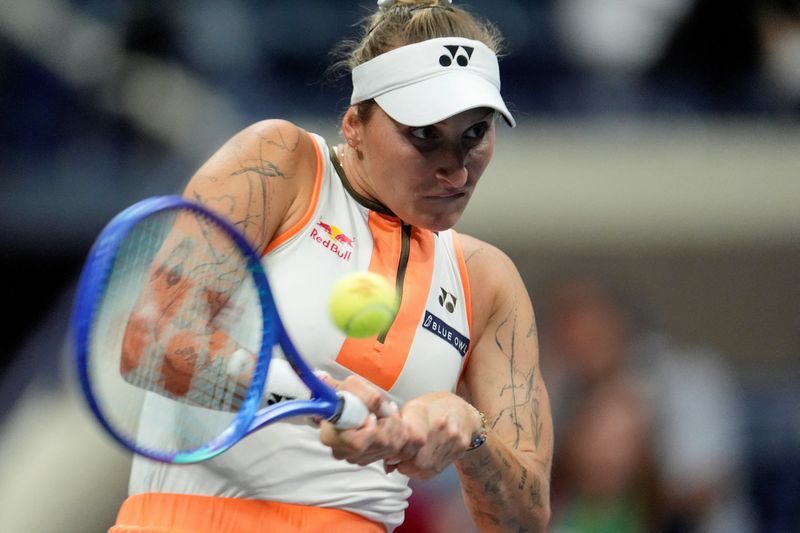
Professional tennis finds itself at a crossroads following the International Tennis Integrity Agency's decision to suspend Marketa Vondrousova for four years after she declined to provide a sample during an out-of-competition test at her Czech home in December. The punishment has become the latest flashpoint in an increasingly fractious relationship between players and the sport's anti-doping guardians, raising fundamental questions about how the balance should be struck between maintaining competitive integrity and protecting individual rights.
Vondrousova, the 26-year-old former Wimbledon champion, had articulated her distress over the incident in April, describing months of accumulated strain and anxiety. The unexpected arrival of a doping control officer at 8:15 p.m., demanding immediate compliance with testing protocols, felt like a profound violation of her personal space and security. Her reluctance to open her door was shaped by a visceral fear rooted in the traumatic 2016 knife attack on fellow Czech player Petra Kvitova at her home—a historical reference point that adds considerable emotional weight to her objections.
The Professional Tennis Players Association has seized on this case as emblematic of broader structural problems within anti-doping governance. The players' advocacy body argues that existing frameworks treat athletes as subjects of enforcement rather than stakeholders with legitimate grievances. The PTPA's statement acknowledged the necessity of testing while asserting that a four-year suspension for someone with a clean competitive history represents a disproportionate sanction, particularly when circumstances involving late-night home visits and undocumented visitors carry genuine safety implications for female competitors.
This dispute cannot be divorced from recent controversies that have tested public confidence in how anti-doping authorities apply their own rules. High-ranked players Jannik Sinner and Iga Swiatek received substantially reduced sentences for positive tests, outcomes that sparked widespread accusations of inconsistent enforcement and potential preferential treatment based on ranking and marketability. These precedents have given the PTPA considerable ammunition in arguing that the process itself lacks transparency and fairness, even if individual cases are decided on technical merits.
The ITIA maintains that its decision-making follows standardised protocols established under the World Anti-Doping Agency framework, which governs athletes across all Olympic sports globally. Karen Moorhouse, the agency's chief executive, emphasised that cases are resolved through objective analysis of facts and evidence, independent of a competitor's profile or commercial significance. This standardisation argument resonates in principle—ensuring that tennis players face the same rules as swimmers, weightlifters, or track athletes preserves consistency across international sport.
Moorhouse's defence of the testing procedures also highlighted the professional standards maintained by anti-doping personnel. Testers receive formal training, carry identification credentials that players may verify independently, and follow protocols that require gender-matched witnesses when conducting examinations. These safeguards are presented as evidence that the system has been designed with both player protection and regulatory integrity in mind, attempting to address safety concerns without compromising the unpredictability essential to effective testing.
Yet the gender-matching provision and credential verification, while necessary, do not fully address the anxiety that materialises when unknown individuals appear unexpectedly at an athlete's residence late at night. For female players particularly, whose vulnerability to violence has been demonstrated through incidents like Kvitova's assault, the risk calculation involved in refusing to answer the door carries emotional stakes that institutional reassurance cannot entirely ameliorate. The tension between testing imperatives and personal security represents a genuine dilemma rather than a matter of simple non-compliance.
The PTPA's earlier litigation against tennis governing bodies, which alleged privacy violations inherent in random testing regimes, underscores the philosophical divide over whose interests should predominate when institutional demands collide with individual autonomy. Rather than seeking to eliminate testing altogether, the players' association has advocated for meaningful consultation in formulating the rules themselves—a structural reform that would grant athletes agency in designing systems that constrain them.
Vondrousova remains sidelined by a shoulder injury since January and has the right to appeal her suspension to the Court of Arbitration for Sport, a venue that may afford opportunity for her specific circumstances to be weighed against established precedent. However, the broader institutional question persists regardless of the outcome in her particular case: should elite athletes have substantive input into the regulatory frameworks that govern their careers, or should such authority rest exclusively with independent anti-doping bodies?
For Malaysian and regional sports audiences, this dispute carries significance beyond tennis. As Southeast Asian athletes increasingly compete at international levels across multiple disciplines, they will operate within anti-doping systems that balance institutional power in favour of regulatory authorities. The principles at stake—transparency, proportionality, athlete voice, and procedural fairness—are universally relevant to how sporting governance functions across all our nations. The Vondrousova case illuminates whether contemporary anti-doping architecture can evolve to accommodate legitimate athlete concerns without sacrificing its core mission of protecting fair competition and clean sport.

