The controversy surrounding the use of government-organised events for political purposes has surfaced once again in Johor, with opposition lawmakers questioning the propriety of a technical education programme that allegedly doubled as a campaign platform. Johor DAP chairman Teo Nie Ching has called on Menteri Besar Datuk Onn Hafiz Ghazi to provide a detailed explanation regarding claims that vocational training students were directed to attend an event that subsequently morphed into a rally for Barisan Nasional support ahead of the state election.
According to Teo's account, the Johor MARA TVET Roadshow held at the Inland Revenue Board Hall in Kluang on July 4 drew complaints from parents and students who alleged they faced pressure to participate. The Deputy Communications Minister revealed that attendees had reportedly been warned that non-attendance would be recorded as absenteeism, creating an obligation for participation that extended beyond voluntary engagement. What transformed the event into a political flashpoint was the allegation that Onn Hafiz subsequently used the platform to openly encourage voters to support the BN candidate, directly invoking the candidate's polling number during his remarks.
The distinction Teo drew during her public remarks cuts to the heart of electoral regulations in Malaysia. She emphasised that the Menteri Besar's participation in a government programme would ordinarily warrant no objection, acknowledging that senior officials routinely attend events related to their portfolios. The difficulty arises when such occasions transition from their stated purpose into vehicles for partisan political messaging. Teo highlighted the fundamental tension: if the gathering was genuinely a government initiative, regulations should have prevented its conversion into a campaigning venue, yet if it functioned as a party event, serious questions emerge about whether a state agency facility can legitimately be deployed for political mobilisation.
The opposition coalition has documented their concerns methodically. Teo indicated that Pakatan Harapan possesses the event itinerary, official correspondence mandating attendance, and video evidence purporting to capture the controversial campaign statements. This documentation provides the factual foundation for scrutinising whether institutional resources were improperly leveraged. The availability of such materials suggests that whatever transpired was sufficiently overt to leave an auditable trace, raising accountability questions that extend beyond mere allegations into demonstrable conduct.
The incident resonates particularly strongly because it intersects with concerns about the treatment of younger citizens in the political process. Teo deliberately reframed her objections beyond partisan calculation, appealing to parental instincts and educational ethics. By emphasising her perspective as a mother rather than a politician, she attempted to elevate the issue above electoral competition into questions about whether students should encounter political pressure within educational contexts. This framing proved rhetorically effective precisely because it questioned institutional boundaries that transcend party politics—the principle that schools and vocational institutions should remain neutral spaces.
Regarding enforcement mechanisms, Teo indicated that the decision to pursue formal complaints would rest with individual Pakatan Harapan candidates contesting the election. Specifically, she referenced the possibility of escalating the matter to the Election Commission, the independent statutory body responsible for overseeing electoral integrity. Such referrals would initiate investigative procedures, though the commission's authority remains circumscribed by existing electoral law. The deferral to candidates reflects the distributed nature of campaign authority within Malaysia's coalition structures, where individual aspirants retain discretion over tactical responses within the broader political strategy.
Simultaneously, Teo launched a secondary critique directed at Onn Hafiz's recent statements questioning federal policies on grounds that they impose hardships on Johoreans. She characterised such pronouncements as intellectually dishonest positioning, arguing that senior state officials cannot simultaneously claim credit for popular initiatives whilst deflecting blame for unpopular measures onto federal colleagues. Her observation points to a recurring pattern in Malaysian politics where state governments selectively appropriate or distance themselves from national policies depending on popularity dynamics. Teo countered that major policy frameworks require Cabinet approval, implying that state leaders cannot genuinely claim exoneration when measures prove unpopular.
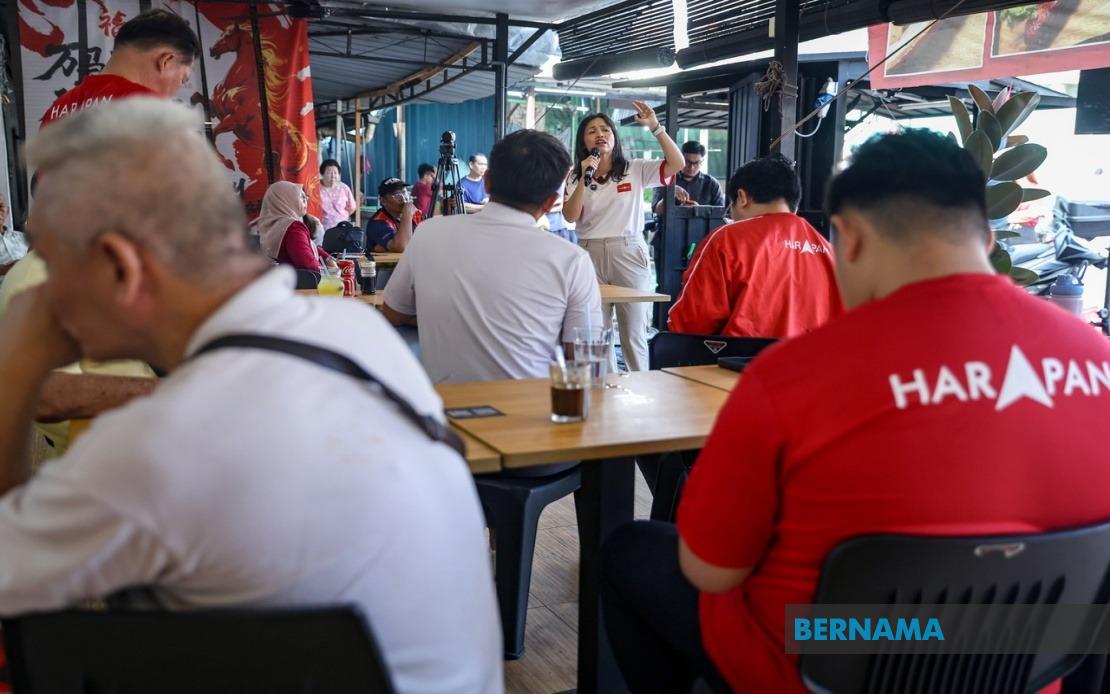
Tan Sri Lim Kit Siang's participation in the Kulai forum where these allegations were aired underscored the gravity that opposition hierarchies attached to the incident. The DAP stalwart complemented the specific grievance with broader messaging concerning electoral choice and national vision. Lim enjoined voters to reject what he characterised as racial politics, instead rallying behind a conception of Malaysian identity rooted in equality, pluralistic freedoms, material prosperity, and institutional respect for human dignity. His invocation of the "Malaysian Dream" attempted to elevate the election campaign beyond transactional politics into philosophical contestation about the nation's foundational values.
Lim's emphasis on consolidated voting rather than fragmented support suggested concern that opposition divisions could disadvantage Pakatan Harapan candidates relative to BN's consolidated machinery. This tactical consideration nested within his broader call for national unity, illustrating how electoral necessity and ideological messaging intersect within opposition rhetoric. The juxtaposition of his abstract vision with concrete concerns about voting patterns revealed the simultaneous operation of principle and pragmatism in election campaigning.
The Johor state election itself encompasses 56 state assembly seats contested by 172 candidates across the constituency, making it a substantial electoral exercise that will determine the state government's composition for the subsequent term. The timing of these allegations during early voting phases, with the main polling day scheduled for July 11, created heightened sensitivity around election conduct. Any substantiation of improper use of government platforms during the pre-polling period could generate momentum for opposition candidates by highlighting institutional accountability concerns that resonate with voters sensitive to good governance considerations.
The underlying tensions exposed by this controversy extend beyond Johor's immediate political context. Across Southeast Asia, questions about the boundary separating government functions from partisan activity remain perennially contested. Malaysian electoral regulations attempt to impose such boundaries through statutory provisions and institutional guidelines, yet enforcement depends upon the willingness of officials to respect these demarcations and regulatory bodies to investigate violations credibly. When senior leaders exploit ambiguities in these boundaries, they effectively test the robustness of institutional safeguards against politicisation.
The incident also illuminates broader questions about resource distribution and institutional autonomy within Malaysian governance. Government facilities and programmes theoretically serve public purposes transcending partisan affiliation, yet competing interpretations of what constitutes appropriate participation by elected officials create practical dilemmas. Whether Onn Hafiz's presence and remarks at the TVET event constituted legitimate engagement with a government initiative or improper instrumentalisation of state resources for party purposes ultimately requires adjudication through the electoral commission's investigative processes and, potentially, through voter judgment in the ballot box.

