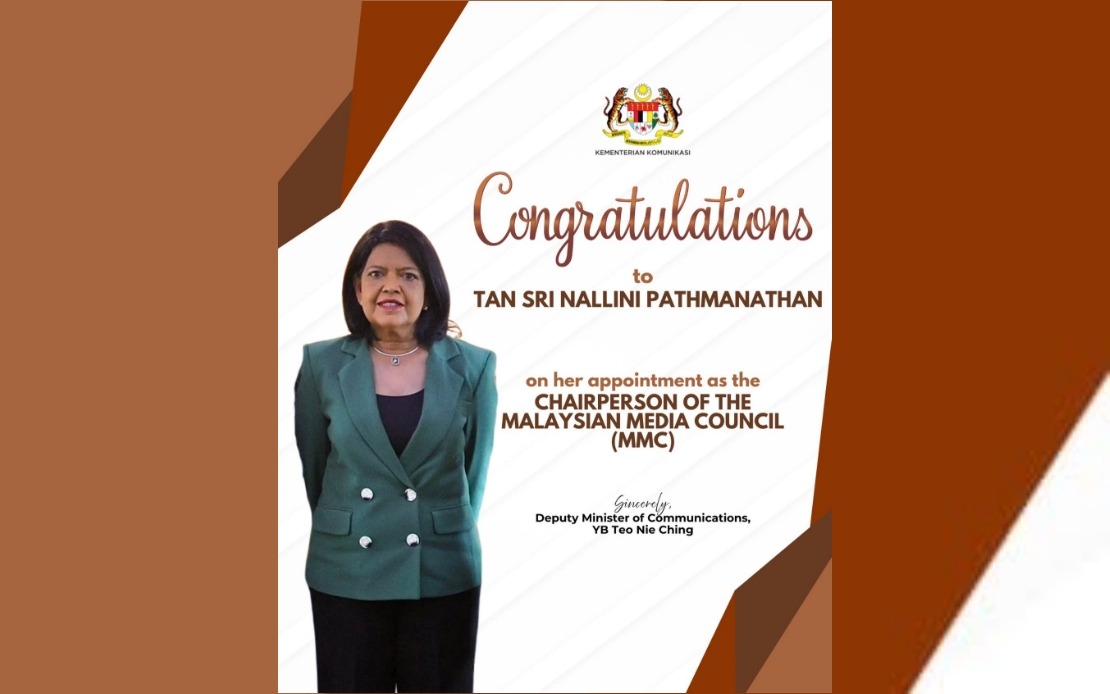
Former Federal Court judge Tan Sri Nallini Pathmanathan has been unanimously appointed as the first chairperson of the Malaysian Media Council (MMC), a self-regulatory body established under the Malaysian Media Council Act 2025, with Deputy Communications Minister Teo Nie Ching lending strong political support to the appointment by publicly endorsing Nallini's suitability for the role.
Teo's endorsement, shared via Facebook following the MMC Board's unanimous decision on May 26, centres on Nallini's demonstrated commitment to protecting constitutional rights and press freedoms throughout her distinguished judicial tenure. Rather than viewing the appointment as routine, Teo has framed it as strategically significant, suggesting that Nallini's judicial philosophy aligns closely with the principles necessary to guide Malaysia's newly created media self-regulatory framework at a critical juncture in the nation's media landscape.
Among the cases Teo highlighted is a contested citizenship ruling where Nallini authored a dissenting judgment advocating for a purposive and compassionate interpretation of Malaysia's constitutional citizenship provisions. The case, CTBE, involved the citizenship eligibility of a child born to a Malaysian father and a foreign mother, with the four-to-three split decision ultimately going against the position Nallini championed. Her willingness to author a moving dissent in such a constitutionally sensitive matter demonstrates an interpretive approach that prioritises substantive justice over narrow textual readings, a characteristic Teo suggests will prove invaluable in shaping media regulation principles.
Equally important to Teo's confidence is Nallini's landmark judgment in a case involving an online news portal and user-generated comments. Nallini ruled that the portal should not bear legal liability for content posted by subscribers, a decision with profound implications for digital media operations across the region. This ruling exemplifies judicial restraint in holding intermediaries accountable for third-party speech, a principle that has become contentious globally as regulators grapple with balancing content moderation obligations against press freedom.
The Malaysian Media Council's establishment in 2025 marks the culmination of decades of industry advocacy, with Teo noting that the achievement followed five decades of petitions, dialogues, and policy recommendations. The lengthy gestation period reflects the inherent tensions between government oversight concerns and industry demands for autonomy, tensions that remain unresolved in many Southeast Asian democracies. Teo's emphasis on this hard-won institutional gain suggests the government views the MMC as a significant democratic infrastructure development.
Teo articulated a principled argument for why self-regulation rather than state-led media governance is essential for press freedom in the Malaysian context. She characterised journalists not merely as commercial operators but as the fourth estate of democracy, a constitutional metaphor that positions media practitioners as systemic pillars rather than economic actors. From this perspective, any direct government intervention in media regulation would inevitably carry the appearance and substance of authoritarian control, thereby delegitimising regulatory efforts and undermining public trust in the regulatory framework itself.
This reasoning carries particular resonance for Malaysia and other Southeast Asian states where historical experiences with state media control remain politically salient. The framing of self-regulation as intrinsically protective of press freedom, as opposed to a dilution of regulatory authority, represents a considered rejection of models where governments maintain direct sanctioning power over editorial decisions. For Malaysian readers, this institutional choice signals a departure from earlier paradigms, though implementation questions remain unanswered.
Nallini's appointment also reflects evolving regional discussions about judicial expertise and media regulation. By placing a retired Federal Court judge at the helm of a self-regulatory body, the Malaysian model attempts to leverage judicial experience in constitutional interpretation while ostensibly insulating the council from political pressures that might affect elected or appointed government officials. This hybrid approach—combining judicial credentials with self-regulatory governance—may offer lessons to other Southeast Asian nations reconsidering their media regulatory architectures.
The implications of Nallini's leadership extend beyond symbolic appointment protocol. Her judicial background suggests the MMC will likely adopt a constitutionally informed approach to media regulation, potentially prioritising substantive rights protection over procedural compliance. However, tensions remain between self-regulation and effective enforcement, particularly regarding digital platforms, misinformation, and transnational content flows that characterise modern media ecosystems. Whether a self-regulatory body can adequately address these systemic challenges while maintaining independence from both state and commercial pressures remains an open question for Malaysia's media community and civil society observers.
For Malaysian readers and regional media practitioners, the MMC's establishment and Nallini's appointment represent a significant institutional development with uncertain outcomes. The council's success will depend on whether it can command respect from both the government and media industry while establishing enforceable standards that enhance journalistic integrity without becoming a vehicle for suppressing critical reporting. Teo's confidence in Nallini's judicial record provides some assurance of principled leadership, though the real test lies in the council's first decisions regarding contested cases and regulatory standards.

