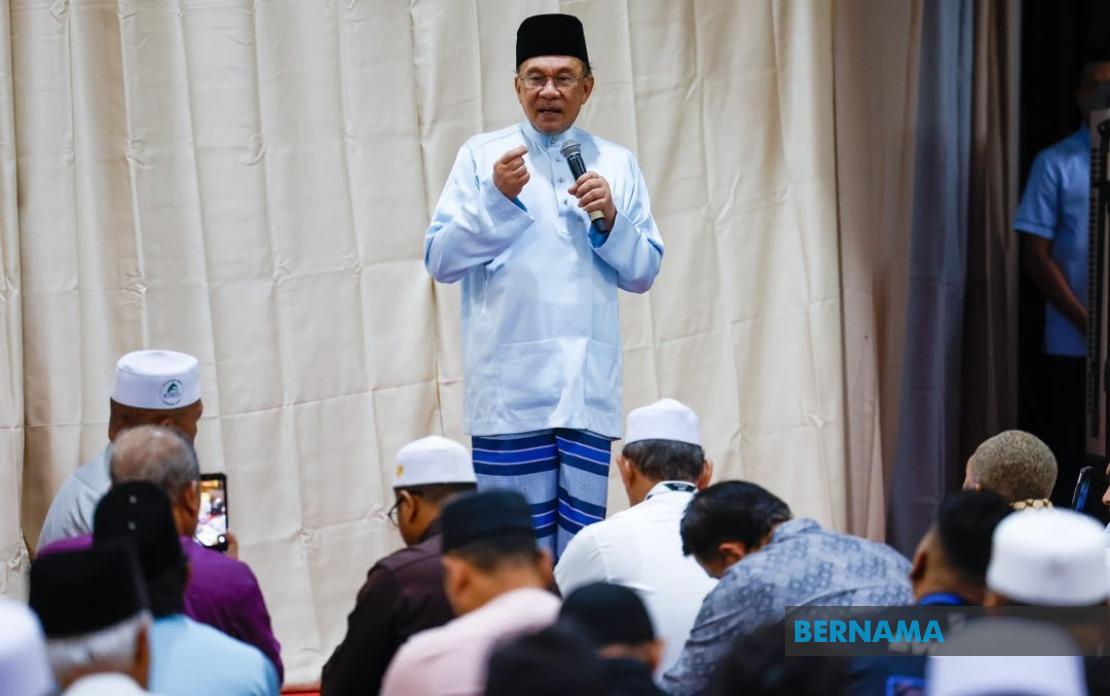
Prime Minister Datuk Seri Anwar Ibrahim has firmly rejected suggestions that the public release of the Royal Commission of Inquiry report on Lembaga Tabung Haji represents political opportunism, instead framing the decision as a fundamental obligation to safeguard the financial interests of millions of Muslim Malaysians who have deposited their savings with the pilgrimage fund.
Speaking at a community gathering in Port Dickson, Anwar stressed that the matter transcends partisan calculations and speaks to the core responsibility of government to maintain fiduciary standards and public accountability. The distinction he drew reflects broader anxieties about institutional integrity and the management of public trust, particularly where religious institutions and communal savings schemes are concerned. For Malaysian Muslims, Tabung Haji represents far more than a financial vehicle—it embodies a cultural and spiritual commitment to the hajj pilgrimage, making the governance of the institution a matter of deep communal concern.
The Prime Minister, who concurrently serves as Finance Minister, highlighted findings in the RCI report that expose a troubling institutional history. Specifically, the report documents that critical warnings issued by Bank Negara Malaysia in 2014 and 2017 regarding Tabung Haji's precarious financial position were not addressed with appropriate urgency or remedial action. These oversight lapses span nearly a decade, suggesting systemic governance failures that allowed vulnerabilities to persist and potentially compound over time. The dormancy of regulatory alerts in the face of explicit central bank concerns raises fundamental questions about accountability layers within government-linked institutions.
Anwar's comments at the Linggi Community Hall event, attended by Negeri Sembilan Menteri Besar Datuk Seri Aminuddin Harun, underscore an emerging political reality: transparency around institutional failures has become a test of administrative credibility. By publicly owning the decision to release the RCI findings, Anwar positions his government as responsive to public interest claims, a posture that carries weight in a Malaysian context where concerns about institutional capture and patronage networks remain salient.
Crucially, the Prime Minister clarified that the RCI investigation itself was not initiated by his administration, a point that moderates potential criticism that the current government weaponized the inquiry for political gain. The Royal Commission was established under the previous administration, lending the report an appearance of institutional independence and temporal distance from contemporary political calculations. This layering of accountability—distinguishing between who commissioned the investigation, who now releases it, and who will discuss it—attempts to construct a narrative of responsible stewardship rather than partisan deployment.
The government's decision to grant all members of parliament the opportunity to debate the report in parliament on August 11 reflects a deliberate choice toward inclusive deliberation. By opening parliamentary discussion, Anwar's administration signals commitment to evidence-based debate and democratic processes, allowing opposition voices and backbenchers equal standing to scrutinize findings and propose remedies. This approach contrasts with more opaque alternatives and may blunt accusations of selective disclosure or partisan framing.
The underlying context makes Anwar's emphasis on protecting depositors particularly resonant. Tabung Haji manages savings from millions of Malaysians, many of modest means, who rely on the institution to accumulate capital for one of Islam's five pillars. Any erosion of the fund's value or institutional credibility directly harms vulnerable households already managing tight financial margins. In this light, the RCI report's revelations about unheeded regulatory warnings carry urgent practical consequences beyond abstract governance discussions.
For Southeast Asian observers, the Tabung Haji situation illustrates broader regional challenges in managing state-linked financial institutions within democratic frameworks. Across the region, sovereign wealth funds, pilgrimage trusts, and developmental financial vehicles often occupy ambiguous spaces between commercial logic and social mission, creating persistent tension over governance standards. Malaysia's approach of eventual transparency and parliamentary debate, while imperfect, represents one model for reconciling these tensions.
The implications for Malaysian depositors extend beyond institutional reform. A comprehensive parliamentary examination of the RCI findings could prompt legislative changes to strengthen governance protocols, accelerate regulatory enforcement mechanisms, and clarify oversight responsibilities. Equally, the public airing of institutional failures creates opportunities for civil society scrutiny and for affected depositors to demand accountability through both formal and informal channels.
Anwar's framing ultimately reflects a calculation that transparency serves the government's long-term credibility more than opacity would. In an environment where public trust in institutions has faced repeated shocks, demonstrating responsiveness to accountability mechanisms—even when investigating predecessors' lapses—becomes a form of political capital. The release of the RCI report and the ensuing parliamentary debate will test whether substantive policy responses follow or whether the exercise remains primarily symbolic.
The August 11 parliamentary debate will reveal whether lawmakers across party lines prioritize depositor protection through robust questioning and remedial proposals, or whether discussion devolves into predictable partisan posturing. The real measure of the government's commitment to fiduciary responsibility will lie not in the rhetoric surrounding the report's release, but in concrete legislative and administrative reforms that follow from parliamentary deliberations.

