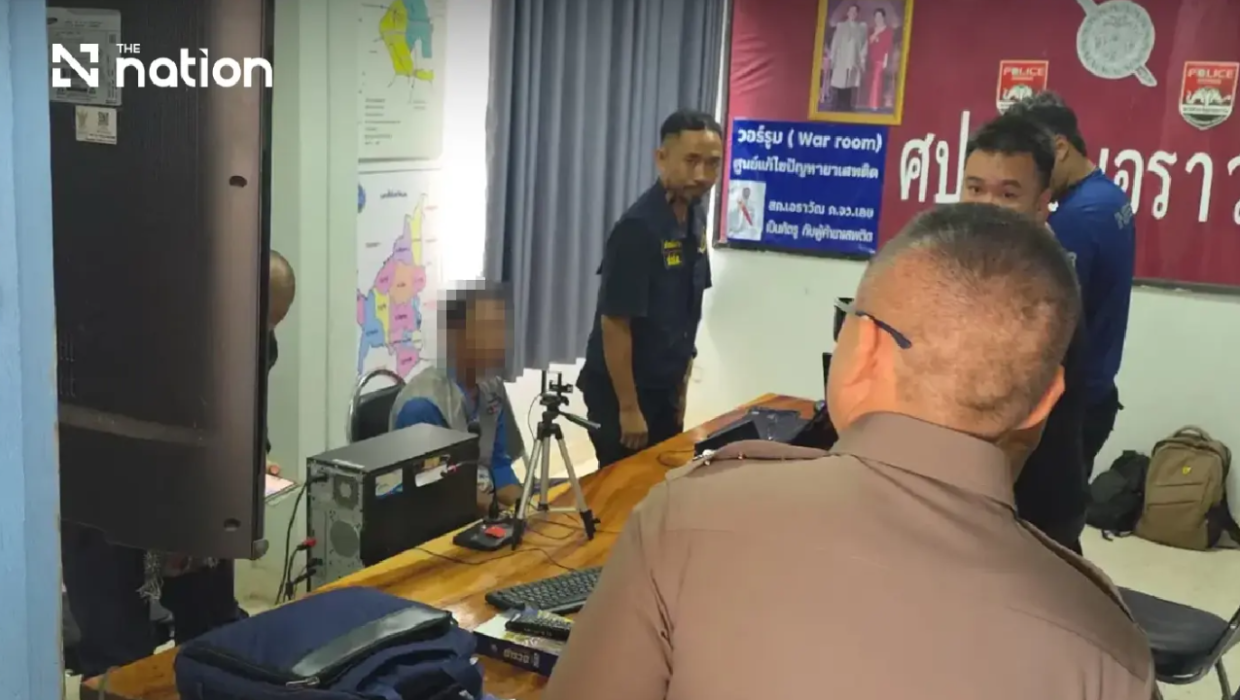
Thai law enforcement has intensified its crackdown on what appears to be a sophisticated cross-border drug smuggling operation, with the arrest of a married couple in Loei province marking a significant development in a case that began with the interception of heroin at Melbourne Airport. The detentions are part of a broader investigation initiated after a Thai Airways flight attendant was apprehended by Australian authorities, suggesting the existence of an organised network capable of moving narcotics across international boundaries using aviation personnel as couriers.
The suspected courier, identified in Thai police reports as Mina, was arrested at Melbourne Airport when approximately one kilogram of heroin was discovered concealed within her luggage. This discovery prompted Thai authorities to pivot their investigation strategy, shifting focus from the individual carrier to the supply chain behind the shipment. Rather than treating the incident as an isolated smuggling attempt, investigators recognised the hallmarks of a larger operation and began systematically tracing the parcel's origins within Thailand.
On Thursday, July 2, officers from Chiang Khan Police Station in Loei province, working alongside agents from the Office of the Narcotics Control Board and related law enforcement units, conducted operations to locate individuals suspected of involvement in the distribution chain. Initial intelligence pointed to a specific address in That subdistrict of Chiang Khan district, but the targets were not found at the location. The investigation then shifted to surrounding areas after authorities learned the suspects had taken employment in the region, demonstrating how participants in such networks often maintain low profiles through casual labour.
The breakthrough came when police traced Athit, a 43-year-old Thai national, to Wat Tham Pha Mak Ho temple in Wang Saphung district, where he was employed in construction work on temple roofing. Removed from the worksite for questioning at Erawan Police Station, Athit reportedly admitted during preliminary interrogation to a damning pattern of activity. According to police statements, he confessed to receiving payments of 8,000 baht, approximately US$240, for each parcel delivery he facilitated over a six-month period.
The logistics of the alleged smuggling operation reveal a deliberate strategy to compartmentalise activities across different locations and couriers. Police records indicate that Athit had sent three parcels through a commercial parcel service operating in Chiang Khan, with two originating from Ban That in That subdistrict and one from Erawan district. These seemingly routine shipments were apparently part of a coordinated supply system, with the most recent parcel dispatched on June 28, 2026, arriving at Bangkok addresses. The choice of commercial parcel services suggests an attempt to obscure the true nature of the contents by utilising seemingly legitimate business infrastructure.
The investigation subsequently led authorities to detain Thatsaphon, Athit's 42-year-old spouse and a Lao national, after officers discovered a black Mitsubishi Triton pickup truck bearing Loei registration parked in a rubber plantation within Erawan district. The vehicle was located in the Pha Nang-Pha Koeng area, a region suitable for discreet activities away from main roads. When questioned at Erawan Police Station, Thatsaphon denied any knowledge of or involvement in the alleged drug operations, though her proximity to key logistics infrastructure and her position within the household network suggest investigators view her as a significant figure in the chain.
Crucially, police identified the source of payments flowing to Athit as a Lao national, indicating the network's transnational character and hinting at broader regional dimensions to the smuggling operation. The involvement of Laotian nationals at critical junctures—both as the initial supplier paying Athit and as Athit's spouse—suggests established connections across the Thai-Lao border, a region long known for illicit trafficking. This border proximity makes the area particularly susceptible to drug transit operations, as traditional enforcement infrastructure often struggles to monitor the porous boundary effectively.
According to statements from the Office of the Narcotics Control Board secretary-general, the case exemplifies the operational methodology favoured by sophisticated international drug networks. These organisations deliberately fragment the smuggling process across multiple individuals at different hierarchical levels, banking on compartmentalisation to prevent the arrest of any single operative from exposing the entire structure. By employing local couriers unfamiliar with the final destination and destination contacts unfamiliar with upstream sources, these networks create breaks in the intelligence chain that complicate law enforcement efforts.
The swift cooperation between Thai and Australian law enforcement agencies, facilitated through formal diplomatic channels and bilateral agreements, proved instrumental in identifying the Melbourne link and tracing it backward to Thai sources. The ONCB has signalled its intention to leverage this international coordination further, indicating plans to intensify cross-border collaboration with foreign agencies to intercept transnational drug movements at transit points, disrupt established transport corridors, and target the financial mechanisms that sustain these operations.
Looking ahead, Thai authorities have expanded the investigative scope beyond the two detainees, explicitly seeking to identify and apprehend individuals who ordered the shipments, provided logistical support, or facilitated financial transactions within the network. This wider net reflects recognition that Athit and Thatsaphon likely occupy mid-tier positions within a larger hierarchy, and that dismantling the operation will require identifying both upstream suppliers and downstream distributors. The case underscores how aviation personnel can be vulnerable to recruitment by trafficking organisations, particularly those with financial pressures or family connections in drug-producing regions.
For Malaysia and other Southeast Asian nations, the case serves as a reminder of the region's persistent vulnerability to transnational drug networks that exploit porous borders, commercial infrastructure, and cross-border family ties. The cooperation demonstrated in this investigation—whereby a drug seizure in Australia prompted comprehensive domestic investigations in Thailand—represents the kind of integrated regional approach that Malaysian authorities increasingly champion. As drug syndicates become more sophisticated in their operational methods, the ability of regional law enforcement to communicate, coordinate, and conduct simultaneous operations across borders becomes essential to disrupting these criminal enterprises before their contraband reaches consuming populations.

