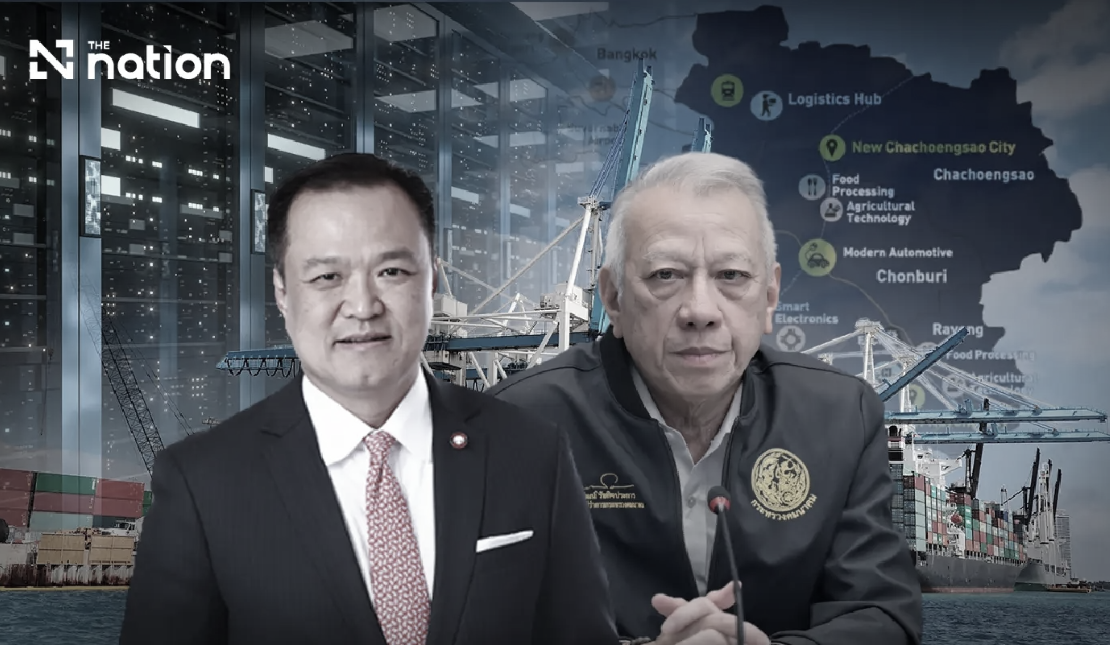
Thailand's Prime Minister Anutin Charnvirakul has reasserted direct control over the Eastern Economic Corridor, signalling a strategic reorientation of one of Southeast Asia's most ambitious regional development projects. The move, formalised through Cabinet orders signed on June 15 and immediately implemented, strips Deputy Prime Minister and Transport Minister Phiphat Ratchakitprakarn of his supervisory role over the EEC Office and his position as chairman of the Eastern Economic Corridor Policy Committee. According to Government House sources, the recentralisation reflects not internal political friction but rather a deliberate repositioning of Thailand's investment flagship to capture emerging opportunities in global food systems and digital infrastructure.
The decision to withdraw authority from Phiphat represents a significant shift in how Thailand intends to market its eastern region to foreign investors. Rather than continuing to emphasise the EEC's traditional strengths in heavy manufacturing and petrochemicals, Anutin now intends to position himself as the face of Thailand's investment pitch, personally overseeing the rebranding exercise. This personalisation of the EEC portfolio at the Prime Minister's level underscores the strategic importance Bangkok now attaches to reversing years of sluggish investment momentum and repositioning the corridor as a competitive destination within an increasingly crowded Southeast Asian landscape.
The acceleration towards food security as a primary investment pillar reflects deeper calculations about global market trends and Thailand's regional advantages. The eastern region possesses substantial capabilities in livestock production, commercial fisheries, large-scale agriculture, and horticultural exports—sectors experiencing renewed international demand as food supply chains become increasingly fragmented and countries pursue localised procurement strategies. This pivot acknowledges that Thailand's agricultural heartland, concentrated in the eastern provinces, represents untapped potential for attracting agribusiness investors seeking reliable sourcing and processing capacity close to Asian consumption centres. By framing food security as a strategic national asset rather than a commodity sector, the government signals to foreign corporations that Thailand can be a cornerstone of their supply chain resilience efforts.
The data centre pillar of this strategy addresses a more immediate infrastructure opportunity, one that has gained urgency as major technology companies seek geographically distributed server capacity across Asia. Thailand's positioning as a regional tech hub has improved substantially in recent years, yet the eastern provinces have remained peripheral to this narrative. The EEC's designation as a potential data centre cluster would require substantial coordination across multiple government agencies—energy, telecommunications, water resources, and local administration—to address the sector's demanding requirements for reliable power, high-capacity water supply for cooling systems, and redundant telecommunications backbone infrastructure. These infrastructure needs have proven challenging precisely because the EEC's existing industrial base already strains provincial electricity and water networks, a constraint that has previously limited expansion of energy-intensive manufacturing.
This infrastructure bottleneck reveals the underlying logic driving the strategic pivot. Rather than intensifying competition with other Southeast Asian industrial zones for heavy manufacturing investment, which would only exacerbate resource constraints, Thailand is deliberately repositioning the EEC towards sectors with different value propositions. Data centres and food processing offer higher value-added revenue potential per unit of resource consumption than traditional petrochemical or automotive component manufacturing. The government's simultaneous decision to create a new electricity user category, Type 9, specifically for data centre operations—with tariff structures reflecting higher power consumption—demonstrates how regulatory frameworks are being adjusted to accommodate this sectoral transition. Such measures suggest Thai officials recognise that conventional industrial policy tools have exhausted their effectiveness in the eastern region.
The explanation provided by Government House sources regarding Phiphat's voluntary relinquishment of the EEC portfolio merits scrutiny within the broader context of Thai bureaucratic politics. The assertion that Phiphat himself proposed the transfer due to friction between the EEC Office and the Board of Investment offers a face-saving narrative that allows both figures to characterise the move as collaborative administrative rationalisation rather than a power reduction. Phiphat's subsequent public comments—noting that he had received no advance notice and learned of the orders only during Cabinet proceedings—suggest a more abrupt transfer of authority than the harmonious account provided by government sources. His defensive statements denying any reduced role or party-level tension within Bhumjaithai, Anutin's political party, further indicate that the reshuffle carried implications he felt compelled to address.
Official denials that the reshuffle relates to disputes over the high-speed rail project connecting Bangkok's three major airports appear somewhat unconvincing given the timing and context. Phiphat had taken a notably firm position against amending the original contract structure for the Asia Era One concession, resisting pressure to shift from a conventional build-before-payment model to an alternative arrangement tying government disbursements to construction progress. This contractual dispute has paralysed the project for years despite the original concession agreement being signed in 2019. The fact that Phiphat's resistance to contract amendments coincided with his loss of the EEC portfolio suggests that removing him from oversight positions may facilitate more flexible negotiating positions on infrastructure contracts deemed strategically important.
Anutin's reported questioning of Phiphat regarding a proposed Disneyland development within the EEC adds another dimension to the administrative reshuffle. The Prime Minister's inquiry about timelines for this entertainment complex, coupled with scepticism about whether financial returns would justify capital investment, signals a broader desire to impose greater scrutiny on EEC initiatives. This critical approach contrasts with the more permissive posture that may have characterised earlier oversight arrangements. The focus on justifying large-scale investments through rigorous economic analysis—rather than accepting speculative development proposals—suggests that centralising EEC authority under the Prime Minister creates tighter control over which projects receive institutional backing and promotional support.
For Malaysian and broader Southeast Asian observers, Thailand's recalibration of the Eastern Economic Corridor carries implications for regional competition and investment flows. Thailand's deliberate positioning of food security and data centre infrastructure as primary attraction points may reshape how multinational corporations evaluate investment locations across the region. Malaysia, Indonesia, and Vietnam have pursued comparable strategies in recent years, but Thailand's explicit framing of the eastern region as a global food security solution represents a distinctive angle that addresses post-pandemic anxieties about supply chain fragmentation. Additionally, the regulatory flexibility demonstrated through creating new electricity tariff categories specifically for data centres suggests Thai authorities are willing to adjust policy frameworks rapidly in pursuit of high-value investment targets.
The EEC's evolution also reflects broader tensions in Thailand's development model. The eastern region's original conception emphasised heavy industrialisation and petrochemical clustering—a model that has delivered tangible economic gains but has also generated environmental pressures and resource constraints that limit further expansion along conventional lines. By consciously pivoting towards food security and digital infrastructure, Thai policymakers acknowledge that industrial-era development paradigms have reached their practical limits in densely settled regions. This recognition positions Thailand somewhat ahead of other Southeast Asian economies still pursuing maximal industrial clustering regardless of environmental and resource consequences. Yet the success of this repositioning strategy remains contingent upon whether foreign investors actually view the eastern region as a credible platform for food security and data centre operations, or whether the rebranding exercise merely reflects administrative reorganisation without corresponding market-side changes in investment flows.

