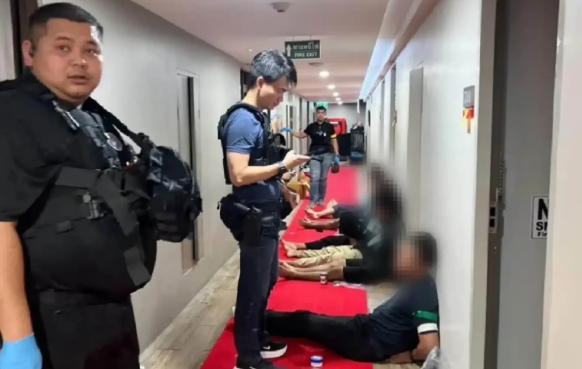
Thailand's police have completed a significant raid on a luxury hotel in Nonthaburi province that allegedly functioned as a clandestine hub for gambling, drug distribution and illicit services targeting Chinese clientele. The Central Investigation Bureau, working through its Crime Suppression Division, executed the operation at a property on Ngam Wong Wan Road in Bang Khen subdistrict following sustained intelligence gathering. Authorities described the setup as part of what they termed a "grey dragon" network — a reference to illicit Chinese capital operations that operate in opacity across Southeast Asia, exploiting weak regulatory oversight and corruption vulnerabilities to establish shadow enterprises.
The raid, designated Operation "Dragon Nest," represented a coordinated response to community complaints that had accumulated over several months. Residents and local business owners had reported suspicious activity at the hotel, particularly noting that the establishment seemed to operate differently from conventional hospitality venues. Rather than welcoming walk-in tourists and ordinary guests, the property appeared to function as a closed compound with restricted access. Witnesses observed that Chinese nationals were entering and exiting at irregular hours throughout the day and night, suggesting a membership-based or invitation-only model of operation. This pattern of activity eventually prompted concerned citizens to alert police authorities, triggering a formal investigation that would culminate in the coordinated enforcement action.
Investigators discovered that Chinese investors had allegedly leased the entire hotel and repurposed its infrastructure to serve their specific business model. The property's structural layout was reorganised to compartmentalise different illegal activities across separate sections. The lower floors, specifically levels two through six, functioned as residential accommodation where patrons and operatives could lodge without leaving the premises. This arrangement minimised exposure and movement through public spaces, reducing the likelihood of detection. The upper floors, particularly levels seven and eight, had been converted into dedicated spaces for what authorities characterised as drug-fuelled entertainment gatherings, gaming tables with various casino offerings, and arranged sexual encounters. This vertical segregation of activities within a single building created an all-encompassing vice operation accessible to a restricted clientele.
The enforcement action itself demonstrated significant police mobilisation and planning. More than 100 officers from multiple specialised units surrounded the hotel and executed simultaneous searches under authority of a Criminal Court-issued warrant. The operation yielded a substantial haul of evidence and detained approximately 40 individuals found within the premises at the time of the raid. Among those arrested was a 33-year-old Chinese national facing charges related to commercial drug trafficking. Police accused him of possessing ketamine — a Category 2 psychotropic substance under Thai drug classification — in quantities and circumstances suggesting intent to distribute rather than personal consumption. Three Myanmar nationals were also taken into custody on immigration violations, specifically for unlawfully entering and remaining in Thailand without proper documentation or permission.
The material evidence seized during the operation provides insight into the operational sophistication of the network. Officers recovered more than 200 distinct items from the premises, including substantial quantities of ketamine and "happy water," a colloquial reference to pharmaceutical-grade GHB or similar date-rape drugs commonly used in club and party contexts. Police also discovered manufacturing and packaging equipment, suggesting that some drug processing occurred on site rather than simply serving as a distribution point. The gaming infrastructure recovered included professional-grade casino equipment such as chips, playing cards, dice, baccarat scoring sheets and hi-lo equipment — apparatus typically associated with organised gambling operations rather than casual domestic gaming. The search also uncovered cash in multiple currencies, banking records, numerous mobile devices and extensive CCTV footage, all indicating a professionally managed enterprise with documented transactions and surveillance systems.
Initial interrogation of the detained Chinese suspect revealed the hierarchical structure common to such operations. The individual maintained that he was merely an employee executing instructions from supervisors rather than a principal organiser. He denied personal responsibility for drug trafficking, claiming he functioned solely as a delivery mechanism following orders transmitted through the command hierarchy. This defensive posture is standard among operatives in transnational criminal networks, where compartmentalisation insulates higher-level organisers from direct exposure to trafficking charges. The Myanmar nationals, by contrast, reportedly cooperated with questioning and acknowledged entering Thailand illegally to seek employment. Their presence suggests that such operations recruit low-skilled migrant workers from neighbouring countries who lack documentation and consequently possess little bargaining power within the employment relationship.
This case illuminates broader patterns of cross-border criminal organisation within Southeast Asia. The deliberate targeting of Chinese clients, combined with apparent capital investment from Chinese sources, reflects how transnational networks exploit ethnic and linguistic connections to establish underground economies in neighbouring jurisdictions. Thailand, with its well-developed tourism infrastructure, established Chinese diaspora communities, and notorious regulatory vulnerabilities in certain sectors, has become an attractive location for such ventures. The hotel setting specifically offers particular advantages: it provides legitimate commercial cover, built-in security infrastructure, controlled access points, and ready-made accommodation facilities that discourage clients from venturing into public spaces where they might encounter authorities or witnesses.
The implications for Malaysian readers extend beyond simple criminal justice interest. Malaysia faces similar vulnerabilities as a transit and destination point for such networks. The Malaysian Chinese community, the country's significant tourist infrastructure in urban centres, and ongoing concerns about underground gambling and drug operations suggest that comparable operations may exist domestically or use Malaysian territory as a logistical base. The sophistication demonstrated in the Thai case — compartmentalised facilities, professional equipment, multiple revenue streams, and documented record-keeping — represents an operational model that could easily be replicated elsewhere in the region. Regional law enforcement agencies share intelligence about such networks, and Thai authorities' success in dismantling this particular operation may prompt preventive action by counterpart agencies across Southeast Asia.
The arrests and material seizures were transferred to Rattanathibet Police Station for formal legal processing and prosecution proceedings. Thai authorities indicated that further investigations would pursue the command structure and financial networks sustaining the operation, suggesting that those detained may face pressure to reveal higher-level organisers and funding sources. The case demonstrates that despite Thailand's reputation for certain regulatory challenges, sustained police investigation and community reporting can generate successful enforcement outcomes. The scale of resources deployed — more than 100 officers and a Criminal Court warrant — reflects official classification of the matter as sufficiently serious to warrant coordinated, capital-intensive police action. For Southeast Asian nations concerned about transnational organised crime, the operation offers both a cautionary lesson about vulnerability to such networks and a practical model of effective inter-agency coordination.

