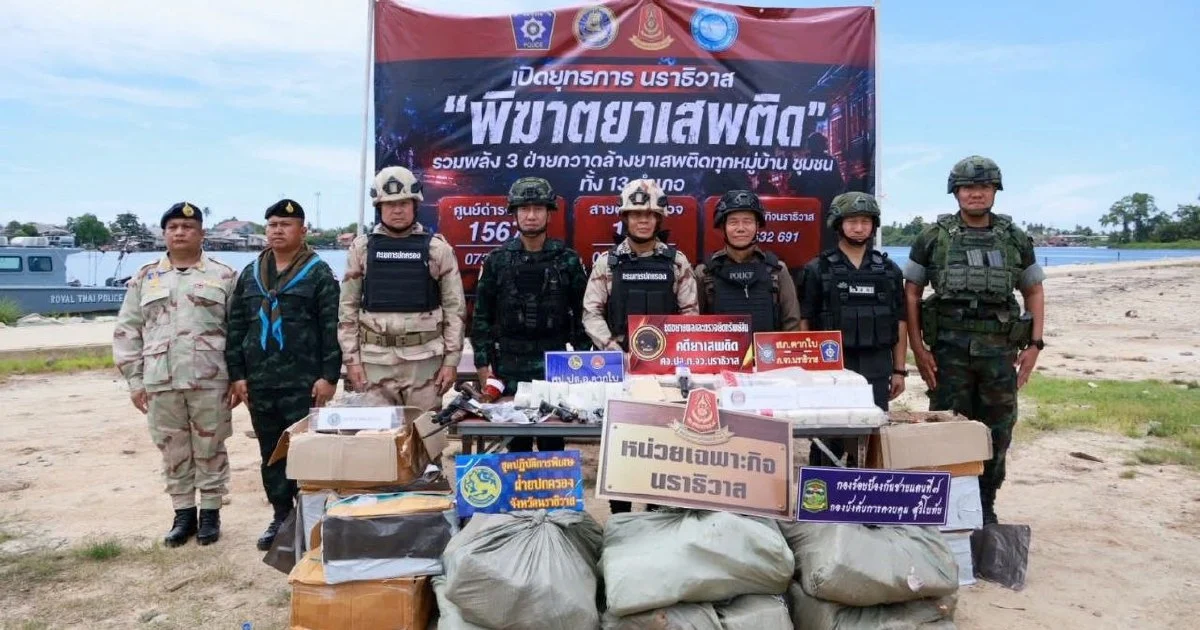
Thai authorities have successfully disrupted a significant cross-border drug trafficking operation, arresting 233 suspected members of organised smuggling networks in Narathiwat province during an intensive month-long enforcement campaign. Intelligence gathered during the crackdown suggests that some of the detained individuals maintained direct operational links with Malaysian-based drug trafficking syndicates, highlighting the transnational nature of narcotics distribution networks operating across the shared border region.
The scale of the operation reflects the growing sophistication of drug trafficking enterprises that exploit the porous borders between Thailand, Malaysia, and other Southeast Asian nations. Authorities intercepted shipments valued at approximately RM1.2 million during the enforcement drive, preventing substantial quantities of illegal substances from reaching street-level distribution networks. The successful intervention represents a significant disruption to supply chains that rely on moving contraband through established corridors, many of which are known to operate with assistance from corrupt officials or inadequate border monitoring infrastructure.
Narathiwat province, located in Thailand's southernmost region along the Malaysian frontier, has long served as a critical transit point for drug trafficking operations moving products between regional production hubs and consumer markets. The province's geography, combined with historically fragile security conditions and complex tribal and ethnic networks, has created an environment where criminal enterprises can establish protected operations. Seizures in this region often reflect broader patterns of narcotics flow affecting Malaysia's northern states, particularly Kedah, Perlis, and Kelantan, where street-level consumption and local distribution networks depend substantially on supplies originating from or transiting through southern Thai provinces.
The identification of alleged connections between arrested Thai suspects and Malaysian criminal organisations underscores how regional trafficking has evolved into an integrated enterprise. Rather than operating as isolated national operations, drug syndicates now function as interconnected networks that coordinate procurement, logistics, and distribution across multiple jurisdictions. This integration allows them to exploit regulatory gaps, diversify risk through geographical distribution, and leverage comparative advantages in different markets. The involvement of Malaysian networks suggests that contraband intercepted in Thailand was destined for domestic consumption or further redistribution to other Southeast Asian markets.
The enforcement campaign conducted by Thai authorities appears to have incorporated intelligence-sharing protocols and operational coordination with regional partners. The month-long duration suggests a coordinated effort targeting multiple suspected facilities, supply caches, and operational personnel simultaneously. Such comprehensive approaches have proven more effective than reactive interdiction efforts, as they dismantle infrastructure rather than merely removing individual shipments. The scale of arrests—233 individuals—indicates that authorities moved systematically through identified networks, potentially using initial detainees to generate leads for expanding the investigation.
For Malaysian law enforcement agencies, the operation carries significant implications for domestic drug control efforts. A disruption of Thailand-based supply sources creates temporary market pressures that may drive price increases and supply shortages in Malaysian consumption networks. However, these disruptions often encourage trafficking organisations to develop alternative sourcing arrangements, potentially shifting procurement to other production regions or facilitating increased local manufacturing of synthetic drugs. Malaysian authorities will likely experience subsequent surges in activity as syndicates adjust operational protocols and redistribute contraband through alternative routes.
The involvement of Malaysian trafficking networks in cross-border operations reflects the continuing demand for narcotics within Malaysian consumer populations. Despite sustained enforcement efforts and substantial investment in drug control initiatives, Malaysia's street markets remain attractive targets for regional suppliers. The country's infrastructure, including its developed transportation networks and commercial hubs, facilitates rapid distribution. Additionally, the relative prosperity of Malaysian markets compared to adjacent regions supports higher price points for refined products, incentivising regular supply flows.
Cross-border cooperation remains essential for managing these transnational criminal enterprises. While the Thai operation represents successful enforcement at a singular point in trafficking chains, sustained momentum requires ongoing intelligence collaboration and coordinated action across the Malaysia-Thailand border. Previous joint operations between Thai and Malaysian authorities have yielded significant results, though resource constraints and differing operational priorities sometimes limit consistency. The current operation demonstrates that when resources align, substantial progress in disrupting organised trafficking becomes achievable.
The specific identification of alleged Malaysian connections within the arrested cohort suggests that Thai investigators have developed sufficient evidentiary material to support potential extradition requests or cross-border prosecutions. The presence of such linkages in the official record indicates recognition by Thai authorities that these networks operate as integrated units rather than separate national operations. This framing may facilitate future judicial cooperation and potentially lead to coordinated prosecutions that disrupt not just individual participants but the organisational structures enabling sustained trafficking.
The RM1.2 million seizure, while substantial, represents only a fraction of total narcotics volumes transiting the region. Enforcement agencies estimate that interception rates in cross-border contexts typically range between 10 to 30 percent, suggesting that multiple operations of similar or larger scale continue operating successfully. The arrested individuals, though significant numerically, likely represent distribution and logistical personnel rather than the higher-level organisational architects directing operations. Sustained pressure on these networks requires ongoing enforcement combined with parallel efforts addressing demand factors in consuming markets.
Looking forward, the operation underscores the necessity for Malaysia to maintain robust intelligence capabilities focused on cross-border criminal networks and to allocate adequate resources to northern border security infrastructure. The successful disruption achieved by Thai authorities demonstrates what sustained, coordinated effort can accomplish, while the continuing flow of drugs suggests that episodic operations, however successful individually, cannot permanently disrupt established trafficking networks. Only comprehensive strategies combining border security, domestic enforcement, international cooperation, and demand reduction can create conditions for meaningful progress in controlling narcotics trafficking.

