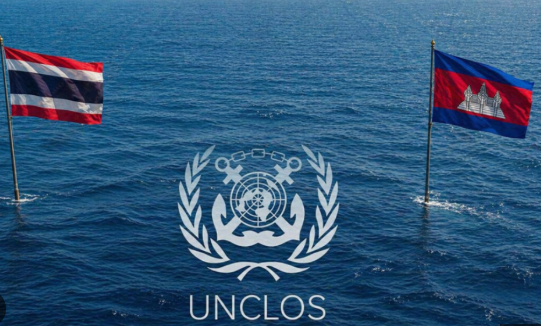
Thailand has formally accepted Cambodia's compulsory conciliation request under the 1982 United Nations Convention on the Law of the Sea regarding their long-contested maritime boundary in the Gulf of Thailand. The Thai Ministry of Foreign Affairs submitted its official response on June 19, more than two weeks after Cambodia initiated the process on June 2, signalling Bangkok's willingness to engage with the international legal mechanism while maintaining firm parameters around what it considers negotiable. Thailand's acceptance, however, comes with significant qualifications that underscore the government's determination to preserve flexibility in how the dispute ultimately resolves.
The crux of Thailand's position centres on the nature of the conciliation process itself. Thai officials have been careful to distinguish between compulsory conciliation and binding arbitration or litigation, emphasizing that the exercise will generate recommendations rather than enforceable judgments. According to Unclos Annex V, any report produced by the conciliation commission—including its conclusions or recommendations—carries no legal obligation for either party. This distinction holds particular importance for Thailand, which has sought throughout the maritime dispute to retain control over final settlement terms rather than submit to external adjudication. By accepting the process while stressing its non-binding character, Bangkok signals both diplomatic engagement and preservation of sovereign decision-making authority.
The composition of the conciliation commission reflects careful institutional planning by both nations. Thailand appointed Deputy Prime Minister and Foreign Minister Sihasak Phuangketkeow as its Agent in the proceedings, elevating the diplomatic rank of its representation. Songchai Chaipatiyut, Thailand's ambassador to Kuwait and a veteran of the Department of Treaties and Legal Affairs, serves as Deputy Agent, providing specialized legal expertise to complement the political leadership. Thailand also nominated two international law experts: Judge Albert J Hoffmann of South Africa and Judge Rudiger Wolfrum of Germany, both recognized authorities on maritime law. These appointments position Thailand to present technically rigorous arguments while ensuring high-level political involvement in steering the proceedings.
The conciliation process itself follows a structured timeline established under Unclos provisions. The four conciliators already appointed by Thailand and Cambodia have 30 days from Thailand's formal response to select a neutral chairperson—the fifth conciliator—who will direct the commission's work. Once constituted, the full commission is expected to complete its report and recommendations within approximately 12 months, though both countries may agree to extend this period if needed. This predictable schedule provides both nations with clarity on when recommendations might emerge, allowing them to plan diplomatic strategies accordingly. The relatively compact timeframe also prevents the dispute from languishing in indefinite procedural limbo.
Thailand has deliberately circumscribed the scope of conciliation to maritime boundary delimitation, seeking to exclude other dimensions of the broader energy and resource-sharing relationship. The Foreign Ministry noted that Cambodia's original notification appeared to encompass not only boundary delimitation but also provisional arrangements for joint development and equitable distribution of hydrocarbon resources. Bangkok's insistence on limiting discussion to boundary delimitation alone reflects strategic preference for separating the technical maritime law question from the more complex negotiations over energy cooperation. This scope limitation, if accepted, would prevent the commission from recommending resource-sharing arrangements that Thailand might find economically disadvantageous.
The underlying dispute concerns overlapping maritime claims in the Gulf of Thailand, an area believed to harbour substantial natural gas reserves and other hydrocarbon deposits. The economic stakes are considerable, as control over maritime boundaries directly determines which nation possesses exploration and extraction rights within its exclusive economic zone. This economic dimension has long complicated the boundary dispute, intertwining pure maritime law questions with resource nationalism and development ambitions. For both Thailand and Cambodia, the conciliation represents an opportunity to obtain expert guidance on where legitimate boundaries should be drawn according to international maritime law principles, potentially clarifying overlapping claims that have generated friction for decades.
Thailand's recent decision to terminate the 2001 memorandum of understanding with Cambodia, officially designated as MoU 44, set the stage for pursuing the conciliation route. Prime Minister Anutin Charnvirakul justified the termination by noting the lack of substantive progress over 25 years of operation under that framework. The Thai government characterized the cancellation not as hostile action or withdrawal from maritime engagement, but rather as institutional recalibration aimed at updating cooperation mechanisms. By terminating the outdated MoU while simultaneously accepting Unclos conciliation, Thailand has attempted to transition toward a clearer legal framework based on international maritime law rather than bilateral accommodation that had produced minimal results.
The conciliation mechanism represents a middle path between purely bilateral negotiation and binding international arbitration. Unlike litigation before the International Court of Justice or arbitral tribunals, conciliation emphasizes cooperative problem-solving and facilitated dialogue rather than adversarial adjudication. The conciliators function as neutral facilitators who listen to both parties' positions, comprehend the historical and strategic context underlying the dispute, and propose solutions designed to prove mutually acceptable. This collaborative ethos theoretically reduces the adversarial temperature compared to formal legal proceedings, potentially preserving diplomatic relationships while addressing the technical maritime boundary question.
Thailand's repeated emphasis that conciliation outcomes remain non-binding reflects deeper anxieties about relinquishing control over the dispute's resolution. Even if the commission produces well-reasoned recommendations grounded in maritime law principles, Thailand retains the sovereign right to reject those recommendations and continue negotiations on its own terms. This flexibility proves particularly valuable given the energy resources at stake and domestic political sensitivities around natural resource management. The government can present acceptance of conciliation as demonstrating commitment to international law and peaceful dispute resolution while simultaneously reserving the option to negotiate bilaterally on more favourable terms if the commission's recommendations prove unsatisfactory.
Cambodia's initiation of compulsory conciliation signals its preference for international legal processes to resolve the dispute, presumably reflecting confidence that neutral experts applying Unclos principles will favour Cambodian claims or at least provide authoritative guidance that supports Cambodia's negotiating position. For Cambodia, the conciliation process offers a mechanism to move beyond stalled bilateral discussions that have failed to produce agreement for decades. The aspiration toward peaceful resolution through international law frameworks reflects both regional norms favouring peaceful dispute settlement and Cambodia's calculation that structured international processes might prove more favourable than ad hoc bilateral bargaining with a larger neighbour.
For Southeast Asia more broadly, this conciliation represents a significant test of how Unclos mechanisms function in resolving substantive maritime disputes among countries with overlapping claims. The region contains numerous unresolved maritime boundary questions—involving Vietnam, the Philippines, Malaysia, Brunei, Indonesia, and Thailand among others—that could potentially follow similar conciliation routes if bilateral negotiations continue to stall. The Thailand-Cambodia process thus offers valuable precedent on how international maritime law mechanisms operate in practice, what timeline and costs conciliation entails, and whether expert recommendations prove sufficient to unblock deadlocked territorial disputes. The outcomes and lessons from this conciliation will likely influence how other regional actors approach their own maritime controversies.
Thailand's acceptance of conciliation while maintaining that any recommendations remain non-binding represents a pragmatic diplomatic compromise that satisfies international legal obligations and cooperative norms while preserving strategic flexibility. The government can simultaneously demonstrate commitment to peaceful, lawful dispute resolution and maintain the option to reject unfavourable recommendations and continue bilateral negotiations. As the conciliation process unfolds over the coming months, both Thailand and Cambodia will navigate between cooperating within the formal procedures and positioning themselves advantageously for whatever subsequent bilateral negotiations may follow. The success of this mechanism will depend substantially on whether the conciliators' recommendations prove sufficiently authoritative and well-reasoned that both nations find them useful as foundations for eventual bilateral settlement, rather than merely advisory documents that allow continued stalemate.

