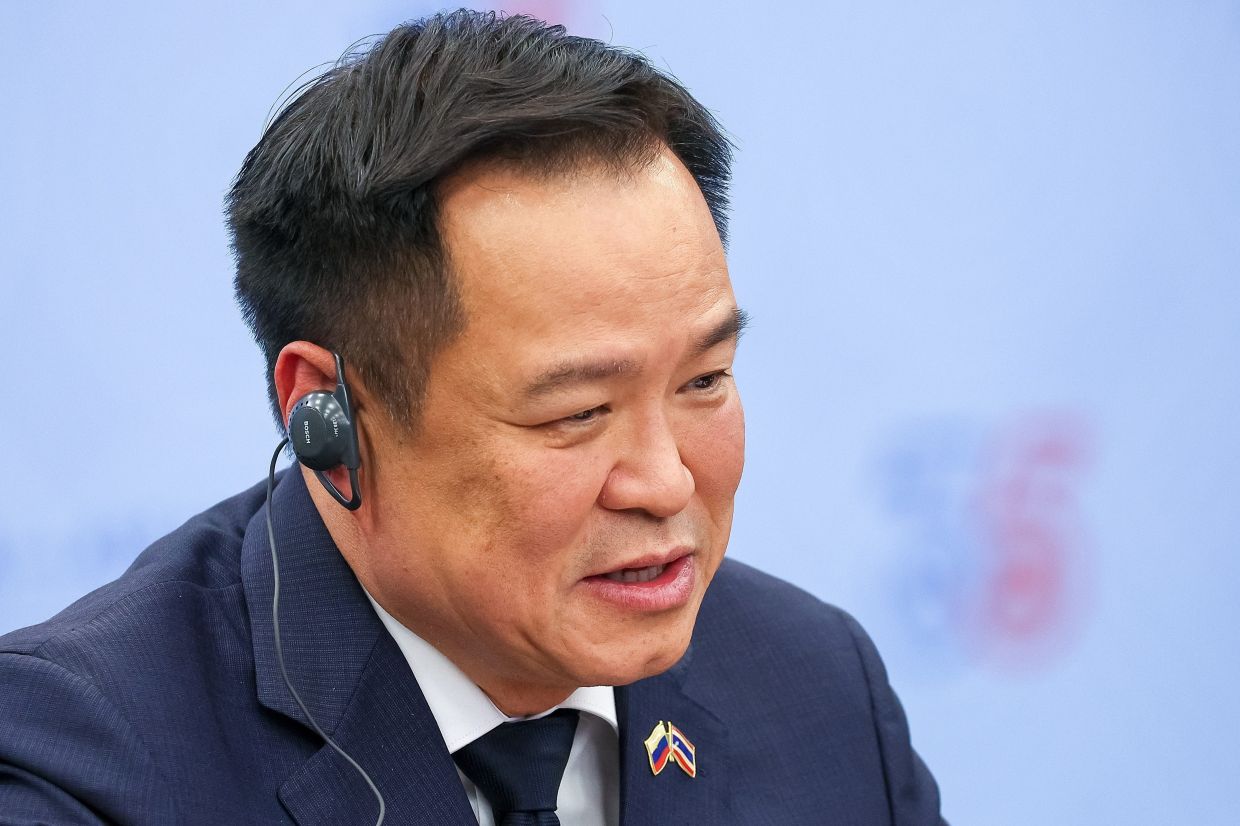
Prime Minister Anutin Charnvirakul, sworn in on March 20 as Thailand's 32nd prime minister following his re-election victory in February 2026, has earned mixed assessments for his opening hundred days in office. While observers credit him with preserving political stability and navigating an acute energy crisis sparked by regional turmoil, his administration faces criticism for sidestepping deeper reforms needed to address Thailand's sluggish growth, mounting household debt, and demographic decline.
Anutin's first major challenge arrived almost immediately after taking office. The February 28 US-Israel attacks on Iran disrupted global oil supplies, triggering panic buying at Thai petrol stations and pushing fuel prices upward. The subsequent instability in the Strait of Hormuz, critical to regional shipping, exposed Thailand's vulnerability to maritime crises beyond its borders. Oil prices climbed above US$100 per barrel for extended periods, threatening to destabilise consumer confidence and industrial costs across the kingdom.
The government's response demonstrated tactical competence. Bangkok tapped the national Oil Fuel Fund to subsidise retail fuel prices, reducing purchasing power pressure on households and businesses. Simultaneously, it lowered borrowing costs for farmers and industrial operators to cushion the economic impact. Coal-fired power plants ramped up to full capacity while authorities diversified energy sourcing by expanding imports from the United States, Malaysia, and Brunei. Mathis Lohatepanont, a political science researcher at the University of Michigan, observed that Anutin "has managed to deal with the disruption for the time being" and "managed to avoid further instability" despite supply disruptions and sharp price increases. Notably, the crisis produced no mass street protests, suggesting public acceptance of the government's crisis management.
Beyond immediate firefighting, Anutin capitalised on nationalist sentiment to consolidate support among his Bhumjaithai Party base and broader Thai voters. His campaign pledge to take a harder line on the long-simmering Cambodia border dispute proved politically rewarding. As premier, he unilaterally terminated the 2001 bilateral pact with Cambodia concerning disputed overlapping maritime boundaries, escalating the issue to United Nations arbitration. He also maintained the military's lead role in border protection operations, signalling resolve to secure Thailand's territorial integrity. This approach reinforced his party's electoral coalition while positioning Anutin as a guardian of national interests.
The government delivered rapid wins on domestic welfare through the "Thais Help Thais Plus" scheme, launched June 1, which grants eligible citizens access to selected goods at 40 per cent of retail price, with the government covering the remainder. The programme targets approximately 30 million citizens aged 18 and above without state welfare cards or access to previous assistance initiatives, backed by a 176 billion baht (US$5.27 billion) allocation. This subsidy scheme proved popular and satisfied campaign promises, boosting consumption among lower and middle-income groups while demonstrating swift executive action. However, analysts regard it as temporary relief rather than structural intervention.
Those same observers increasingly question whether the government possesses appetite for substantive reform. Puangthong Pawakapan of Chulalongkorn University's political science faculty noted that while Thais recognise the "Thais Help Thais Plus" scheme provides transitory relief, it "absolutely nothing to solve the underlying economic crisis." The consensus among academic and policy analysts is that Anutin has succeeded in crisis containment and preserving political equilibrium, but demonstrated no clear commitment to addressing Thailand's chronic structural economic weaknesses.
Thailand's macroeconomic trajectory illustrates the urgency of reform. Over the preceding five years, the kingdom failed to achieve annual economic growth exceeding three per cent, a troubling stagnation for a developing economy. The International Monetary Fund projects just 1.5 per cent growth for the current year—the slowest pace across Southeast Asia. Vietnam is forecast to grow 7.1 per cent, Cambodia four per cent, and Myanmar three per cent despite its civil conflict. This differential underscores how Thailand's policy inertia has rendered it uncompetitive. Anutin has publicly expressed ambitions to develop digital technology, artificial intelligence, and clean energy sectors as new growth engines, yet analysts detect no detailed roadmap for such transformation.
Constitutional reform represents the most glaring omission. Nearly 60 per cent of voters—almost 20 million Thai citizens—indicated in a February 8 referendum held alongside general elections their desire to revise the 2017 Constitution, widely viewed as undemocratic because it was drafted under former premier Prayut Chan-o-cha, who held power following the 2014 coup until 2023. Despite this commanding mandate, constitutional reform has stalled. Stithorn Thananithichot of Chulalongkorn University's political science faculty remarked that "a government that intended to reform would have signalled at least one substantive structural commitment at the outset; this one did not, and that absence is by design rather than a matter of time."
This pattern reflects Thailand's broader predicament with political continuity. Successive military coups and short-lived governments across two decades have frustrated long-term policy planning, allowing structural economic and institutional problems to accumulate unresolved. When stability finally arrives, as it has provisionally under Anutin, governments often prefer managing day-to-day administration over pursuing transformative change. Stithorn observed that Anutin's "energies have gone into routine administration and day-to-day management rather than into any initiative aimed at meaningful economic or political change." This passive posture leaves Thailand's aging population, high household indebtedness, and regional competitive disadvantages unaddressed.
For Malaysia and the broader Southeast Asian region, Thailand's policy trajectory carries implications. Thailand remains a significant trading partner and neighbour, and its economic stagnation could dampen regional growth while potentially generating migration pressures. Moreover, Thailand's apparent unwillingness to pursue institutional reform despite voter demand raises questions about democratic commitment across the region. Anutin's focus on stability rather than reform mirrors patterns elsewhere in Southeast Asia where elected leaders prioritise managing crises over addressing root causes.
The verdict at 100 days is mixed but concerning. Anutin has demonstrated competence in navigating immediate crises and maintaining political order—no small achievement in Thailand's fractious context. Yet his government has provided no evidence that it recognises or intends to tackle the deeper structural ailments that threaten Thailand's prosperity. Popular subsidy schemes offer temporary relief rather than durable solutions, while constitutional reform has been shelved despite clear voter instruction. Unless Anutin's administration pivots toward long-term structural policy in coming months, Thailand risks squandering this window of relative stability.

