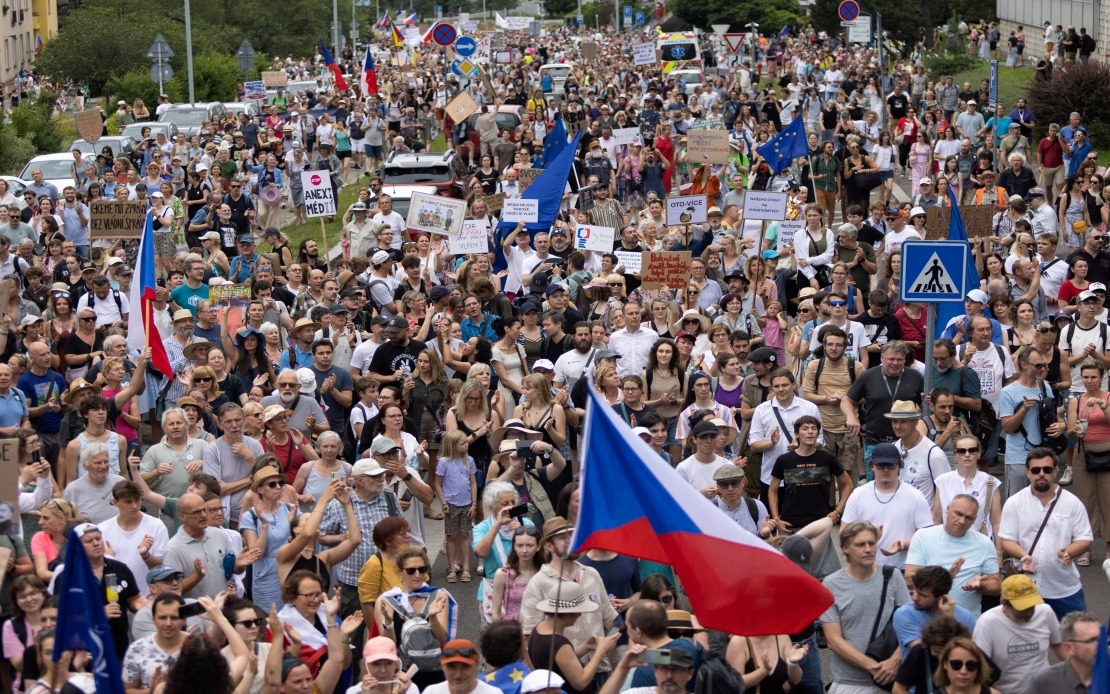
Several thousand people descended on the Czech Television headquarters in Prague on Sunday to express mounting alarm over proposals that could fundamentally alter the operational independence of the country's public broadcasting system. The demonstration, documented by the CTK news agency and confirmed across Czech media outlets, underscored deepening public concern about the trajectory of state-funded media under Prime Minister Andrej Babiš's right-wing populist government.
At the heart of the controversy lies a dramatic restructuring of how Czech public broadcasters—both Czech Television and Czech Radio—would be financed beginning next year. The government has moved to eliminate the traditional licence fee mechanism that has long provided these institutions with a degree of financial autonomy from political interference. In its place, direct state budget allocation would supply the bulk of operational funding, a shift that critics argue fundamentally weakens the institutional shields protecting editorial independence.
What amplifies concerns among civil society groups is that alongside the funding mechanism change, the broadcasters face a reduction in total available resources. Prime Minister Babiš has publicly argued that efficiency savings can be achieved at both institutions without compromising output, while simultaneously pledging that no political interference would occur. However, sceptics contend that direct budget dependence inevitably creates pressure points where government priorities could influence editorial judgment, regardless of formal assurances.
The protest was mobilised by the civic movement "A Million Moments for Democracy," an increasingly active watchdog that has orchestrated similar demonstrations across major Czech cities since May. This continuity of grassroots mobilisation reflects genuine public anxiety that transcends isolated incidents; instead, it points to a systemic concern about media pluralism and democratic checks on executive power. The message emblazoned across banners—"A free society needs free media"—captured the fundamental principle animating the demonstration.
Culture Minister Oto Klempíř of the Motorists party has become the focal point of activist demands for policy reversal and ministerial resignation. Participants in Sunday's rally directed specific calls for him to withdraw the government's plans entirely, treating the funding restructuring not as a technical adjustment but as a test case for whether democratic institutions can constrain executive overreach.
The solidarity between citizens and broadcasters became visually apparent when Czech Television employees unfurled banners from the building expressing gratitude to the assembled demonstrators. This exchange symbolised the alignment between institutional self-preservation instincts and broader civic concern about media independence. The gesture also underscored that the stakes extend beyond abstract principles of press freedom to the lived experience of journalists and production staff facing uncertain working conditions under the proposed arrangement.
The stakes escalated further when employees of both Czech Television and Czech Radio announced strike action planned for Monday, suggesting that workforce concerns about operational viability and editorial autonomy have crystallised into concrete labour action. Such strikes, relatively uncommon in broadcasting sectors, signal deep dissatisfaction that transcends routine industrial disputes.
The political context amplifying these tensions stems from the coalition governing structure that has controlled Prague since December. Prime Minister Babiš's right-wing populist ANO party governs alongside two coalition partners: the far-right Freedom and Direct Democracy party and the Motorists party. This composition means that media oversight operates under significant ideological pressure from parties that have historically demonstrated limited commitment to institutional pluralism or traditional democratic norms.
For regional observers in Southeast Asia, the Czech situation resonates beyond its geographic context. The mechanics of how populist-oriented governments consolidate control over information systems—through ostensibly pragmatic funding restructurings rather than frontal attacks on press freedom—represents a globally relevant pattern. The Czech case demonstrates how financial dependency, even when technically preserved within a state funding model, can serve as an instrument for gradually diluting institutional autonomy without triggering the immediate constitutional alarm that more overt censorship would provoke.
Moreover, the Czech scenario illustrates the vulnerability of public broadcasting systems to political pressure when they lack revenue streams independent from governmental discretion. Nations throughout Europe and Southeast Asia that depend primarily or entirely on state budget allocations for public media funding face similar structural vulnerabilities, making the outcomes of Prague's current institutional struggle instructive for democracies grappling with media independence questions.
The demonstrated capacity of Czech civil society to mobilise rapidly around media independence concerns, through established networks like "A Million Moments for Democracy," suggests that public vigilance remains a functional check on institutional capture, at least in environments where demonstration remains permitted. Whether such mobilisation ultimately influences government policy reversal remains uncertain, but the visible commitment of thousands of citizens to defending abstract principles of media autonomy underscores that press freedom retains normative force in Central European political culture.

