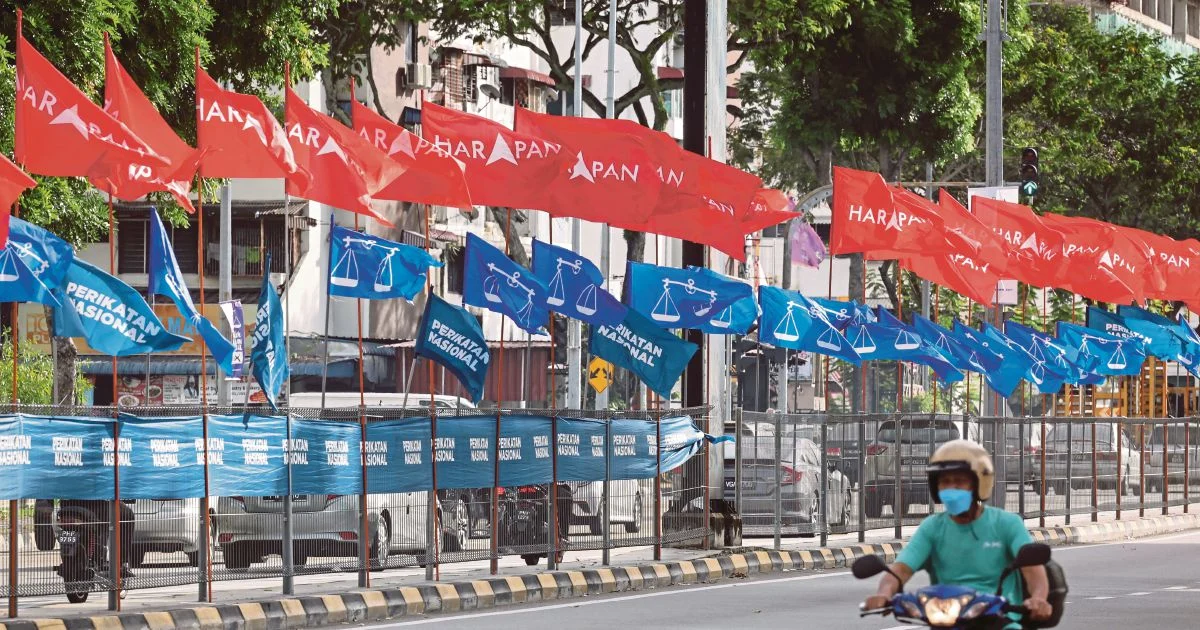
The political landscape in Johor is set to become significantly more complex in the coming state election, with Barisan Nasional, Pakatan Harapan, and Perikatan Nasional expected to contest 33 of the 56 available state seats simultaneously. This convergence of three major political forces across more than half the state's electoral constituencies suggests a fragmented contest where traditional two-coalition politics may give way to fluid, three-way battles that could dramatically reshape the distribution of power in one of Malaysia's most influential states.
The concentration of three-way contests in roughly 59 per cent of constituencies reflects the increasingly fragmented nature of Malaysian politics at the state level. Rather than clear bipolar competition between established coalitions, Johor voters in these 33 seats will be presented with a genuine tripartite choice. This structural shift carries significant implications for strategic voting behaviour, as traditional supporters of each coalition may face internal divisions about where their votes will be most effective in influencing outcomes.
Barisan Nasional has historically dominated Johor politics, maintaining strong roots in the state's administrative machinery and rural constituencies. However, the emergence of credible competition from both Pakatan Harapan and Perikatan Nasional indicates that the coalition's traditional voter base is no longer monolithic. The challenge for BN will be consolidating support while preventing vote-splitting in the three-way contests, particularly if local sentiment is divided between competing national narratives.
Pakatan Harapan's performance in Johor carries broader significance for the opposition coalition's prospects nationwide. The bloc demonstrated its capacity to win substantial support in the 2022 general election, and a strong showing in Johor would confirm that this appeal extends beyond specific moments of political turbulence to represent sustained voter preference for change. Conversely, underperformance in this election could suggest that the momentum is ebbing or that the coalition faces particular challenges in certain demographic or geographic constituencies.
Perikatan Nasional's competitive positioning in 33 seats reflects its consolidation as a distinct political force outside the traditional BN-PH framework. The coalition has built support by positioning itself as an alternative to both established blocs, appealing to voters dissatisfied with either conventional option. The number of seats where PN is contending signals that this alternative has gained traction among Johor voters, potentially reshaping alignments that have held for decades.
The remaining 23 seats, where three-way contests do not materialise, likely represent constituencies where one coalition has insufficient organisational capacity or local appeal to mount a credible challenge. These seats could determine the overall election outcome, as they may reflect areas of dominant support for one or two coalitions. Their relative absence of three-way competition suggests that political fragmentation is not uniform across the state, with some constituencies maintaining more traditional patterns of bipolar contest.
Voter behaviour in three-way contests differs fundamentally from bipolar elections. Tactical voting becomes more complex, as voters cannot simply choose between two clear alternatives but must navigate multiple options. This often benefits candidates with strong local credentials and grassroots organisation, potentially shifting power from those who rely primarily on party machinery or national messaging. The Johor election will therefore test which parties have invested adequately in ground-level campaign infrastructure.
The concentration of three-way battles in Johor carries implications extending far beyond the state itself. As Malaysia's second-largest state economy and a politically strategic location between the federal capital and Singapore, Johor's electoral direction often presages broader national trends. If all three coalitions can competitively contest the majority of seats, this pattern may become a template for future state and national elections, signalling a more durable fragmentation of Malaysian politics into multiple competing blocs rather than a return to simple two-coalition dynamics.
For voters across the 33 contested seats, this election represents a genuine moment of choice with unpredictable outcomes. The absence of clear two-way dynamics means that plurality winners rather than majority supporters may determine representation in many constituencies. This shifts incentives for campaigns—rather than consolidating an existing base, parties must expand beyond core supporters to capture enough first-preference votes to win. Such campaigns often emphasise local and bread-and-butter issues over national ideology, potentially producing representatives more attuned to constituency-specific concerns than those elected in polarised, bipolar contests.
The electoral commission's delimitation of the 56 seats has therefore created the structural conditions for a genuinely competitive election, but the patterns emerging from candidate nomination and early campaign dynamics suggest that voters will indeed be offered meaningful choices across a substantial portion of the state. Whether this translates into significantly altered political representation or merely produces a reshuffling of power within existing coalitions will become clear once ballots are counted.

