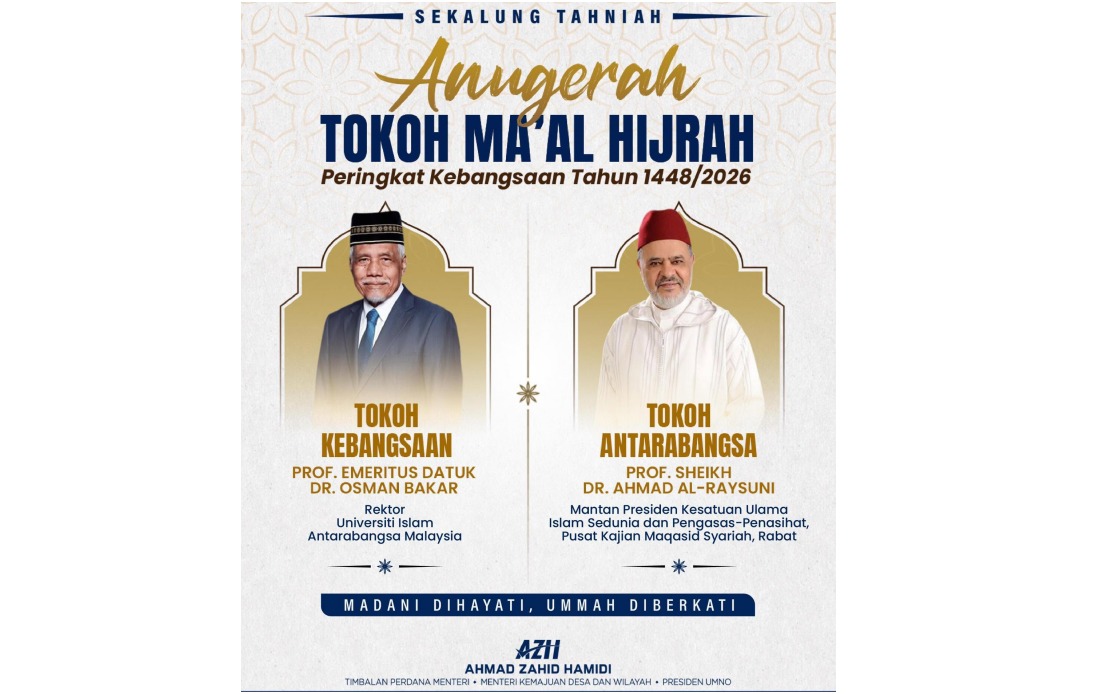
The recognition bestowed on this year's Tokoh Maal Hijrah award winners carries significance extending well beyond ceremonial honour, according to Malaysia's Deputy Prime Minister Datuk Seri Dr Ahmad Zahid Hamidi. Speaking following the national-level Maal Hijrah celebration held at Masjid Putra in Putrajaya, he characterised the awards as a catalyst for broader inspiration within the Muslim community, emphasising that recipients represent an achievable standard of excellence and contribution that others might aspire to match.
Prof Emeritus Datuk Dr Osman Bakar received the National Tokoh Maal Hijrah Award, whilst Prof Sheikh Dr Ahmad Al-Raysuni, an Islamic jurisprudence expert from Morocco, earned the International honour at the 1448H/2026M edition of the awards. The dual recognition highlights Malaysia's intention to acknowledge both domestic exemplars and international figures whose work resonates with the country's Islamic values framework. Sultan Nazrin Shah, Sultan of Perak, presided over the presentation ceremony, conferring cash prizes, trophies and certificates of appreciation to both honourees.
According to Ahmad Zahid, the accomplishments of these laureates transcend individual achievement. Their work in strengthening the Muslim community, elevating intellectual pursuits and disseminating Islamic teachings that emphasise compassion, prudence and societal benefit represents the kind of holistic contribution the government wishes to encourage more broadly. By publicly celebrating such figures, Malaysian authorities signal which values and types of engagement they deem worthy of emulation within the broader religious and civic landscape.
The Deputy Prime Minister's remarks underscore an implicit challenge directed at Malaysia's Muslim population: to channel the inspiration provided by award recipients into sustained personal effort. He called upon Muslims to persistently acquire new knowledge, engage actively in community service and work meaningfully toward advancing the ummah's interests alongside national development and the preservation of Islamic civilisation. This framing positions individual aspiration within a concentric framework of responsibility—from personal growth outward through community, nation and the global Muslim community.
Deputy Prime Minister Datuk Seri Fadillah Yusof echoed similar sentiments, though he broadened the appeal to encompass all Malaysians rather than exclusively Muslims. His public commentary reflected the dual-track messaging common in Malaysian leadership discourse, wherein religious exemplars are presented as models for universal civic virtue. Fadillah emphasised that the award recipients' documented contributions to the ummah's development merit recognition precisely because they demonstrate how individual excellence can translate into collective advancement.
Fadillah's interpretation of the hijrah concept itself merits attention, as he deliberately moved beyond treating it as a historical commemoration. Instead, he reframed the Prophet Muhammad's migration as an enduring philosophical template encompassing sacrifice, cohesion, fortitude and purposeful dedication to constructive transformation. By employing this interpretive approach, he positioned the awards and the occasion as opportunities to reinvigorate adherence to these principles across contemporary Malaysian society.
The connection between the hijrah narrative and modern nation-building featured prominently in official remarks. Fadillah explicitly linked the historical hijrah's spiritual lessons to contemporary ambitions—namely the cultivation of a society that simultaneously embodies progressiveness, material prosperity and ethical grounding. This rhetorical move attempts to reconcile sometimes-contested concepts: Islamic tradition and modernisation, material success and moral values, individual accomplishment and communal welfare.
The geographic dimension of the award structure—one national, one international—reflects Malaysia's positioning within broader Islamic discourse. By honouring both a Malaysian scholar and an international Islamic jurist, the country signals its participation in transnational Muslim intellectual networks whilst maintaining recognition of locally-rooted contributions. Prof Sheikh Dr Ahmad Al-Raysuni's selection, in particular, underscores Malaysia's engagement with North African Islamic scholarship and jurisprudence, suggesting deliberate cultivation of scholarly links across the Muslim world.
For Malaysian Muslim professionals and community leaders considering pathways to greater influence and recognition, the awards mechanism provides a visible framework and aspiration model. The prominence afforded to intellectual achievement and community service within the award criteria, as reflected in official commentary, indicates that such pursuits enjoy state sanction and encouragement. This matters considerably in a context where professional advancement and religious standing intersect in complex ways.
The timing and venue of the award ceremony—a national-level celebration at the principal mosque in the federal administrative centre—underscore institutional commitment. The involvement of sultans and deputy prime ministers in presenting the honours elevates their significance beyond academic or religious circles into the mainstream political consciousness. For younger Muslims navigating career and life choices, such visibility reinforces that excellence in Islamic scholarship, community engagement and knowledge advancement represents a legitimate and honoured pathway.
The broader implications extend to Malaysia's ongoing efforts to position itself as a hub for Islamic thought and practice within Southeast Asia. By recognising both domestic and international scholarly contributions, the country projects itself as a centre where Islamic values are taken seriously, debated rigorously and applied to contemporary challenges. This soft power dimension remains crucial as Malaysia competes for influence and moral authority within the region's Muslim communities.
The call for collective action voiced by both Ahmad Zahid and Fadillah—to strengthen unity, deepen religious observance and expand charitable endeavours—represents an attempt to convert ceremonial recognition into mobilised commitment. Whether such rhetoric successfully translates into behavioural change among the broader population remains an open question, but the intent clearly extends beyond honouring individuals to inspiring systemic cultural renewal across Malaysian Muslim society.

