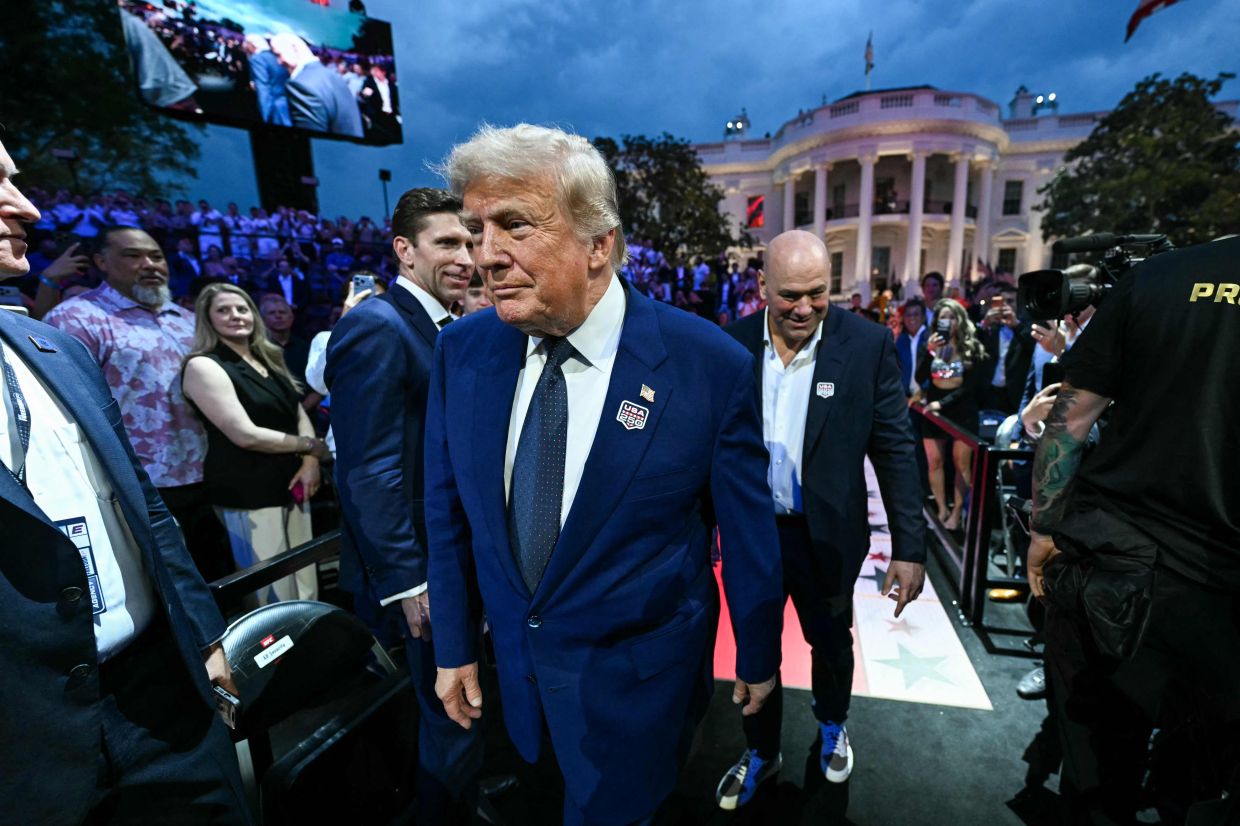
Donald Trump celebrated his 80th birthday in dramatic fashion by hosting the Ultimate Fighting Championship on the South Lawn of the White House on Sunday evening, an unprecedented decision that underscores the former president's willingness to blur traditional boundaries between politics and entertainment. The event, organized by TKO Group Holdings Inc., featured seven cage matches within a towering structure known as the Claw, which rose nearly 100 feet tall and dwarfed even the White House building itself. The fights commenced just before 8:30pm, with Trump and UFC President Dana White walking through the executive residence to the arena, marking the first time the sports league has mounted such a significant operation at the nation's most iconic government building.
The White House event served as a flagship moment for Trump's broader vision of commemorating America's 250th anniversary, which will include a commemorative gold coin bearing his likeness, a major exhibition on the National Mall, and an IndyCar racing series through Washington streets come August. Rather than conventional birthday observances, Trump opted for the high-energy spectacle of mixed martial arts, a sport that appeals directly to his core demographic—predominantly young men who provided crucial voting support during the 2024 election. The choice reflects his administration's strategic alignment with the UFC, which has cultivated a fiercely loyal fanbase that overlaps significantly with Trump's political coalition.
The guest list reflected Washington's highest echelons of power and technology. Meta Platforms Inc. CEO Mark Zuckerberg, Paramount Skydance Corp. CEO David Ellison, Treasury Secretary Scott Bessent, and multiple Trump family members attended the White House event. Podcast host Joe Rogan, whose commentary reaches millions of young male listeners who proved instrumental in Trump's electoral success, provided live commentary throughout the evening's matches. The administration additionally screened the fights at various military installations globally, including bases in Okinawa, Japan, expanding the audience far beyond the White House grounds and into America's security apparatus.
Logistically, the event represented an extraordinary deployment of federal resources. The White House stated that the UFC covered all costs and managed sponsorship arrangements independently. However, court filings revealed that more than seven federal agencies allocated significant resources and manpower to facilitate the spectacle. The UFC reportedly spent over $60 million staging the event, with the larger venue design accommodating 4,300 seats directly at the Claw while an additional 120,000 spectators could gather at the Ellipse nearby, where lottery-distributed free tickets drew massive crowds.
Despite its scale and prominent attendance, the White House fight generated considerable public resistance. A YouGov poll released June 5 found that 51 percent of Americans disapproved of hosting UFC matches at the presidential residence, while only 27 percent approved. Legal opposition also materialized, with the Public Integrity Project filing a lawsuit characterizing the event as a "volcano of corruption" and attempting unsuccessfully to prevent the spectacle from proceeding. These objections reflected broader concerns about the appropriateness of using the nation's most symbolic building for commercial sporting entertainment, particularly when significant federal resources supported the endeavor.
The financial and political implications extended into cryptocurrency and automotive industries. Crypto.com and Dodge's Ram truck brand appeared prominently among sponsors listed on the UFC Freedom 250 website. Most notably, Trump's family venture World Liberty Financial provided an additional $250,000 bonus to the event's top two fighters, demonstrating how the celebration interwove the president's commercial interests with the spectacle itself. This arrangement highlighted the blurred lines between official state functions and private business promotion that have characterized Trump's tenure.
The ceremonial elements of the weekend reinforced this fusion of entertainment and statecraft. The news conference announcing the event occurred at the Lincoln Memorial, one of America's most revered historical landmarks, where fighters engaged in competitive trash-talk and victory predictions rather than more dignified discussion. Fighter Michael Chandler emphasized the symbolic weight of competing on the White House grounds, declaring that audiences would witness the superior version of himself fighting "for America's 250th birthday." This framing elevated the matches beyond sport into quasi-patriotic performance, binding athletic competition with national commemoration.
The physical transformation of the White House grounds themselves represented an unusual deployment of presidential authority. Locker rooms were established on the presidential property, including in the Indian Treaty Room, a space ordinarily reserved for formal state functions and diplomatic negotiations. The South Lawn, historically hosting genteel events like the Easter Egg Roll and Congressional Picnic, now featured a structure exceeding the White House's own height. Trump's suggestion in a June 2 TikTok video that the Claw might remain permanently—comparing it to the Eiffel Tower—captured his tendency toward architectural grandeur, though he later characterized the remark as joking. Court filings indicated plans for dismantling to commence at 10am Monday, though the structure's unprecedented presence underscored how dramatically Trump reimagines ceremonial space.
The timing proved strategically significant. By Sunday evening's conclusion, Trump was preparing to depart for France to attend a Group of Seven leaders' meeting—forums typically concerned with economic coordination and geopolitical strategy. His arrival at such diplomatic gatherings reportedly included possession of a UFC championship belt, symbolizing his personal connection to the league and the entertainment world more broadly. This juxtaposition—trading the White House for international diplomacy while carrying symbols of commercial sports—illustrated the fluid boundaries Trump maintains between political office and entertainment celebrity.
For Southeast Asian observers, the event offers insights into American political culture and Trump's governing philosophy. The UFC's expansion into the White House reflects how contemporary political movements increasingly blur entertainment and governance, particularly when targeting younger demographics crucial to electoral coalitions. The decision to broadcast fights to military bases including Okinawa demonstrates how even ceremonial events carry strategic messaging about American military commitments throughout the Asia-Pacific region. The extensive corporate sponsorship and cryptocurrency industry involvement additionally illustrate how political events increasingly serve as platforms for emerging industries seeking mainstream legitimacy.
The White House UFC event ultimately encapsulates Trump's broader approach to political power: spectacular, commercially intertwined, demographically targeted, and deliberately unconventional. While critics viewed it as inappropriate mixing of state functions and entertainment, supporters saw it as refreshingly authentic engagement with popular culture that traditional politicians avoided. The public disapproval evident in polling suggested ongoing tension between Americans' expectations of presidential dignity and Trump's inclination toward entertainment-driven spectacle. As the Claw was dismantled and Trump departed for France, the event remained a defining symbol of his administration's distinctive approach to executive authority and public presentation.

