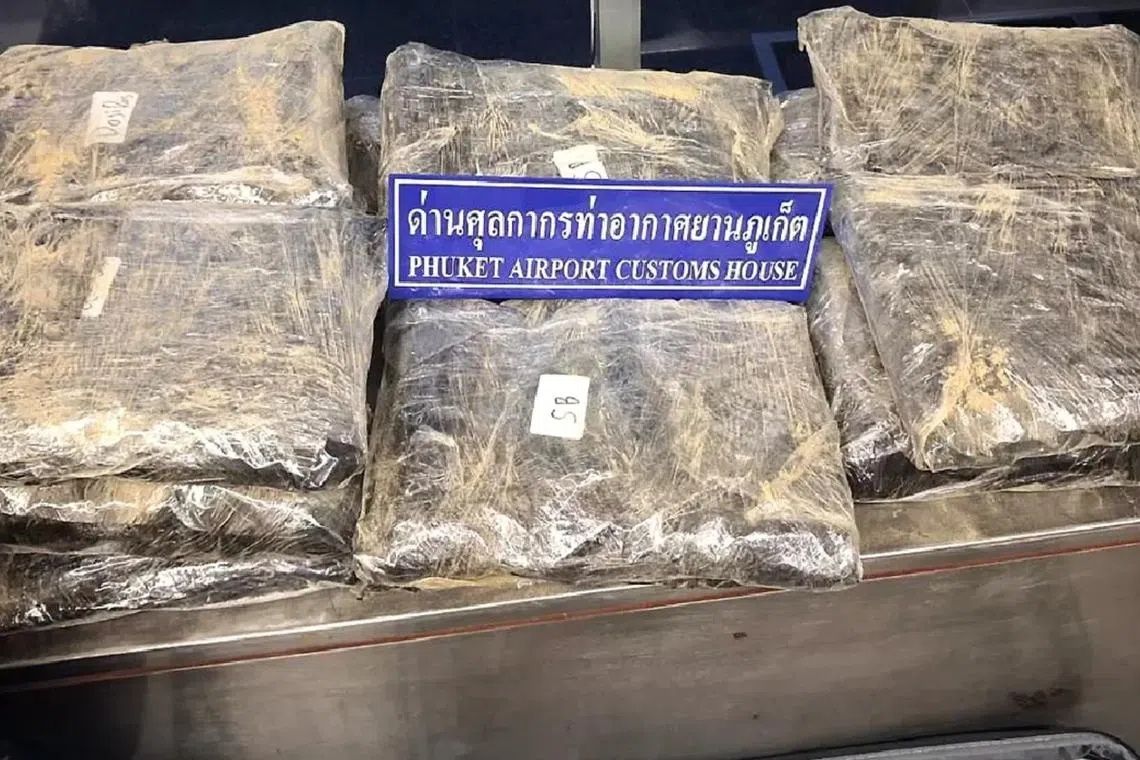
Thailand's customs authorities have intensified their crackdown on illegal narcotics trafficking, successfully apprehending two women attempting to smuggle cannabis out of the country through Phuket International Airport. The dual arrests on Thursday underline the heightened vigilance at Thailand's major gateway airports, where officers have been deployed with expanded search protocols to intercept contraband before it leaves Thai jurisdiction.
The first detention occurred around 11 in the morning when Phuket Airport Customs House officers, working alongside Sakhu Police Station personnel, inspected a black Pierre Cardin wheeled suitcase at the international departures terminal. The luggage belonged to 18-year-old Levannah Chelsea Guzman, a Filipino national, and contained 14 vacuum-sealed packages of cannabis flowers. The total weight of the seized material, inclusive of packaging, amounted to 14.5 kilograms—a substantial quantity that would indicate either personal supply for distribution or intended commercial transaction abroad.
Guzman cooperated with investigators and confirmed ownership of both the suitcase and its contents during the formal questioning process. Her case was processed under multiple legislative frameworks governing Thailand's stringent anti-narcotics regime, including violations of the Customs Act BE 2560 (2017) for attempting to export goods without proper customs clearance. Additional charges were filed under the Narcotics Code and the Public Health Ministry's 2025 notification on controlled herbs, which reflects Thailand's evolving regulatory approach to cannabis regulation following the kingdom's limited decriminalization of the plant for medicinal purposes.
Just two hours later, at approximately 1 o'clock in the afternoon, customs officers flagged a green Swish Navy wheeled suitcase for inspection. The luggage belonged to Penpitcha Phutsiang, a Thai national, and contained 16 vacuum-sealed packages of cannabis flowers totalling 17.6 kilograms. This second seizure demonstrated that the smuggling attempt was not an isolated incident but part of a coordinated operation, or at minimum reflected a broader pattern of attempted cannabis exportation through the same airport on the same day.
Phutsiang similarly acknowledged responsibility for the suitcase and its contents when questioned by enforcement officers. She faced charges identical in nature to those leveled against Guzman, relating to customs violations and narcotics trafficking offences. Both women were subsequently transferred to Sakhu Police Station for formal investigation and legal proceedings, where additional evidence would be documented and case files prepared for prosecution.
The combined haul of 32 kilograms represents a significant seizure by regional standards and highlights the scale of cannabis trafficking attempts passing through Thai airports. For Malaysian and Southeast Asian observers, the incident underscores the porous nature of regional borders and the continued movement of contraband despite enforcement efforts. Thailand's position as a transit hub for regional narcotics trade remains a concern for neighbours including Malaysia, where cannabis trafficking carries severe penalties including mandatory long prison sentences.
Thailand's approach to cannabis regulation has become notably more permissive compared to its Southeast Asian peers, particularly following the government's decision to remove cannabis from its narcotics list for medical research and therapeutic purposes. However, this liberalization applies strictly to domestic medical use; export of cannabis products remains illegal under existing customs and narcotics legislation. The distinction appears to have created confusion or opportunity for traffickers who may underestimate enforcement levels regarding outbound shipments.
The arrests also reflect Thailand's broader strategy to combat drug trafficking at transport nodes, a necessary response given the country's geographic position along major smuggling routes. Phuket International Airport, one of Thailand's busiest international terminals, handles millions of passengers annually and presents both opportunity and challenge for customs authorities attempting to balance passenger flow with thorough security screening.
For regional security analysts, the timing of these arrests—occurring simultaneously at the same airport—raises questions about intelligence coordination and whether officers were acting on advance information or conducting routine enhanced inspections. The fact that both suspects were successfully intercepted suggests that customs procedures at Phuket remain relatively effective, though the volume of traffic and sophistication of modern smuggling techniques mean that some contraband undoubtedly proceeds undetected.
The legal consequences facing both women will likely be severe under Thai law. Cannabis trafficking charges can result in lengthy prison sentences, with penalties ranging from years to decades depending on quantity and intent. For foreign nationals, conviction carries additional consequences including deportation, criminal records that affect future travel, and the diplomatic complications that arise when citizens are detained abroad on drug charges.
Malaysian authorities maintain similarly stringent policies on cannabis, with trafficking classified as a major felony carrying potential capital punishment in certain circumstances. The contrast between Thailand's incremental liberalization and Malaysia's uncompromising stance illustrates the divergent approaches within Southeast Asia, though both nations ultimately prohibit cannabis export regardless of domestic policy nuances.
These arrests coincide with broader enforcement initiatives across Thailand's transportation infrastructure, including airports, seaports, and land borders. Customs agencies have reported increased vigilance and resource allocation toward narcotics interdiction, reflecting government recognition that drug trafficking threatens social stability and public health. The successful seizure at Phuket sends a deterrent message to would-be smugglers, though enforcement experts acknowledge that determined traffickers continuously adapt their methods.
Looking forward, the case demonstrates the ongoing challenge Southeast Asian governments face in managing drug trade dynamics within an increasingly globalized movement of people and goods. Enhanced cooperation between Thai and Filipino authorities may follow, particularly given that Guzman's nationality suggests potential links to Philippine-based trafficking networks. For Malaysian stakeholders monitoring regional security trends, these arrests reinforce the importance of maintaining robust customs capacity and international intelligence sharing to combat the persistent threat of narcotics smuggling across borders.

