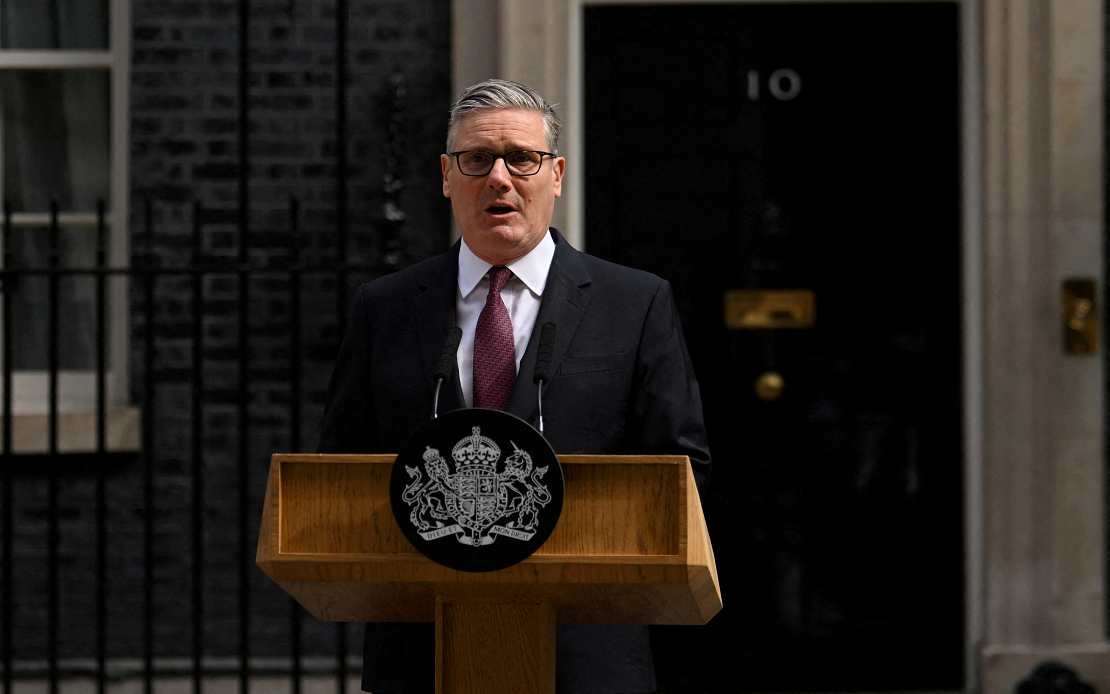
British Prime Minister Keir Starmer announced on Monday that he will resign from his position, with a replacement expected to be in place by September when parliament reconvenes. The decision marks a dramatic reversal for a leader who, less than two years earlier, had secured an overwhelming election mandate promising to restore stability to British politics. Starmer has committed to supporting whoever emerges as his successor through the Labour Party leadership process.
The pressure on Starmer's leadership had been building steadily for months, but reached a critical juncture on Friday following a significant electoral setback. Andy Burnham, the mayor of Greater Manchester, won a parliamentary by-election by a substantial margin, defeating a candidate from Nigel Farage's Reform UK party. This victory proved symbolically and strategically important for the Labour Party, as it demonstrated that the party could still compete electorally and that Burnham possessed the political appeal to potentially reverse Labour's slide in public favour.
Burnham has emerged as the frontrunner to succeed Starmer, largely due to his reputation as a skilled communicator and seasoned political operator. Throughout his career, he has demonstrated an ability to connect with voters and articulate party messages effectively, qualities that Starmer has struggled to maintain. Labour lawmakers believe Burnham could reverse the party's dramatic loss of public support, which has accelerated under Starmer's leadership. The Prime Minister's personal popularity ratings have sunk to their lowest point for any British leader in office, a metric that has weighed heavily on Labour's electoral prospects.
Despite the enthusiasm surrounding his potential candidacy, Burnham has provided limited clarity on his policy agenda beyond broad statements about the need for fundamental national change and reducing the cost of living for ordinary Britons. His positions on critical areas including foreign policy, economic management and defence spending remain largely undefined. This lack of detailed policy direction reflects both the compressed timeline of the succession process and the reality that any incoming Prime Minister will inherit an extraordinarily constrained governing environment.
The fiscal challenges facing Britain's next leader are formidable and will severely limit the scope for ambitious domestic programmes. The country currently carries the highest borrowing costs among Group of Seven economies, a consequence of elevated debt levels, substantial interest payment obligations, persistent economic stagnation, and the competing demands of defence spending and public service investment. Any government hoping to implement significant policy changes will find itself heavily constrained by bond market sentiment and investor expectations regarding fiscal discipline.
Analysts are divided on whether Burnham would prioritise reassuring financial markets or pursue more ambitious economic intervention. Burnham stated last September that Britain must move beyond its perceived dependence on bond market approval, a rhetorical position that has unsettled some investors. Economists at Citibank assessed the situation sceptically, arguing that a Burnham government would inherit such constrained fiscal circumstances that meaningful policy innovation would prove extraordinarily difficult to achieve. This structural reality means the next Prime Minister may struggle to deliver the transformative change that voters increasingly demand.
Starmer had initially indicated on Friday that he would contest any formal leadership election, a statement that appeared to shift substantially over the weekend as broader party dynamics evolved. The rapid change in positioning reflected the accelerating nature of the crisis and growing recognition that a swift transition would likely prove less disruptive than a prolonged internal contest. The compressed succession process also creates space for party unity and allows Burnham time to prepare for government.
Britain's political instability has reached unprecedented levels in recent history. Starmer's departure will make him merely the seventh prime minister since the Brexit referendum ten years ago. This extraordinary turnover rate, the highest experienced by Britain in nearly two centuries, reflects deep voter frustration with repeated leadership changes and the failure of successive governments to meaningfully improve living standards, enhance public service quality, or effectively address public concerns about immigration. Each change of premier has failed to restore voter confidence in the political system.
The underlying discontent driving this instability runs deeper than personality or individual leadership capability. Voters across the United Kingdom have grown increasingly angry at what they perceive as systemic failure across multiple policy domains. Public services remain under stress, housing costs have become prohibitive for many younger Britons, wages have stagnated in real terms, and persistent anxiety about immigration policy continues to dominate public discourse. These grievances have proven remarkably resistant to political solutions, partly because they often reflect genuine structural economic challenges rather than problems susceptible to rapid policy fixes.
Experts identified potential advantages in Starmer remaining in post through September, allowing him to participate in a planned UK-European Union reset summit in July. This arrangement provides continuity for important international relationships during the transition period and gives Burnham sufficient time to prepare for the transition to office. The succession timeline, therefore, balances the political urgency of change against the practical requirements of responsible governance.
For Malaysia and Southeast Asia, the continuing turmoil in British politics carries implications for regional security and trade relationships. Britain maintains important defence commitments in the Indo-Pacific region and continues to pursue post-Brexit trade relationships with regional partners. Leadership instability in London can create uncertainty regarding Britain's regional engagement and the consistency of its strategic commitments. Malaysian policymakers will be monitoring how quickly a new British government can establish coherent policies affecting the region.

